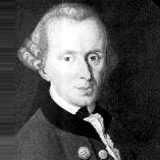
Kant
Immanuel Kant1724–1804
What Kant argues and who answers him, as Marci Shore presents it in her Yale lectures European Intellectual History since Nietzsche: 9 claims, and 15 places where another thinker builds on him or breaks with him. Each claim is our paraphrase and links to the minute of the lecture it comes from.
The core ideas
The 3 claims the lectures spend most time on.
Enlightenment is humanity's exit from immaturity, an immaturity that is self-imposed rather than forced on us from outside.
Put simply Kant: enlightenment is humanity leaving its immaturity behind. And that immaturity is our own doing, not something forced on us from outside.
Where to read it Kant, "An Answer to the Question: What Is Enlightenment?" (1784), opening paragraph.
"Sapere aude," dare to know: Kant's motto for enlightenment asks for courage, the nerve to reason for oneself rather than let a priest or a book decide.
Where to read it Kant, "An Answer to the Question: What Is Enlightenment?" (1784), opening paragraph.
The Copernican turn in Kant's epistemology reverses the direction of fit: not the mind conforming to things as they are, but knowable things conforming to the mind's capacities.
Put simply Kant's "Copernican turn": it was assumed that the mind must fit itself to things as they are. Kant reverses this: what we can know of things has to fit what the mind is able to take in.
Who Kant answers, and who answers him
Each entry joins one of his claims to another thinker’s. The handwriting names the link; the line beside it says which kind. “Our inference” marks a link Shore does not state outright.
Kant and Johann Gottlieb Fichte 1762–1814
KantFree will cannot be proven, yet without it there is no ethics at all. Kant therefore simply posits it, and, almost in passing, posits God too. L3 · 31:04
FichteFichte: "to be free is nothing, to become free is heaven." Freedom is not a state you have but a becoming you live, driven by desire. L3 · 37:08
Takes Kant's merely-posited free will and turns it into an active, never-finished existential project of becoming free.
KantFor Kant, acting morally means acting from duty, not from whatever one feels like doing; acts are judged by their intentions, never by consequences nobody can control. L3 · 31:51
FichteFor Fichte, sincerity and motive outweigh consequences. Whatever it costs, you must not betray your own ideals. L3 · 37:32
Radicalizes Kant's focus on motive over consequence into an absolute imperative never to betray one's ideals.
Kant and Georg Wilhelm Friedrich Hegel 1770–1831
KantThe Copernican turn in Kant's epistemology reverses the direction of fit: not the mind conforming to things as they are, but knowable things conforming to the mind's capacities. L2 · 38:03
HegelHegel sets out to solve the old bridge problem, how to get from mind to world: he will join subject and object, though with a dash of mysticism. L4 · 11:43
Takes up the problem of the bridge between subject and object that Descartes and Kant tried to solve
KantFor Kant, acting morally means acting from duty, not from whatever one feels like doing; acts are judged by their intentions, never by consequences nobody can control. L3 · 31:51
HegelHegel rejects Kant's intention-centered morality as inadequate: acts usually have consequences far beyond what anyone meant, so their meaning can be judged only in hindsight. L4 · 29:14
Intentions are not enough; actions are judged by consequences that exceed them
Kant and Edmund Husserl 1859–1938
KantThe Copernican turn in Kant's epistemology reverses the direction of fit: not the mind conforming to things as they are, but knowable things conforming to the mind's capacities. L2 · 38:03
HusserlKant's willingness to set aside the thing-in-itself as unreachable amounts to fatalism, a kind of surrender; the real thing can be reached, with absolute truth and full clarity. L11 · 28:39
Brands Kant's decision to set the thing-in-itself aside as fatalism and giving up.
KantThe Copernican turn in Kant's epistemology reverses the direction of fit: not the mind conforming to things as they are, but knowable things conforming to the mind's capacities. L2 · 38:03
HusserlWhere Kant left the thing-in-itself beyond reach, Husserl substitutes "the things themselves": the real things are simply objects as they show up to us, given in experience. L11 · 41:58
Recasts the thing-in-itself as the thing as given in experience; Shore says the result is a hair's breadth from Kant.
Kant and Shore
KantAmong the transcendental conditions that make knowledge possible are time and space: without them, no input from the world could be processed at all. L1 · 22:54
ShoreMetaphorically, time and place do for historical study what time and space do for knowledge in Kant: nothing can be studied without fixing when and where it happened. L1 · 23:13
Shore likens time and place in historical study, metaphorically, to Kant's time and space as conditions of possible knowledge.
Kant and René Descartes 1596–1650
DescartesKnowledge should be rebuilt from scratch: treat as false whatever admits the slightest doubt, and see what survives to serve as a foundation. L2 · 12:40
KantThe Copernican turn in Kant's epistemology reverses the direction of fit: not the mind conforming to things as they are, but knowable things conforming to the mind's capacities. L2 · 38:03
Takes off from Descartes's inner/outer problem: a real world exists, but known only as minds process it.
Kant and Lev Shestov 1866–1938
KantThe Copernican turn in Kant's epistemology reverses the direction of fit: not the mind conforming to things as they are, but knowable things conforming to the mind's capacities. L2 · 38:03
ShestovKant's Critique of Pure Reason, on Shestov's reading, really defends reason rather than critiquing it. The genuine critique of pure reason, he holds, is by Dostoevsky: Notes from Underground. L3 · 30:18
Argues Kant's first Critique defends reason rather than truly interrogating its limits; only Dostoevsky supplies the real critique.
Kant and Karl Marx 1818–1883
KantHumans possess dignity, which is "above all price," because they are free moral agents. Hence Kant's basic rule: treat every person as an end, never merely as a means. L3 · 31:51
MarxIn the Manifesto's picture, capitalism's profit motive converts what ought to be relations between persons into relations between things, and human beings themselves into commodities. L5 · 42:38
Shore sees Kantian influence in the Manifesto's objection to people being turned into things: a person is an end, not a means.
Kant and Friedrich Nietzsche 1844–1900
KantKant's test when unsure whether an act is moral: imagine everyone acting on your principle. Should disaster follow, the act fails. L3 · 32:07
NietzscheWhat eternal recurrence means is disputed. On one Kantian reading, you should live every moment as though it would return forever, acting only as you would wish to see repeated. L6 · 40:45
Shore reports one interpretation of eternal recurrence as Kantian, going back to the categorical imperative; she does not say Nietzsche took it from Kant.
Kant and Henri Bergson 1859–1941
KantFree will cannot be proven, yet without it there is no ethics at all. Kant therefore simply posits it, and, almost in passing, posits God too. L3 · 31:04
BergsonFree will is inseparable from qualitative time: because we live time as an undivided flow, we can act spontaneously, in ways no one could have fixed beforehand. L7 · 23:13
Where Kant merely postulates free will, Bergson tries to ground it in the nature of time.
Kant and Jean-Paul Sartre 1905–1980
KantKant's test when unsure whether an act is moral: imagine everyone acting on your principle. Should disaster follow, the act fails. L3 · 32:07
SartreAnguish is the price of responsibility: whoever commits to anything settles not only who they will be but, in effect, legislates for all humanity. Absolute freedom means absolute responsibility. L13 · 44:48
Choosing for oneself is choosing for everyone: a Kantian universalizing moment inside existentialism
Kant and Theodor Adorno 1903–1969
KantEnlightenment is humanity's exit from immaturity, an immaturity that is self-imposed rather than forced on us from outside. L2 · 35:21
AdornoEnlightenment set out to free people from fear and make them sovereign; by its own dialectic it ends in catastrophe, an earth that "radiates disaster triumphant." L14 · 44:58
Enlightenment's promise of liberation and sovereignty turns into its opposite
Kant and Hannah Arendt 1906–1975
KantThe Copernican turn in Kant's epistemology reverses the direction of fit: not the mind conforming to things as they are, but knowable things conforming to the mind's capacities. L2 · 38:03
ArendtIn her postwar lecture on existential philosophy, Arendt blames Kant: by severing being from thought and putting the thing-in-itself beyond reach, he opened the subject-world gap that alienates us. L19 · 7:57
Declaring the thing-in-itself unreachable cut thought off from being and alienated us from the world
All 9 claims, lecture by lecture
In the order they come up. The time opens that minute of the lecture on YouTube.
Lecture 1Introduction to the Course
Among the transcendental conditions that make knowledge possible are time and space: without them, no input from the world could be processed at all.
Put simply Kant: some conditions must already be in place before we can know anything ("transcendental conditions"). Time and space are among them: without them, nothing coming in from the world could be processed at all.
Lecture 2The Heritage of the Enlightenment
Enlightenment is humanity's exit from immaturity, an immaturity that is self-imposed rather than forced on us from outside.
Put simply Kant: enlightenment is humanity leaving its immaturity behind. And that immaturity is our own doing, not something forced on us from outside.
Where to read it Kant, "An Answer to the Question: What Is Enlightenment?" (1784), opening paragraph.
"Sapere aude," dare to know: Kant's motto for enlightenment asks for courage, the nerve to reason for oneself rather than let a priest or a book decide.
Where to read it Kant, "An Answer to the Question: What Is Enlightenment?" (1784), opening paragraph.
The Copernican turn in Kant's epistemology reverses the direction of fit: not the mind conforming to things as they are, but knowable things conforming to the mind's capacities.
Put simply Kant's "Copernican turn": it was assumed that the mind must fit itself to things as they are. Kant reverses this: what we can know of things has to fit what the mind is able to take in.
Kant's call to think for yourself is no license for rebellion: soldiers still obey and taxes still get paid, but across many other spheres, nobody else should do your thinking.
Where to read it Kant, "An Answer to the Question: What Is Enlightenment?" (1784), on the public and private use of reason.
Lecture 3The Legacy of Romanticism
Free will cannot be proven, yet without it there is no ethics at all. Kant therefore simply posits it, and, almost in passing, posits God too.
Put simply Kant: no one can prove we have free will, yet without it there could be no ethics at all. So he simply assumes it, and, almost in passing, assumes God exists too.
In the text In the Critique of Practical Reason (1788), Kant calls consciousness of the moral law "a fact of reason" (Remark to §7), and treats God and immortality as postulates of pure practical reason (Dialectic, Book II, ch. II).
Humans possess dignity, which is "above all price," because they are free moral agents. Hence Kant's basic rule: treat every person as an end, never merely as a means.
Put simply Kant: people have dignity, a worth beyond any price, because they are free moral beings. So never treat a person merely as a tool for your purposes; always treat them as valuable in themselves.
Where to read it Kant, Groundwork of the Metaphysics of Morals, Ak. 4:429 and 4:434–435.
Kant's test when unsure whether an act is moral: imagine everyone acting on your principle. Should disaster follow, the act fails.
In the text In the Groundwork (1785; Gregor translation), Kant's test is whether I "could also will that my maxim should become a universal law"; a maxim fails when it cannot be universalized without contradiction.
For Kant, acting morally means acting from duty, not from whatever one feels like doing; acts are judged by their intentions, never by consequences nobody can control.
The questions Kant is part of
A throughline follows one question across the whole course. These are the ones his claims sit on.
Works and dates
As they come up in the lectures.
Critique of Pure Reason Kritik der reinen Vernunft
Prolegomena to Any Future Metaphysics Prolegomena zu einer jeden künftigen Metaphysik
What Is Enlightenment? Beantwortung der Frage: Was ist Aufklärung?
An Answer to the Question: What is Enlightenment? Beantwortung der Frage: Was ist Aufklärung?
Mendelssohn (September) and Kant (December) each answer "What is Enlightenment?" in the Berlinische Monatsschrift, a question the pastor Johann Friedrich Zöllner had raised in the journal the year before.
Foundations (Groundwork) of the Metaphysics of Morals Grundlegung zur Metaphysik der Sitten
Terms
The ideas his claims turn on, as the lectures gloss them.
Sapere aude. Kant's motto for enlightenment: have the courage to use your own understanding rather than deferring to authority.
Reason. The Enlightenment's central "key word": the human faculty held capable of understanding, and progressively mastering, the world.
Copernican revolution. Kant's reversal: instead of the mind conforming to the world, what we can know of the world must conform to the mind's structures.
Ding an sich. The mind-independent world as it is in itself, which for Kant really exists but which we can never directly access.
Categorical imperative. Kant's test for a moral maxim: act only as you could will that everyone act, regardless of the act's consequences.
Dignity vs. price. What can be exchanged for an equivalent has a price; what admits no equivalent has dignity — persons, as ends in themselves, have the latter.