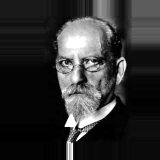
Husserl
Edmund Husserl1859–1938
What Husserl argues and who answers him, as Marci Shore presents it in her Yale lectures European Intellectual History since Nietzsche: 19 claims, and 24 places where another thinker builds on him or breaks with him. Each claim is our paraphrase and links to the minute of the lecture it comes from.
To the things themselves!
Edmund Husserl. The epigraph Shore gives lecture 11.
The core ideas
The 6 claims the lectures spend most time on.
Kant's willingness to set aside the thing-in-itself as unreachable amounts to fatalism, a kind of surrender; the real thing can be reached, with absolute truth and full clarity.
Put simply Husserl: Kant set aside things as they really are, apart from our minds, as out of reach. That is fatalism, a kind of surrender. The real thing can be reached, with absolute truth and full clarity.
Strip away the contingent particulars distinguishing empirical egos and a transcendental ego remains: the deepest, most essential I, yet universal and identical in everyone, as H2O underlies all water.
Put simply Husserl: strip away everything that makes each actual person different, and a "transcendental ego" is left: the deepest core of the self, yet the same in everyone. To use the lecture's analogy, it is like H2O in all water.
In the text In the Fifth Cartesian Meditation (§56), Husserl describes other egos as "monads, existing for themselves precisely as I exist for myself", a plurality he calls transcendental intersubjectivity.
Intentionality is the structure of consciousness: always reaching for its object, like a magnet on a string. Neither subject nor object comes first; their relation does, bridged by intentionality.
Put simply Husserl: consciousness is always reaching out toward some object, like a magnet on a string in Shore's image. He calls this "intentionality." Neither mind nor thing comes first; the link between them does, and that link is the bridge.
The phenomenological reduction jolts us from the natural attitude, where the world's existence is taken for granted, into reflection on consciousness; the reality question is bracketed, suspended rather than doubted.
Put simply Husserl: normally we just assume the world exists, his "natural attitude". The "phenomenological reduction" jolts us out of that into examining our own experience. We set aside, or "bracket", whether things are real, without doubting it.
Europe slid into barbarism because people stopped believing in reason and in the possibility of absolute truth; convince them that such truth is reachable and the world could be saved.
Put simply Husserl: Europe fell into barbarism because people lost faith in reason and in the possibility of absolute truth. Convince them such truth can be reached, and the world could be saved.
Take a die on a table: from any single spot I see only some faces. Others standing elsewhere complete the picture, which is why knowledge, for Husserl, is intersubjective.
Who Husserl answers, and who answers him
Each entry joins one of his claims to another thinker’s. The handwriting names the link; the line beside it says which kind. “Our inference” marks a link Shore does not state outright.
Husserl and Martin Heidegger 1889–1976
HusserlIntentionality is the structure of consciousness: always reaching for its object, like a magnet on a string. Neither subject nor object comes first; their relation does, bridged by intentionality. L11 · 40:21
HeideggerDescartes starts from thinking and Husserl from thinking about an object; Heidegger starts from existing. That I am comes before anything I think: being precedes knowing. L12 · 20:46
Reverses the order: being precedes thinking, so the "I think an object" already presupposes an I existing in the world.
HusserlIntentionality is the structure of consciousness: always reaching for its object, like a magnet on a string. Neither subject nor object comes first; their relation does, bridged by intentionality. L11 · 40:21
HeideggerThe subject-object split assumes an Archimedean vantage outside the world. There is none: Dasein is inside, so the bridge problem is not solved but dissolved, since no gap exists. L12 · 25:27
Husserl bridges subject and object by intentionality; Heidegger denies there is any gap to bridge.
HusserlStrip away the contingent particulars distinguishing empirical egos and a transcendental ego remains: the deepest, most essential I, yet universal and identical in everyone, as H2O underlies all water. L11 · 34:29
HeideggerHeidegger drops the words subject, consciousness and human being in favor of Dasein, literally being-there. Whatever remains of the subject is an entity that is somewhere. L12 · 18:35
Dasein is the next move in overcoming the notion of subjectivity that the transcendental ego began to unsettle.
HusserlThe phenomenological reduction jolts us from the natural attitude, where the world's existence is taken for granted, into reflection on consciousness; the reality question is bracketed, suspended rather than doubted. L11 · 30:57
HeideggerOur first and usual relation to things is using them, not looking at them: the hammer is ready-to-hand. Only when it breaks does it turn into present-at-hand, something to contemplate. L12 · 27:26
Shore calls ready-to-hand breakdown another variation on Husserl's question: when do we really see?
HusserlWhere Freud locates the essential self in what is most hidden, the transcendental ego is pure light: nothing in it stays concealed, and knowing is a matter of clear seeing. L11 · 45:42
HeideggerHusserl's transcendental ego is wholly transparent to itself; Dasein never is. Forever up to something, evading something, tempted toward inauthenticity, it stays partly hidden from itself, closer to Freud. L12 · 46:01
Dasein occupies the transcendental ego's privileged place but is never transparent to itself.
HusserlPhenomenology, both in Husserl's conception and largely in its later development, is more method than theory: an account of how we ought to go about understanding the world. L11 · 30:57
HeideggerWriting to his wife during the war, Heidegger rejected Husserl's phenomenology as "too narrow and bloodless": no such method could be made absolute, because life outruns it. L24 · 7:00
Phenomenology as method is too confined and lifeless for life's richness
Husserl and Shore
HusserlStrip away the contingent particulars distinguishing empirical egos and a transcendental ego remains: the deepest, most essential I, yet universal and identical in everyone, as H2O underlies all water. L11 · 34:29
ShoreHusserl, in Shore's judgment, wants to dance at both weddings at once, as the Polish proverb forbids: subjectivity's full depth and objectivity's firm certainty, surrendering neither. L12 · 3:55
Shore judges the pure, transparent I an unstable attempt to keep both subjective depth and objective certainty.
HusserlThe phenomenological reduction jolts us from the natural attitude, where the world's existence is taken for granted, into reflection on consciousness; the reality question is bracketed, suspended rather than doubted. L11 · 30:57
ShoreBracketing subject and object alike and studying only how signifiers interact is structuralism's own route past the bridge problem of how subject reaches world. L19 · 47:26
Shore calls structuralism's bracketing of both subject and object analogous in impulse to phenomenology's bracketing of the world.
HusserlStrip away the contingent particulars distinguishing empirical egos and a transcendental ego remains: the deepest, most essential I, yet universal and identical in everyone, as H2O underlies all water. L11 · 34:29
ShoreIn structuralism the subject is radically decentered: meaning is not something people produce; language produces people, more than the reverse. L19 · 46:01
Language and structure produce the subject instead of the transcendental ego producing all meaning
Husserl and Immanuel Kant 1724–1804
KantThe Copernican turn in Kant's epistemology reverses the direction of fit: not the mind conforming to things as they are, but knowable things conforming to the mind's capacities. L2 · 38:03
HusserlKant's willingness to set aside the thing-in-itself as unreachable amounts to fatalism, a kind of surrender; the real thing can be reached, with absolute truth and full clarity. L11 · 28:39
Brands Kant's decision to set the thing-in-itself aside as fatalism and giving up.
KantThe Copernican turn in Kant's epistemology reverses the direction of fit: not the mind conforming to things as they are, but knowable things conforming to the mind's capacities. L2 · 38:03
HusserlWhere Kant left the thing-in-itself beyond reach, Husserl substitutes "the things themselves": the real things are simply objects as they show up to us, given in experience. L11 · 41:58
Recasts the thing-in-itself as the thing as given in experience; Shore says the result is a hair's breadth from Kant.
Husserl and René Descartes 1596–1650
DescartesKnowledge should be rebuilt from scratch: treat as false whatever admits the slightest doubt, and see what survives to serve as a foundation. L2 · 12:40
HusserlThe phenomenological reduction jolts us from the natural attitude, where the world's existence is taken for granted, into reflection on consciousness; the reality question is bracketed, suspended rather than doubted. L11 · 30:57
Husserl reworks the Cartesian fresh start: he suspends the world's reality in brackets instead of doubting it.Our inference
DescartesKnowledge should be rebuilt from scratch: treat as false whatever admits the slightest doubt, and see what survives to serve as a foundation. L2 · 12:40
HusserlModern philosophy's basic trouble is that it has no ground to stand on. The remedy is Descartes' experiment: discard everything you think you know and ask what survives as certain. L11 · 9:55
Husserl adopts Descartes's radical start from zero, but thinks Descartes didn't go far enough.
Husserl and Jean-Paul Sartre 1905–1980
HusserlI have no direct line into anyone else's primordial experience. So for Husserl, another person counts as an existing other only insofar as my consciousness constitutes them as such. L17 · 9:52
SartreSartre quickly spotted what was at stake, morally and existentially, in a thin conception of other people as mere objects of awareness; the other needed to be more than that. L17 · 31:17
Sartre sees moral and existential risk in Husserl's other, constituted in me as an object for my consciousness.
HusserlThe phenomenological reduction jolts us from the natural attitude, where the world's existence is taken for granted, into reflection on consciousness; the reality question is bracketed, suspended rather than doubted. L11 · 30:57
SartreIn his early Transcendence of the Ego (1937), Sartre rejects Husserl's phenomenological reduction on broadly Heideggerian grounds: always already in a world, we cannot bracket our belief in it. L13 · 19:10
The reduction is impossible: we cannot suspend belief in a world we are always already in
Husserl and Edith Stein 1891–1942
HusserlHusserl's first route to other minds is epistemological: I grasp another ego by analogy with mine, and the result is a community of monads, each still self-contained. L17 · 5:32
SteinOnly one body, mine, is lived from inside; other bodies reach me as exteriors. Empathy, by analogy and pairing, lets me take those exteriors as living bodies someone else inhabits. L17 · 25:33
Stein reaches another's living body by the same analogy and pairing that Husserl uses for other egos, but adds the body he leaves out.
HusserlWhere Freud locates the essential self in what is most hidden, the transcendental ego is pure light: nothing in it stays concealed, and knowing is a matter of clear seeing. L11 · 45:42
SteinStein's objection to the transcendental ego is that it has no body. A subject, she insists, cannot be conceived as bodiless pure consciousness; philosophy has to reckon with embodiment. L17 · 22:15
Pure, bodiless, transparent consciousness is inadequate; the lived body must enter philosophy
Husserl and Sigmund Freud 1856–1939
FreudWe can never fully know ourselves: what is most basic in us sits in the unconscious, so the self stays opaque to itself and permanently at odds with itself. L9 · 48:02
HusserlWhere Freud locates the essential self in what is most hidden, the transcendental ego is pure light: nothing in it stays concealed, and knowing is a matter of clear seeing. L11 · 45:42
Keeps a radical theory of subjectivity but flips the depth from hidden to transparent, all light.
Husserl and Emmanuel Levinas 1906–1995
HusserlTreating consciousness the way natural science treats its objects almost inevitably turns it into a material thing, and that reification, as the 1910 manifesto argues, leads straight into absurdity. L11 · 13:42
LevinasScience's pursuit of pure objectivity, which expels everything subjective for the object's glory, struck the young Levinas as "a leap into nothingness"; phenomenology's appeal was that it reversed this attitude. L11 · 14:33
A later student recalls the same critique of scientific objectivism that drew him to phenomenology.
Husserl and Stanisław Ignacy Witkiewicz (Witkacy) 1885–1939
HusserlStrip away the contingent particulars distinguishing empirical egos and a transcendental ego remains: the deepest, most essential I, yet universal and identical in everyone, as H2O underlies all water. L11 · 34:29
WitkiewiczHusserl's trouble, Witkacy wrote to Ingarden, is that he lacks a body: in Shore's retelling, just eyes, glasses and a beard floating in space, never present in the real world as a person. L11 · 24:10
Mocks the pure, bodyless, generic ego as a philosopher floating out of the real world.Our inference
Husserl and Herbert Spencer 1820–1903
SpencerThe only knowledge worth the name comes from the sciences; no other source yields anything solid. L7 · 10:48
HusserlTreating consciousness the way natural science treats its objects almost inevitably turns it into a material thing, and that reification, as the 1910 manifesto argues, leads straight into absurdity. L11 · 13:42
Scientific objectivism expels the subject and ends in absurdityOur inference
Husserl and Theodor Adorno 1903–1969
HusserlEurope slid into barbarism because people stopped believing in reason and in the possibility of absolute truth; convince them that such truth is reachable and the world could be saved. L11 · 49:50
AdornoEnlightenment set out to free people from fear and make them sovereign; by its own dialectic it ends in catastrophe, an earth that "radiates disaster triumphant." L14 · 44:58
Barbarism comes not from losing faith in reason but from reason itselfOur inference
Husserl and Michel Foucault 1926–1984
HusserlStrip away the contingent particulars distinguishing empirical egos and a transcendental ego remains: the deepest, most essential I, yet universal and identical in everyone, as H2O underlies all water. L11 · 34:29
FoucaultDescartes's cogito, Husserl's transcendental ego, Heidegger's Dasein, Sartre's radical freedom: each keeps an indubitable self at the center, and Foucault's early work revolts against that sovereign subject. L21 · 8:47
The transcendental ego is one more version of the sovereign subject he refuses
Husserl and Leszek Kołakowski 1927–2009
HusserlKant's willingness to set aside the thing-in-itself as unreachable amounts to fatalism, a kind of surrender; the real thing can be reached, with absolute truth and full clarity. L11 · 28:39
KołakowskiOn Shore's account, Kołakowski concedes the subject-object gap cannot be bridged and Husserl's quest fails, yet insists we keep seeking truth: abandon it and ethics goes too. L23 · 48:36
Absolute truth cannot be reached across the bridge, yet the search must go on for ethics' sake
All 19 claims, lecture by lecture
In the order they come up. The time opens that minute of the lecture on YouTube.
Lecture 11Phenomenology
Modern philosophy's basic trouble is that it has no ground to stand on. The remedy is Descartes' experiment: discard everything you think you know and ask what survives as certain.
Put simply Husserl: modern philosophy's basic problem is that it has nothing solid to build on. The fix is Descartes' experiment: throw out everything you think you know and ask what you can still be certain of.
Kant's willingness to set aside the thing-in-itself as unreachable amounts to fatalism, a kind of surrender; the real thing can be reached, with absolute truth and full clarity.
Put simply Husserl: Kant set aside things as they really are, apart from our minds, as out of reach. That is fatalism, a kind of surrender. The real thing can be reached, with absolute truth and full clarity.
Treating consciousness the way natural science treats its objects almost inevitably turns it into a material thing, and that reification, as the 1910 manifesto argues, leads straight into absurdity.
Put simply Husserl, in his 1910 manifesto: studying the mind the way science studies objects almost always turns it into a material thing. Treating consciousness as a thing, he says, leads straight to absurdity.
Psychologism, the view that logic, truth and evidence are only empirical facts about how minds happen to operate, is unsatisfactory too; it must be rejected along with positivism.
Put simply Husserl also rejects "psychologism", the idea that logic and truth are only facts about how our minds happen to work. It must go, along with positivism, the view that only observed facts count.
Phenomenology sets out to escape solipsism, the picture of a mind sealed inside itself with only its own contents for certainty; consciousness can reach its objects and claim objective truth.
Put simply Husserl's phenomenology tries to escape "solipsism," the picture of a mind shut inside itself, sure of nothing but its own thoughts. He holds that consciousness can reach real objects and claim objective truth.
Phenomenology has two starting points: the world, the single all-encompassing horizon where objects appear, and the I, a worldly thing unlike any other because the world is given to it.
Put simply Husserl starts from two things. The world: one single, all-embracing backdrop against which every object appears. And the I: a thing in the world, but unlike any other, because it is the one to whom the world appears.
Strip away the contingent particulars distinguishing empirical egos and a transcendental ego remains: the deepest, most essential I, yet universal and identical in everyone, as H2O underlies all water.
Put simply Husserl: strip away everything that makes each actual person different, and a "transcendental ego" is left: the deepest core of the self, yet the same in everyone. To use the lecture's analogy, it is like H2O in all water.
In the text In the Fifth Cartesian Meditation (§56), Husserl describes other egos as "monads, existing for themselves precisely as I exist for myself", a plurality he calls transcendental intersubjectivity.
Intentionality is the structure of consciousness: always reaching for its object, like a magnet on a string. Neither subject nor object comes first; their relation does, bridged by intentionality.
Put simply Husserl: consciousness is always reaching out toward some object, like a magnet on a string in Shore's image. He calls this "intentionality." Neither mind nor thing comes first; the link between them does, and that link is the bridge.
Where Kant left the thing-in-itself beyond reach, Husserl substitutes "the things themselves": the real things are simply objects as they show up to us, given in experience.
Put simply Kant said we can never reach things as they are in themselves. Husserl replies with "the things themselves": the real things just are objects as they show up in our experience.
The phenomenological reduction jolts us from the natural attitude, where the world's existence is taken for granted, into reflection on consciousness; the reality question is bracketed, suspended rather than doubted.
Put simply Husserl: normally we just assume the world exists, his "natural attitude". The "phenomenological reduction" jolts us out of that into examining our own experience. We set aside, or "bracket", whether things are real, without doubting it.
Where Freud locates the essential self in what is most hidden, the transcendental ego is pure light: nothing in it stays concealed, and knowing is a matter of clear seeing.
Put simply Freud thinks the most important part of the self is what is most hidden. Husserl's pure self is the opposite: nothing in it stays hidden, and knowing means seeing clearly.
Bracketing reached into Husserl's own life: weeks after the First World War killed his younger son, he wrote to a friend that the war was now bracketed.
Put simply Husserl's habit of "bracketing," setting a question aside, reached into his own life. Weeks after his younger son was killed in the First World War, he wrote to a friend that the war was now bracketed.
Europe slid into barbarism because people stopped believing in reason and in the possibility of absolute truth; convince them that such truth is reachable and the world could be saved.
Put simply Husserl: Europe fell into barbarism because people lost faith in reason and in the possibility of absolute truth. Convince them such truth can be reached, and the world could be saved.
Phenomenology, both in Husserl's conception and largely in its later development, is more method than theory: an account of how we ought to go about understanding the world.
Put simply Husserl's phenomenology, and mostly what grew from it, is less a set of claims than a method: an account of how we ought to go about understanding the world.
Lecture 17Husserl's Children, Searching for the Other
Husserl's first route to other minds is epistemological: I grasp another ego by analogy with mine, and the result is a community of monads, each still self-contained.
Put simply Husserl's first answer to "how do I know other minds?": by analogy with my own. Each mind still stays sealed in itself, a separate unit (a "monad") among others.
Take a die on a table: from any single spot I see only some faces. Others standing elsewhere complete the picture, which is why knowledge, for Husserl, is intersubjective.
Could separate groups of monads, out of contact with one another, each constitute its own world? Husserl rejects the idea as "a pure absurdity": monads jointly constitute one world.
Put simply Could groups of minds that never meet each live in a world of their own? Husserl says no: however many minds there are, together they make one world.
I have no direct line into anyone else's primordial experience. So for Husserl, another person counts as an existing other only insofar as my consciousness constitutes them as such.
Put simply Husserl: I can never live through another person's experience from the inside. So, for me, someone else is another person only because my own consciousness makes sense of them as one.
Husserl's reduction brackets whatever may or may not exist, other egos included; only my transcendental ego stays unbracketed. What remains is the sphere of ownness: what is mine.
Put simply Husserl's reduction asks me to put aside every question about what exists, other people included. Only my own "I" stays. What remains is my "sphere of ownness": whatever is given to me as mine.
The questions Husserl is part of
A throughline follows one question across the whole course. These are the ones his claims sit on.
Works and dates
As they come up in the lectures.
Husserl, still a teenage student in Leipzig, meets the slightly older Masaryk; a lifelong friendship follows.
Husserl's younger son is killed fighting for Germany; weeks later Husserl declares the war bracketed and returns to work.
Freud born in a small Moravian town in the Habsburg Empire.
Husserl born in Prossnitz (Prostějov), Moravia, in the Habsburg Empire. Husserl is 0.
Husserl and his wife, both Habsburg Jews, convert to Protestantism (he in 1886, she in 1887 shortly before their wedding).
Logical Investigations Logische Untersuchungen
The Idea of Phenomenology Die Idee der Phänomenologie
Philosophy as a Rigorous Science Philosophie als strenge Wissenschaft
Husserl publishes his manifesto "Philosophy as a Rigorous Science".
Ideas Pertaining to a Pure Phenomenology, Book I (Ideas I) Ideen zu einer reinen Phänomenologie und phänomenologischen Philosophie, Erstes Buch
Stein goes to Göttingen to study with Husserl and joins his close-knit circle of students.
Husserl leaves Göttingen for a chair in Freiburg, with almost no students left because they had gone to war.
Ingarden, turned down for Piłsudski's Polish Legions because of a heart condition, and Stein both end up studying with Husserl in Freiburg.
Stein's dissertation On the Problem of Empathy, written under Husserl (defended summa cum laude in 1916, published 1917); she then serves as his assistant.
Stein, having stepped down as Husserl's assistant while contemplating conversion, meets "Little Heidegger" at Husserl's door; Heidegger takes over her post.
Heidegger tells his wife he has outgrown Husserl but must feign loyalty for his career; Stein notices him drawing students away.
Stein is turned away from habilitation; Husserl's recommendation says he would back her warmly if university careers were open to women.
Heidegger delivers the draft of Being and Time to Husserl for his birthday, dedicated to him.
Husserl retires at Freiburg and Heidegger succeeds to his chair; Levinas studies with both.
Levinas studies with Husserl in Freiburg and attends Heidegger's seminar as Heidegger succeeds Husserl in the chair.
Introduction to Transcendental Phenomenology (the Paris lectures) Pariser Vorträge
Cartesian Meditations Méditations cartésiennes
With the Nazis in power, Husserl, classed as non-Aryan, is suspended from the university in April 1933 and progressively shut out (teaching license withdrawn 1936), becoming a non-person.
New Nazi law removes Husserl's surviving son from his law professorship as a non-Aryan.
Patočka helps bring Husserl to Prague for lectures he can no longer give in Nazi Germany.
The Crisis of the European Sciences and Transcendental Phenomenology Die Krisis der europäischen Wissenschaften und die transzendentale Phänomenologie
Husserl dies; Heidegger and his wife do not attend the funeral.
Terms
The ideas his claims turn on, as the lectures gloss them.
Radical (Cartesian) doubt. Descartes's method of rejecting as false anything not incontrovertibly certain, to find an absolutely solid foundation for knowledge.
Cogito, ergo sum. "I think, therefore I am": the one certainty radical doubt cannot dissolve, since doubting itself proves a thinking self exists.
Groundlessness. The modern fear that nothing is given or certain: a thrilling yet unbearable freedom for the avant-garde, philosophy's missing foundation for Husserl.
Ding an sich. The mind-independent world as it is in itself, which for Kant really exists but which we can never directly access.
The problem of the bridge. The epistemological puzzle of how a subject enclosed in its own head can reach an independently existing object or outside world.
Reification. Turning a relation, process or abstraction into a fixed, thing-like entity. In the lecture's account, Marx charges Hegel with reifying consciousness.
Positivism. Understanding the world strictly through empirical observation, with no supernatural forces or metaphysical explanation admitted.
View from nowhere / Archimedean point. The ideal of a fully objective observer outside all perspectives, which phenomenology sees as the fantasy of natural-scientific objectivism.
Psychologism. The view that logic, truth and evidence are only facts about how minds work; Husserl rejects it.
Egocentric predicament / solipsism. The picture of the mind as a windowless box from which nothing but its own contents can be known for certain.
The world as horizon. For Husserl there is a single world, the widest context in which objects appear; differing perspectives on an object do not make objective knowledge impossible.
Givenness. The world and its objects are given to the I, which is the one to whom they appear; consciousness is the starting point.
Transcendental ego vs. empirical ego. The empirical ego is the contingent, worldly self with its own history. The transcendental ego is the pure subject left after the epoché, the source of all sense the world has for me. In the lecture, a universal "I-ness" in everyone.
Intentionality. Consciousness is always directed at an object; subject and object are given together in one relation, which serves as the bridge.
Telos. The end or goal a thing is already developing toward, e.g. the seed is "aiming" at the apple it will become.
The things themselves. Husserl's replacement for Kant's unreachable thing-in-itself: the real things are objects as they appear and are given in experience.
Phenomenological epoché / reduction. Suspending, not doubting, the question whether the world is real, so that things can be described exactly as they are given to pure consciousness.
Natural attitude vs. phenomenological attitude. The natural attitude naively assumes the world exists; the phenomenological attitude is a jolt into reflecting on what consciousness contains.
Clarity and distinctness. Descartes's criterion of certainty, taken up by Husserl as an ideal of vivid, transparent pure seeing.
Intersubjectivity. How one subject relates to, knows and is with another subject, as opposed to how a subject reaches an object.
Community of monads. Husserl's picture of many separate egos, each a monad, whose harmony together constitutes one identical world.
Sphere of ownness. Husserl's name for what remains once the reduction leaves only what is given as one's own, with other selves bracketed.