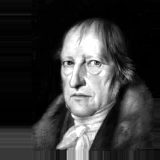
Hegel
Georg Wilhelm Friedrich Hegel1770–1831
What Hegel argues and who answers him, as Marci Shore presents it in her Yale lectures European Intellectual History since Nietzsche: 27 claims, and 45 places where another thinker builds on him or breaks with him. Each claim is our paraphrase and links to the minute of the lecture it comes from.
The truth is the whole.
G. W. F. Hegel, Phenomenology of the Spirit. The epigraph Shore gives lecture 4.
The core ideas
The 6 claims the lectures spend most time on.
Hegel makes history part of philosophy's own substance, reversing a tradition since the Greeks that sought timeless, universal truth and treated the changing and contingent as noise to purge.
Put simply Hegel: since the ancient Greeks, philosophers had looked for truths that never change, and treated whatever changes or happens by chance as noise to get rid of. Hegel reverses this and makes history part of philosophy itself.
Small changes of degree can pile up until, at some threshold, they amount to a change of kind. Hegel's model is water: warmed bit by bit, then suddenly boiling.
Shore's preferred way into the Phenomenology: a Bildungsroman of consciousness as such, maturing through stages until, midway, it merges with Geist.
Put simply Shore's preferred way to read Hegel's Phenomenology: as a coming-of-age story whose hero is consciousness itself, anyone's. It grows up in stages until, halfway through, it merges with "Geist," our shared collective life.
Geist is "the I that is a We": for Hegel meaning is relational, so a single act, like hitting a ball, counts for something only within the whole.
Put simply Hegel's "Geist" is "the I that is a We": the shared life we are each part of. Meaning is relational. In Jay Bernstein's baseball image, hitting a ball counts as a home run only within the whole game.
Where to read it Hegel, Phenomenology of Spirit §177.
Alienation, in Hegel, is failing to see your own particular life as part of Geist, of the whole; its cure is coming to feel at one with the universe's telos.
Put simply Hegel: alienation means failing to see your own life as part of the whole, which he calls "Geist". The cure is to feel at one with the goal (the "telos") the universe is moving toward.
On one reading, a master is master only through a slave's acknowledgment, yet only subjects can recognize, and he has made the slave a thing; hence his permanent dissatisfaction.
Put simply One reading of Hegel's master and slave: a master is a master only if a slave acknowledges him. But only a person can truly acknowledge anyone, and he has made the slave a thing. So he is never satisfied.
Who Hegel answers, and who answers him
Each entry joins one of his claims to another thinker’s. The handwriting names the link; the line beside it says which kind. “Our inference” marks a link Shore does not state outright.
Hegel and Karl Marx 1818–1883
HegelHistory's telos is a reconciliation in which the great oppositions, being and thought, freedom and necessity, fact and value, subject and object, dissolve into a single whole. L5 · 10:02
MarxMarx inverts Hegel, turning dialectics into dialectical materialism: history's driver is not Geist but socioeconomic forces, so philosophy must leave the metaphysical and ideal for the material and concrete. L5 · 33:55
Keeps Hegel's drive toward reconciling all dualisms but replaces Geist's spiritual resolution with a material, socioeconomic one.
HegelHegel's image for history is a "slaughter bench": the suffering piled up along the way is the price paid for progress toward a somewhat mystical end-point. L5 · 9:02
MarxAll history so far is class struggle, and each order carries the seeds of its own destruction: feudalism yielded to capitalism, whose bourgeoisie produces "its own grave diggers." L5 · 38:25
Class struggle concretizes Hegel's violent, sacrificial dialectic: capitalism, like feudalism, breeds its own gravediggers.Our inference
HegelFor Hegel the subjective is nearly a term of abuse: freedom means recognizing necessity, identifying with history's objective movement until you stop wanting it otherwise. L5 · 12:06
MarxIn Hegelian fashion, the Manifesto makes no distinction between forecast and prescription: the proletariat's triumph is predicted, predestined, and right, all at once. L5 · 36:39
Inherits Hegel's collapse of subjective/objective into a philosophy of history where prediction and prescription coincide, now centered on the proletariat.
HegelGeist is "the I that is a We": for Hegel meaning is relational, so a single act, like hitting a ball, counts for something only within the whole. L4 · 26:43
MarxMarx inverts Hegel, turning dialectics into dialectical materialism: history's driver is not Geist but socioeconomic forces, so philosophy must leave the metaphysical and ideal for the material and concrete. L5 · 33:55
Keeps the dialectic but puts material forces where Geist stood
HegelDialectics is Hegel's name for what contradictions do when they meet: a position turns out unstable, its negation displaces it, and such clashes drive history forward in jolts. L4 · 32:56
MarxMarx inverts Hegel, turning dialectics into dialectical materialism: history's driver is not Geist but socioeconomic forces, so philosophy must leave the metaphysical and ideal for the material and concrete. L5 · 33:55
Retains dialectical motion through antagonism as the engine of history
HegelShore's preferred way into the Phenomenology: a Bildungsroman of consciousness as such, maturing through stages until, midway, it merges with Geist. L4 · 21:10
MarxFor Marx, your place in the socioeconomic structure, the base, determines your thinking; consciousness, culture and art, the superstructure, derive from it. L5 · 46:02
Consciousness is no longer the protagonist of history but derivative of social being
HegelAlienation, in Hegel, is failing to see your own particular life as part of Geist, of the whole; its cure is coming to feel at one with the universe's telos. L4 · 40:49
MarxFactory work estranges workers from labor itself: hired by the hour, tending machines, performing one fragment of a process whose finished product is never theirs. L5 · 29:36
Shore presents alienation as a shared preoccupation: failure to see oneself within Geist for Hegel, concrete estrangement from one's labor for Marx.
HegelAufheben, Hegel's untranslatable verb for how one stage gives way to the next, means canceling something while also keeping it and raising it onto a higher plane. L4 · 35:40
MarxAll history so far is class struggle, and each order carries the seeds of its own destruction: feudalism yielded to capitalism, whose bourgeoisie produces "its own grave diggers." L5 · 38:25
Every order carries the seeds of its own supersession, now as class antagonism
HegelIn Hegel, calling something necessary and calling it good amount to the same judgment. The French Revolution was both: it had to come, so it was right. L4 · 3:13
MarxIn Hegelian fashion, the Manifesto makes no distinction between forecast and prescription: the proletariat's triumph is predicted, predestined, and right, all at once. L5 · 36:39
Inherits the collapse of what will happen into what should happen
HegelHegel makes history part of philosophy's own substance, reversing a tradition since the Greeks that sought timeless, universal truth and treated the changing and contingent as noise to purge. L4 · 12:04
MarxWhat decisively shapes modern social behavior, for Marx, is industrialization: modernization in a technical and empirical sense rather than modernity as a broad condition. L5 · 24:37
Marx's historicism makes a concrete, contingent process, industrialization, decisive for thoughtOur inference
Hegel and Friedrich Nietzsche 1844–1900
HegelHistory's end, for Hegel, is a mystical point where all oppositions (freedom and necessity, is and ought, subject and object) dissolve into synthesis; nobody has ever witnessed it. L4 · 41:30
NietzscheSooner or later everyone concludes that the harmonious world where contradictions resolve, Hegel's end of history, is never coming. Unity cannot be found: life is nothing but difference. L6 · 45:04
Declares Hegel's reconciling telos gone: the harmonious whole is not coming and life does not come together.
HegelHistory's end, for Hegel, is a mystical point where all oppositions (freedom and necessity, is and ought, subject and object) dissolve into synthesis; nobody has ever witnessed it. L4 · 41:30
NietzscheHegel's philosophy, by crowning the belated present as the goal of all history, deifies history and sets it, as "the sole sovereign power," in place of art and religion. L6 · 29:53
Treats the world-process philosophy as making history a god, justifying the present as its necessary result and paralyzing culture.
HegelWith Hegel, History acquires a capital H: in the Hegelian sense it is a phenomenon of its own, with a dialectical forward motion. L5 · 12:57
NietzscheHegel's philosophy, by crowning the belated present as the goal of all history, deifies history and sets it, as "the sole sovereign power," in place of art and religion. L6 · 29:53
Hegel turned History into a god that rules over art and religion
HegelDialectics is Hegel's name for what contradictions do when they meet: a position turns out unstable, its negation displaces it, and such clashes drive history forward in jolts. L4 · 32:56
NietzscheThe revered virtues may owe their worth to being "insidiously related, tied to, and involved with" their wicked opposites, perhaps even sharing one essence with them: good and wicked, true and false, come together. L6 · 31:36
Shore finds something very dialectical in Nietzsche despite his anti-Hegelianism: the same coming together of good and wicked that Hegel is always doing.
Hegel and Shore
HegelHegel's slogan "the true is the whole" means everything is interdependent and intelligible only together; since a totality shows itself only from its end, meaning arrives in retrospect. L4 · 46:56
ShoreWhat seduces people in Hegel, Shore judges, is wholeness itself: the promise that unity can finally be achieved and everything be seen as interwoven. L4 · 47:55
Shore's judgment that Hegel's seduction is the seduction of wholeness rests directly on Hegel's own slogan that the true is the whole.
HegelHegel's slogan "the true is the whole" means everything is interdependent and intelligible only together; since a totality shows itself only from its end, meaning arrives in retrospect. L4 · 46:56
ShoreStructuralists meet Hegelians on totality: a sign means something only within a whole that holds everything in place, so faint echoes of Hegel persist even on the synchronic plane. L19 · 21:24
Shore hears vague echoes of Hegel's "the true is the whole" in Saussure's holistic system and says structuralists and Hegelians converge on totality.
HegelSmall changes of degree can pile up until, at some threshold, they amount to a change of kind. Hegel's model is water: warmed bit by bit, then suddenly boiling. L4 · 16:53
ShoreThe twentieth century matters because its stakes are so high: death tolls so vast that, as Hegel describes, a change of scale becomes a change of kind. L25 · 29:45
Shore likens the twentieth century's death tolls to what Hegel describes as changes in scale becoming changes in kind.
Hegel and Max Horkheimer 1895–1973
HegelDialectics is Hegel's name for what contradictions do when they meet: a position turns out unstable, its negation displaces it, and such clashes drive history forward in jolts. L4 · 32:56
HorkheimerDialectics survives without its destination: the contradictions inside things still push history forward, but nothing promises that history ends or resolves. L14 · 24:00
History still moves through contradiction
HegelHistory's end, for Hegel, is a mystical point where all oppositions (freedom and necessity, is and ought, subject and object) dissolve into synthesis; nobody has ever witnessed it. L4 · 41:30
HorkheimerDialectics survives without its destination: the contradictions inside things still push history forward, but nothing promises that history ends or resolves. L14 · 24:00
Drops the guaranteed telos and final reconciliation
HegelHistory's end, for Hegel, is a mystical point where all oppositions (freedom and necessity, is and ought, subject and object) dissolve into synthesis; nobody has ever witnessed it. L4 · 41:30
HorkheimerCritical Theory, as Shore sketches the school, opposes theories promising reconciliation of subject and object, closed systems, and claims to absolute truth. L14 · 35:13
Refuses any promised identity of subject and object; no closed systems
Hegel and Isaiah Berlin 1909–1997
HegelFreedom, for Hegel, means recognizing necessity: since whatever happens had to happen, there is no room for a subjectively good choice, only for grasping why things are so. L4 · 40:12
BerlinBerlin thinks Hegel extremely dangerous: his system, as Shore recalls him saying, is a very dark wood from which few return to report, and once inside you are meant to stop wanting things otherwise. L4 · 40:29
Berlin argues that requiring people to stop wanting the world otherwise, once necessity is grasped, is what makes Hegel's determinism dangerous.
HegelFor Hegel the subjective is nearly a term of abuse: freedom means recognizing necessity, identifying with history's objective movement until you stop wanting it otherwise. L5 · 12:06
BerlinOn Berlin's reading, Hegel admits only one evil: resisting the world process, reason incarnate. Those who wring their hands over history's victims are thus not merely blind but immoral. L5 · 15:44
Reads the objective/subjective hierarchy as licensing amoral indifference to atrocity committed in the name of "progress."
Hegel and Immanuel Kant 1724–1804
KantThe Copernican turn in Kant's epistemology reverses the direction of fit: not the mind conforming to things as they are, but knowable things conforming to the mind's capacities. L2 · 38:03
HegelHegel sets out to solve the old bridge problem, how to get from mind to world: he will join subject and object, though with a dash of mysticism. L4 · 11:43
Takes up the problem of the bridge between subject and object that Descartes and Kant tried to solve
KantFor Kant, acting morally means acting from duty, not from whatever one feels like doing; acts are judged by their intentions, never by consequences nobody can control. L3 · 31:51
HegelHegel rejects Kant's intention-centered morality as inadequate: acts usually have consequences far beyond what anyone meant, so their meaning can be judged only in hindsight. L4 · 29:14
Intentions are not enough; actions are judged by consequences that exceed them
Hegel and Alexandre Kojève 1902–1968
HegelAufheben, Hegel's untranslatable verb for how one stage gives way to the next, means canceling something while also keeping it and raising it onto a higher plane. L4 · 35:40
KojèveFor Kojève, being human means negating the given, in Hegel's sense of overcoming: its concrete features still mark us, but we are no longer its captives. L16 · 15:30
Human being as negating the given echoes Aufhebung: overcome yet marked by what it overcomes
HegelOn one reading, a master is master only through a slave's acknowledgment, yet only subjects can recognize, and he has made the slave a thing; hence his permanent dissatisfaction. L4 · 43:04
KojèveKojève, reading Hegel, holds that a person counts as genuinely human, to himself as much as to others, only through recognition by others, ultimately by all of them. L16 · 38:33
A Heidegger-tinged reading of master and slave: becoming human through others' recognition
Hegel and Simone de Beauvoir 1908–1986
HegelOn one reading, a master is master only through a slave's acknowledgment, yet only subjects can recognize, and he has made the slave a thing; hence his permanent dissatisfaction. L4 · 43:04
BeauvoirOtherness, for Beauvoir, is built into thought, "as primordial as consciousness itself": no subject simply is who it is; each finds itself only against an Other. L16 · 35:13
Takes the master-slave dialectic of recognition into relations between the sexes
HegelOn one reading, a master is master only through a slave's acknowledgment, yet only subjects can recognize, and he has made the slave a thing; hence his permanent dissatisfaction. L4 · 43:04
BeauvoirConflict between the sexes can be overcome, Beauvoir thinks, if people take hold of their subjectivity: free, autonomous subjects could then recognize one another reciprocally, and with desire. L16 · 48:11
Mutual recognition, each both subject and object, as the way out of the master-slave impasse
Hegel and Jean-Paul Sartre 1905–1980
HegelOn one reading, a master is master only through a slave's acknowledgment, yet only subjects can recognize, and he has made the slave a thing; hence his permanent dissatisfaction. L4 · 43:04
SartreBeing looked at makes me someone's object, and that very fact brings home that the looker is a subject. In Sartre's words, "I cannot be an object for an object." L17 · 32:07
Only a subject can objectify me; like Hegel's master, the gaze needs the other as subject.Our inference
HegelNobody in the Phenomenology gets to be simply identical with themselves: identity is always mediated, handed to you through another's gaze, so no self stands on its own. L4 · 45:29
SartreSartre holds that genuine self-knowledge depends on being recognized by another subject; absent that acknowledgment, I cannot really know who I am. L17 · 34:17
No self-knowledge without recognition by another subject
Hegel and Jacques Derrida 1930–2004
HegelHistory's end, for Hegel, is a mystical point where all oppositions (freedom and necessity, is and ought, subject and object) dissolve into synthesis; nobody has ever witnessed it. L4 · 41:30
DerridaTo Derrida, anything linear, one-directional or Hegelian feels totalitarian, and goes with an illusion: that a transcendental signified, a unifying first principle, exists. L22 · 16:37
Derrida calls Hegel's linear march toward a final synthesis totalitarian.
HegelHistory's end, for Hegel, is a mystical point where all oppositions (freedom and necessity, is and ought, subject and object) dissolve into synthesis; nobody has ever witnessed it. L4 · 41:30
DerridaDerrida labels the undertaking a hauntology: the many spirits of Marx, and with them Hegel's teleological conception of time, will go on haunting us indefinitely. L25 · 36:24
Hegel's teleological time survives as a haunting rather than a destination
Hegel and Angela Davis 1944–
HegelOn one reading, a master is master only through a slave's acknowledgment, yet only subjects can recognize, and he has made the slave a thing; hence his permanent dissatisfaction. L4 · 43:04
DavisFor Davis the master is never secure: he stands perpetually on the brink of turning into the slave, who holds real and concrete power to flip the relation. L4 · 44:34
Shore presents Davis's lectures as a clear reading of Hegel's master-slave dialectic in an American context: the master depends on the slave.
Hegel and Jay Bernstein 1947–
HegelNobody in the Phenomenology gets to be simply identical with themselves: identity is always mediated, handed to you through another's gaze, so no self stands on its own. L4 · 45:29
BernsteinBernstein reads Hegel's master-slave dialectic as showing identity is never self-contained but always mediated by another's recognition; these dependencies are one of the things we find unbearable. L4 · 45:15
Bernstein concludes from mediated identity that our dependence on others is unbearable, even murderous.
Hegel and Hannah Arendt 1906–1975
HegelHegel's slogan "the true is the whole" means everything is interdependent and intelligible only together; since a totality shows itself only from its end, meaning arrives in retrospect. L4 · 46:56
ArendtFor Arendt, Hegel's philosophy was Western thought's last attempt to reunite being and thought, subject and object; whether it housed reality or imprisoned it, nobody could say. L4 · 47:34
Arendt questions whether achieving Hegel's totality is a home for reality or a prison, casting doubt on the value of the whole.
Hegel and Alexander Herzen 1812–1870
HegelShore's preferred way into the Phenomenology: a Bildungsroman of consciousness as such, maturing through stages until, midway, it merges with Geist. L4 · 21:10
HerzenIn his memoirs Herzen describes Hegel's Phenomenology of Spirit as something you live through rather than read: an experience, not a book. L4 · 7:22
Herzen's description of living through the book as an experience matches Shore's Bildungsroman framing of consciousness's maturation.Our inference
Hegel and Johann Gottlieb Fichte 1762–1814
FichteFichte: "to be free is nothing, to become free is heaven." Freedom is not a state you have but a becoming you live, driven by desire. L3 · 37:08
HegelLike the Romantics, Hegel cares less about what is than about what is becoming: nothing holds still, and everything is always on its way to being something else. L4 · 14:38
Shore says Hegel takes the being-versus-becoming distinction central to Romanticism, which she recalls through Fichte's line on becoming free, and makes it central.
Hegel and Jean-Jacques Rousseau 1712–1778
RousseauTwo things distinguish humans from other creatures, on Rousseau's account: free agency, and an openness to becoming. We are underdetermined, self-creating beings rather than finished ones. L3 · 17:39
HegelLike the Romantics, Hegel cares less about what is than about what is becoming: nothing holds still, and everything is always on its way to being something else. L4 · 14:38
Humans defined by becoming, not fixed nature, now generalized to all of realityOur inference
Hegel and Henri Bergson 1859–1941
HegelHistory's end, for Hegel, is a mystical point where all oppositions (freedom and necessity, is and ought, subject and object) dissolve into synthesis; nobody has ever witnessed it. L4 · 41:30
BergsonFinalism (teleology) holds that life moves toward an end planned from the start; Bergson rejects it: more determinism means less contingency and free will, which he wants room for. L7 · 27:08
A goal fixed in advance leaves no room for contingency or freedom
Hegel and Georg Lukács 1885–1971
HegelHegel's slogan "the true is the whole" means everything is interdependent and intelligible only together; since a totality shows itself only from its end, meaning arrives in retrospect. L4 · 46:56
LukácsMarxism, for Lukács, stands or falls on totality: revolution comes only from a standpoint that sees the social whole, and trade-unionism plainly fails that test. L8 · 32:46
Makes Hegel's "the true is the whole" the test of revolutionary class consciousnessOur inference
Hegel and Theodor Adorno 1903–1969
HegelAlienation, in Hegel, is failing to see your own particular life as part of Geist, of the whole; its cure is coming to feel at one with the universe's telos. L4 · 40:49
AdornoEnlightenment reason knows nature only as something to manipulate, and the price of the power it gains is alienation from the very nature it dominates. L14 · 45:41
Alienation reappears as reason's estrangement from the nature it dominatesOur inference
Hegel and Leszek Kołakowski 1927–2009
HegelFor Hegel the subjective is nearly a term of abuse: freedom means recognizing necessity, identifying with history's objective movement until you stop wanting it otherwise. L5 · 12:06
KołakowskiHuman beings are, in Kołakowski's phrase, the "sole creators of values," and this holds whether one affirms or denies a deterministic account of the world. L18 · 27:20
Reinstates subjective value-creation against Hegelian contempt for "the subjective"Our inference
Hegel and René Girard 1923–2015
HegelOn one reading, a master is master only through a slave's acknowledgment, yet only subjects can recognize, and he has made the slave a thing; hence his permanent dissatisfaction. L4 · 43:04
GirardGirard calls it the scandal: the mediator whose desire one copies also blocks access to the object, so the same person is admired and hated at once. L20 · 29:51
Shore draws an analogy between loving and hating Girard's mediator and the bind of Hegel's master, who needs recognition from a slave made an object.
Hegel and Jean-François Lyotard 1924–1998
HegelHegel's slogan "the true is the whole" means everything is interdependent and intelligible only together; since a totality shows itself only from its end, meaning arrives in retrospect. L4 · 46:56
LyotardThe postmodern, in Lyotard's famous 1979 formula, is "incredulity toward meta-narratives": a refusal to believe any single grand story could gather everything up and make it cohere. L22 · 17:41
Incredulity toward any grand story claiming to hold the whole togetherOur inference
Hegel and Jan Patočka 1907–1977
HegelHegel's slogan "the true is the whole" means everything is interdependent and intelligible only together; since a totality shows itself only from its end, meaning arrives in retrospect. L4 · 46:56
PatočkaPatočka and Michalski shared a conviction: in the 1970s communist bloc Heidegger could counteract Hegel, showing meaning need not require wholeness, nor some kind of truth an inevitable destination. L25 · 42:24
Uses Heidegger to show meaning without wholeness and truth without a preordained end
All 27 claims, lecture by lecture
In the order they come up. The time opens that minute of the lecture on YouTube.
Lecture 4Hegel and the Historicist Chronotope
In Hegel, calling something necessary and calling it good amount to the same judgment. The French Revolution was both: it had to come, so it was right.
Other readings Terry Pinkard (Does History Make Sense?, 2017) defends Hegel's philosophy of history against the common reading of it as a theory of inevitable progress, grounding it in an account of human subjectivity.
Where to read it Hegel, Encyclopedia Logic §6; Philosophy of Right, Preface.
Hegel makes history part of philosophy's own substance, reversing a tradition since the Greeks that sought timeless, universal truth and treated the changing and contingent as noise to purge.
Put simply Hegel: since the ancient Greeks, philosophers had looked for truths that never change, and treated whatever changes or happens by chance as noise to get rid of. Hegel reverses this and makes history part of philosophy itself.
Hegel shares the Enlightenment's ambition to make philosophy scientific but thinks it went about it wrongly: too skeptical, too shallow, better at dismantling faith than at offering depth in return.
Like the Romantics, Hegel cares less about what is than about what is becoming: nothing holds still, and everything is always on its way to being something else.
Small changes of degree can pile up until, at some threshold, they amount to a change of kind. Hegel's model is water: warmed bit by bit, then suddenly boiling.
Spirit ripens quietly and gradually toward a new form; then, like a child being born, the new world arrives all at once, "in one flash."
Put simply Hegel: "Spirit", the shared life of humanity, matures slowly and quietly toward a new form. Then, like a child being born, the new world arrives all at once, "in one flash."
Shore's preferred way into the Phenomenology: a Bildungsroman of consciousness as such, maturing through stages until, midway, it merges with Geist.
Put simply Shore's preferred way to read Hegel's Phenomenology: as a coming-of-age story whose hero is consciousness itself, anyone's. It grows up in stages until, halfway through, it merges with "Geist," our shared collective life.
Consciousness climbs from one stage to the next by trying, in some highly abstract sense, to overcome alienation; the whole Phenomenology is that struggle.
Put simply Hegel's Phenomenology: the mind climbs from stage to stage by trying to overcome alienation, the feeling of not being at home in the world. The whole book is that struggle, in a very abstract sense.
Geist is "the I that is a We": for Hegel meaning is relational, so a single act, like hitting a ball, counts for something only within the whole.
Put simply Hegel's "Geist" is "the I that is a We": the shared life we are each part of. Meaning is relational. In Jay Bernstein's baseball image, hitting a ball counts as a home run only within the whole game.
Where to read it Hegel, Phenomenology of Spirit §177.
As Shore tells it, the Phenomenology's world history is a short European list: Greece, a lesser Rome, then nothing significant until the French Revolution and its deeper interpretation by German philosophers.
In the text In the Phenomenology (1807; Miller translation), the chapter on Spirit runs from the ethical order and legal status through culture, faith and the Enlightenment to "Absolute Freedom and Terror" and then morality, without naming any period.
Understanding is retrospective: Hegel's owl of Minerva "spreads its wings only with the falling of the dusk." What anything meant becomes clear only afterward, never in advance.
Put simply Hegel: we understand things only by looking back. His image: the owl of Minerva "spreads its wings only with the falling of the dusk." What anything meant becomes clear afterward, never in advance.
Where to read it Hegel, Philosophy of Right, Preface, closing paragraphs.
Hegel rejects Kant's intention-centered morality as inadequate: acts usually have consequences far beyond what anyone meant, so their meaning can be judged only in hindsight.
Put simply Hegel rejects Kant's view that an act is judged by the intention behind it. Acts usually have effects far beyond what anyone meant, so what they mean can be judged only looking back.
Dialectics is Hegel's name for what contradictions do when they meet: a position turns out unstable, its negation displaces it, and such clashes drive history forward in jolts.
Put simply Hegel's "dialectics": when opposing positions clash, one turns out to be unstable and its opposite pushes it aside. Clashes like these drive history forward, in sudden jolts rather than smoothly.
Aufheben, Hegel's untranslatable verb for how one stage gives way to the next, means canceling something while also keeping it and raising it onto a higher plane.
Put simply Hegel's German verb "aufheben" has no English equivalent. It describes how one stage gives way to the next: the old is canceled, but also kept, and lifted to a higher level.
Freedom, for Hegel, means recognizing necessity: since whatever happens had to happen, there is no room for a subjectively good choice, only for grasping why things are so.
Put simply Hegel: being free means understanding that things had to happen as they did. Since everything happens as it must, there is no room for choosing what seems good to you, only for grasping why things are so.
In the text In the Philosophy of Right (§124), Hegel calls the right of subjective freedom "the pivot and center of the difference between antiquity and modern times"; "freedom is the insight into necessity" is Engels's summary of Hegel in Anti-Dühring.
Other readings Robert Pippin (Hegel's Practical Philosophy, 2008) reads Hegel's freedom as a relation: agents take their purposes as their own and act within institutions of mutual recognition, so the individual's own endorsement matters.
Alienation, in Hegel, is failing to see your own particular life as part of Geist, of the whole; its cure is coming to feel at one with the universe's telos.
Put simply Hegel: alienation means failing to see your own life as part of the whole, which he calls "Geist". The cure is to feel at one with the goal (the "telos") the universe is moving toward.
History's end, for Hegel, is a mystical point where all oppositions (freedom and necessity, is and ought, subject and object) dissolve into synthesis; nobody has ever witnessed it.
Put simply Hegel: history ends at a mystical point where all opposites (freedom and necessity, what is and what ought to be, the mind and the world) merge into one. Nobody has ever seen this happen.
On one reading, a master is master only through a slave's acknowledgment, yet only subjects can recognize, and he has made the slave a thing; hence his permanent dissatisfaction.
Put simply One reading of Hegel's master and slave: a master is a master only if a slave acknowledges him. But only a person can truly acknowledge anyone, and he has made the slave a thing. So he is never satisfied.
On one reading, through real labor, by reshaping the world with his own work, the slave makes himself into a subject; the one reduced to a thing acquires subjectivity.
Put simply One reading of Hegel's master and slave: by working on the world and reshaping it, the slave makes himself a person with a self of his own. The one treated as a thing becomes a subject.
Nobody in the Phenomenology gets to be simply identical with themselves: identity is always mediated, handed to you through another's gaze, so no self stands on its own.
Put simply Hegel's Phenomenology: nobody can be who they are all by themselves. Your identity always reaches you through someone else, through how another person sees you, so no self stands on its own.
Hegel's slogan "the true is the whole" means everything is interdependent and intelligible only together; since a totality shows itself only from its end, meaning arrives in retrospect.
Put simply Hegel's slogan "the true is the whole": everything depends on everything else and makes sense only together. A whole can be seen only from its end, so meaning comes only looking back.
Where to read it Hegel, Phenomenology of Spirit, Preface §20.
Hegel sets out to solve the old bridge problem, how to get from mind to world: he will join subject and object, though with a dash of mysticism.
Put simply Hegel sets out to solve an old puzzle: how a mind shut inside its own head can reach the world outside. His answer joins mind and world together, with a touch of mysticism.
Lecture 5Marxism
With Hegel, History acquires a capital H: in the Hegelian sense it is a phenomenon of its own, with a dialectical forward motion.
Put simply Hegel: History, with a capital H, becomes a force of its own, not just a record of what happened. It moves forward through clashes between opposites.
History cannot be run backward: the Bastille, once stormed, stays stormed, and whatever actually happens is in some sense what ought to have happened.
Put simply Hegel: history cannot be undone. Once the Bastille was stormed in the French Revolution, it stayed stormed. And whatever actually happens is, in some sense, what ought to have happened.
Other readings Terry Pinkard (Does History Make Sense?, 2017) defends Hegel's philosophy of history against the common reading of it as a theory of inevitable progress, grounding it in an account of human subjectivity.
Where to read it Hegel, Philosophy of Right, Preface; Encyclopedia Logic §6.
Hegel's image for history is a "slaughter bench": the suffering piled up along the way is the price paid for progress toward a somewhat mystical end-point.
Where to read it Hegel, Lectures on the Philosophy of History, Introduction.
History's telos is a reconciliation in which the great oppositions, being and thought, freedom and necessity, fact and value, subject and object, dissolve into a single whole.
Put simply Hegel: history is heading for a final reconciliation in which the great opposites (thought and being, freedom and necessity, facts and values, mind and world) merge into a single whole.
For Hegel the subjective is nearly a term of abuse: freedom means recognizing necessity, identifying with history's objective movement until you stop wanting it otherwise.
Put simply Hegel has little patience for the personal, the "subjective." Freedom means seeing that things must happen as they do, and siding with history's course until you no longer wish it were different.
In the text In the Philosophy of Right (§124), Hegel calls the right of subjective freedom "the pivot and center of the difference between antiquity and modern times"; "freedom is the insight into necessity" is Engels's summary of Hegel in Anti-Dühring.
Other readings Robert Pippin (Hegel's Practical Philosophy, 2008) reads Hegel's freedom as a relation: agents take their purposes as their own and act within institutions of mutual recognition, so the individual's own endorsement matters.
The questions Hegel is part of
A throughline follows one question across the whole course. These are the ones his claims sit on.
Works and dates
As they come up in the lectures.
French Revolution: the Bastille falls (July 14) and the Declaration of the Rights of Man is proclaimed. Hegel is 18.
Napoleon rides through Jena; Hegel allegedly calls him "world spirit on horseback". Hegel is 36. Shore tells this as a story that may not have happened.
Phenomenology of Spirit Phänomenologie des Geistes
Hegel's Phenomenology of Spirit is published (completed in Jena in October 1806). Hegel is 37.
Philosophy of Right Grundlinien der Philosophie des Rechts
Terms
The ideas his claims turn on, as the lectures gloss them.
The problem of the bridge. The epistemological puzzle of how a subject enclosed in its own head can reach an independently existing object or outside world.
Being vs. becoming. Whether identity and history are a fixed state to be understood (being) or an open, self-created process (becoming); Romantics prize becoming.
Transformation of quantity into quality. Gradual quantitative changes accumulate until, at a threshold, they trigger a sudden change in kind rather than degree.
Dialectic. History advances through clashing contradictions: an unstable position is negated by its opposite and carried forward to a new, higher stage.
Bildungsroman. A coming-of-age novel form; Shore reads the Phenomenology as the Bildungsroman of consciousness maturing toward self-understanding.
Geist. The whole of collective, historical life in which individuals gain meaning: "the I that is a we, the we that is an I."
Alienation. In Shore's framing, the central problem of modernity: the felt homelessness of being in the world once God's unifying framework is gone and nothing stable has replaced it.
The owl of Minerva. Hegel's image that understanding of an era or an action arrives only in retrospect, after it is over, never while it unfolds.
Determinate negation. The specific way one state of affairs is canceled by what negates it, yet carried forward rather than simply erased.
Sublation. To negate and preserve at once, lifting something to a higher level; loosely rendered as "sublate," "supersede," or "overcome."
Telos. The end or goal a thing is already developing toward, e.g. the seed is "aiming" at the apple it will become.
Recognition. Identity is not self-standing but constituted through being acknowledged by another consciousness, as with the master's dependence on the slave.
Master-slave dialectic. The lord's mastery depends on recognition from a bondsman he treats as an object, so his apparent independence rests on hidden dependence.
The whole / totality. Nothing has meaning taken in isolation; only the interconnected whole, graspable only from its end, yields truth.
History. History treated as a quasi-autonomous, directional force with its own dialectical forward momentum, not merely the record of past events.