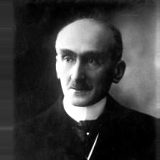
Bergson
Henri Bergson1859–1941
What Bergson argues and who answers him, as Marci Shore presents it in her Yale lectures European Intellectual History since Nietzsche: 17 claims, and 9 places where another thinker builds on him or breaks with him. Each claim is our paraphrase and links to the minute of the lecture it comes from.
All the molds crack.
Henri Bergson, Creative Evolution. The epigraph Shore gives lecture 7.
The core ideas
The 3 claims the lectures spend most time on.
Real time is durée, duration: time as we actually experience it, a flow with no gaps that runs one way only and resists being divided into countable points.
Put simply Bergson: real time is "durée" (duration), time as we actually live it. It flows without gaps, runs only one way, and cannot be split into countable points.
Free will is inseparable from qualitative time: because we live time as an undivided flow, we can act spontaneously, in ways no one could have fixed beforehand.
Put simply Bergson: free will cannot be separated from time lived as one unbroken flow. Because we live time that way, we can act spontaneously, in ways no one could have settled in advance.
Finalism (teleology) holds that life moves toward an end planned from the start; Bergson rejects it: more determinism means less contingency and free will, which he wants room for.
Put simply Bergson rejects "finalism", the idea that life heads toward a goal fixed from the start, as an apple seed already "aims" at its apple. The more is fixed in advance, the less room for chance and free will.
Who Bergson answers, and who answers him
Each entry joins one of his claims to another thinker’s. The handwriting names the link; the line beside it says which kind. “Our inference” marks a link Shore does not state outright.
Bergson and Herbert Spencer 1820–1903
SpencerThe only knowledge worth the name comes from the sciences; no other source yields anything solid. L7 · 10:48
BergsonSpencer and the positivists go wrong by projecting the way they picture space onto time, chopping it into countable units like minutes and instants; time is qualitative, not quantitative. L7 · 12:40
Spencerian quantifying science treats time like space and so misses lived duration.
SpencerSpencer's account of evolution: living things change biologically because they adapt directly to the pressures of their surroundings. L7 · 11:06
BergsonMechanism treats nature as a machine: isolate each part, understand it, reassemble. Applied to life, that reaches only the parts and yields a thin, derivative picture of the whole. L7 · 28:07
Spencer's evolutionism cuts present reality into pieces and recomposes it, presupposing what it claims to explain.
Bergson and Hannah Arendt 1906–1975
BergsonFree will is inseparable from qualitative time: because we live time as an undivided flow, we can act spontaneously, in ways no one could have fixed beforehand. L7 · 23:13
ArendtNatality: every new being who enters the world injects radical contingency into it, able to head in many directions along courses no one can foresee. L7 · 49:55
Shore links Bergson's radical contingency of living beings to Arendt's natality.
BergsonFor Bergson life is choice, continual choice: a newborn child is already a whole, indivisible self, yet which of countless directions that self will take cannot be predicted, and should not be. L7 · 32:23
ArendtNatality: every new being who enters the world injects radical contingency into it, able to head in many directions along courses no one can foresee. L7 · 49:55
Shore sets Bergson's radical contingency entering the world with each living being beside what Arendt called natality.
Bergson and Georg Cantor 1845–1918
CantorThe continuum hypothesis (1878): the integers make up one infinity, the gapless points of a line another, and no set has a size strictly between the two. L7 · 16:24
BergsonReal time is durée, duration: time as we actually experience it, a flow with no gaps that runs one way only and resists being divided into countable points. L7 · 14:39
Shore conjectures that the continuous/discrete contrast comes from calculus and Cantor; time is like the continuum of the line.
Bergson and Immanuel Kant 1724–1804
KantFree will cannot be proven, yet without it there is no ethics at all. Kant therefore simply posits it, and, almost in passing, posits God too. L3 · 31:04
BergsonFree will is inseparable from qualitative time: because we live time as an undivided flow, we can act spontaneously, in ways no one could have fixed beforehand. L7 · 23:13
Where Kant merely postulates free will, Bergson tries to ground it in the nature of time.
Bergson and Georg Wilhelm Friedrich Hegel 1770–1831
HegelHistory's end, for Hegel, is a mystical point where all oppositions (freedom and necessity, is and ought, subject and object) dissolve into synthesis; nobody has ever witnessed it. L4 · 41:30
BergsonFinalism (teleology) holds that life moves toward an end planned from the start; Bergson rejects it: more determinism means less contingency and free will, which he wants room for. L7 · 27:08
A goal fixed in advance leaves no room for contingency or freedom
Bergson and Johann Wolfgang von Goethe 1749–1832
GoetheGoethe's charge against Mendelssohn: he treats beauty as an entomologist treats a butterfly, pinning it down until its color pales and nothing living is left. L2 · 46:35
BergsonIntellect is built for inert matter. It measures, categorizes and breaks things into separable pieces from outside; at ease only with the discontinuous and dead, it cannot grasp life. L7 · 39:12
Analytic intellect, like the pinned butterfly, cannot grasp the living wholeOur inference
Bergson and Simone de Beauvoir 1908–1986
BergsonIntellect is built for inert matter. It measures, categorizes and breaks things into separable pieces from outside; at ease only with the discontinuous and dead, it cannot grasp life. L7 · 39:12
BeauvoirSexuality, for Beauvoir, cannot be absorbed into the social order: eroticism is "a revolt of the instant against time," and trying to channel or exploit it risks killing it. L16 · 41:15
Shore sees Bergson's influence in Beauvoir's view that live spontaneity cannot be disposed of like inert matter: eroticism is a realm of freedom.
All 17 claims, lecture by lecture
In the order they come up. The time opens that minute of the lecture on YouTube.
Lecture 7Henri Bergson and the Revolt against Positivism
Spencer and the positivists go wrong by projecting the way they picture space onto time, chopping it into countable units like minutes and instants; time is qualitative, not quantitative.
Put simply Bergson: Spencer and the positivists, who trust only scientific observation, treat time like space, chopping it into countable units such as minutes and instants. That is their mistake. Time is a matter of quality, not quantity.
Real time is durée, duration: time as we actually experience it, a flow with no gaps that runs one way only and resists being divided into countable points.
Put simply Bergson: real time is "durée" (duration), time as we actually live it. It flows without gaps, runs only one way, and cannot be split into countable points.
Multiplicity comes in two kinds. A number is made of discrete, countable units; the states of consciousness instead permeate one another, forming a qualitative multiplicity that cannot be counted.
Put simply Bergson: there are two kinds of "many". A number is made of separate units you can count. Our states of mind instead blend into one another, a "qualitative multiplicity" that cannot be counted.
In consciousness, one state succeeding another means the two melt into an organic whole without gaps or edges, and the past keeps coexisting virtually with the present.
Put simply Bergson: in the mind, each state melts into the next, forming one whole with no gaps or edges (Shore's picture: cheese slices melting together in a grilled cheese). The past keeps living on in the present.
Free will is inseparable from qualitative time: because we live time as an undivided flow, we can act spontaneously, in ways no one could have fixed beforehand.
Put simply Bergson: free will cannot be separated from time lived as one unbroken flow. Because we live time that way, we can act spontaneously, in ways no one could have settled in advance.
Einstein's relativity theory measures time through instants, and that is the mistake: time must be flow, since only flowing time can accommodate contingency and free will.
Put simply Bergson against Einstein: relativity measures time as a series of instants, and that is the mistake. Time must be a flow, because only flowing time leaves room for an open future and free will.
In the text In the preface to Duration and Simultaneity (1922), Bergson presents the book as asking how far his idea of duration is compatible with Einstein's views on time.
Finalism (teleology) holds that life moves toward an end planned from the start; Bergson rejects it: more determinism means less contingency and free will, which he wants room for.
Put simply Bergson rejects "finalism", the idea that life heads toward a goal fixed from the start, as an apple seed already "aims" at its apple. The more is fixed in advance, the less room for chance and free will.
Mechanism treats nature as a machine: isolate each part, understand it, reassemble. Applied to life, that reaches only the parts and yields a thin, derivative picture of the whole.
Put simply Bergson rejects "mechanism", which treats nature like a machine such as a bicycle: understand each part, then reassemble. Applied to life, it grasps only the parts and gives a thin, second-hand picture of the whole.
Evolution has no single course. Like an exploding shell rather than a cannonball, life moves by splitting apart, scattering along divergent lines, with many possibilities open at once.
Put simply Bergson: evolution does not follow one path. Life is less like a cannonball flying to one spot than a shell bursting into fragments, scattering in many directions with many possibilities open at once.
Living things carry an élan vital, a life force that works on inert matter: it is what makes us want to do things, to act, to create.
Put simply Bergson: living things carry an "élan vital", a life force that acts on lifeless matter. It is what makes us want to do things, to act, to create.
For Bergson life is choice, continual choice: a newborn child is already a whole, indivisible self, yet which of countless directions that self will take cannot be predicted, and should not be.
You cannot spatialize only the past. Lay elapsed time out like space and the future is spread out too, complete behind a screen; contingency vanishes and our acts arrive ready-made.
Put simply Bergson: if you lay out past time like space, you must lay out the future that way too, as if already complete behind a screen. Then nothing is left open, and our actions arrive ready-made.
Intellect is built for inert matter. It measures, categorizes and breaks things into separable pieces from outside; at ease only with the discontinuous and dead, it cannot grasp life.
Put simply Bergson: the intellect is made for lifeless matter. It measures, sorts and breaks things into separate pieces from the outside. At ease only with what is cut up and dead, it cannot grasp life.
Intuition, instinct in sophisticated form, is molded to life itself: it grasps reality from inside, whole and at one stroke, not in represented pieces, and it belongs to time.
Put simply Bergson: intuition, a refined form of instinct, is shaped to fit life itself. It grasps reality from the inside, whole and all at once rather than piece by piece, and it belongs to time.
Intuition completes intellect rather than rejecting it, and consciousness needs both. Rely on mechanistic intellect alone, though, and you get an impoverished world drained of creativity.
Put simply Bergson: intuition completes the intellect rather than rejecting it, and the mind needs both. But rely on the machine-like intellect alone and you get a poorer world, drained of creativity.
Art, whatever its medium, has a single aim: to sweep away the useful symbols and accepted generalities that screen reality from us, and confront us with reality directly.
Put simply Bergson: all art, in any medium, has one aim: to clear away the practical labels and accepted generalities that hide reality from us, and bring us face to face with reality itself.
What is funny is what lacks self-awareness: the aspect of someone that resembles a thing, rigid, mechanical, moving without life. Laughter is society's corrective, jolting that automatism loose.
Put simply Bergson on comedy: we laugh at the side of a person that acts like a thing, rigid and mechanical, unaware of itself. Laughter is society's way of correcting this, jolting people out of autopilot.
The questions Bergson is part of
A throughline follows one question across the whole course. These are the ones his claims sit on.
Works and dates
As they come up in the lectures.
Freud born in a small Moravian town in the Habsburg Empire.
Bergson born in Paris, the year Darwin publishes Origin of Species. Bergson is 0.
Time and Free Will Essai sur les données immédiates de la conscience
Laughter: An Essay on the Meaning of the Comic Le Rire
Creative Evolution L'Évolution créatrice
Concerning the Nature of Time Concerning the Nature of Time
Duration and Simultaneity Durée et simultanéité
Bergson's polemic with Einstein over relativity and the nature of time. Bergson is 63.
Bergson, reportedly offered exemption from the Vichy anti-Jewish laws, refuses it and registers as a Jew.
Bergson dies aged 81, allegedly of a cold caught queueing to register as a Jew. Bergson is 81. Shore tells this as a story that may not have happened.
Terms
The ideas his claims turn on, as the lectures gloss them.
Spatialization of time. Treating time on the model of space, as divisible units (seconds, instants) laid out side by side; for Bergson a category mistake.
Positivism. Understanding the world strictly through empirical observation, with no supernatural forces or metaphysical explanation admitted.
Duration. Time as a continuous, irreversible, lived flow in which past and present interpenetrate, rather than a row of countable instants.
The continuous and the discrete. Bergson's master distinction: what can be counted as separate units versus an unbroken flow with no gaps. Lived time is the flow; cutting it into units treats it as if it were laid out in space.
Qualitative vs quantitative multiplicity. Two kinds of manifold: countable, separable units versus heterogeneous states that permeate one another; conscious life is the second kind.
Free will. Capacity for spontaneous, self-determining action not fixed in advance; Kant postulates it, Bergson claims to ground it in the nature of time.
Contingency. The openness of the future: accident and choice mean that multiple outcomes are always possible; the opposite of determinism.
Finalism. The view that life develops toward a goal fixed from the start; Bergson rejects it because it leaves no room for contingency or free will.
Telos. The end or goal a thing is already developing toward, e.g. the seed is "aiming" at the apple it will become.
Mechanism. The Enlightenment picture of nature as a machine whose whole is fully explained by its separable parts; Bergson rejects it as a theory of life.
Élan vital. A generative life force, acting on inert matter, that makes living beings creative and drives evolution along divergent, unpredictable lines.
Decisionism. In the lecture, the existentialist view that all moral weight falls on the individual's act of choosing, foreshadowed by Bergson. In political theory the word usually refers to Carl Schmitt, for whom the sovereign's decision, not a norm, founds law.
Intellect and intuition. Two faculties: intellect analyzes inert matter from outside in separable parts; intuition grasps living reality from inside, holistically and in time.
The problem of the bridge. The epistemological puzzle of how a subject enclosed in its own head can reach an independently existing object or outside world.
Laughter as social corrective. Comedy arises when a person behaves like a thing or automaton; laughter is the social gesture that pushes back against such mechanical absentmindedness.