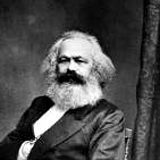
Marx
Karl Marx1818–1883
What Marx argues and who answers him, as Marci Shore presents it in her Yale lectures European Intellectual History since Nietzsche: 17 claims, and 34 places where another thinker builds on him or breaks with him. Each claim is our paraphrase and links to the minute of the lecture it comes from.
A specter is haunting Europe—the specter of communism.
Karl Marx and Friedrich Engels, The Communist Manifesto. The epigraph Shore gives lecture 5.
The core ideas
The 5 claims the lectures spend most time on.
Marx inverts Hegel, turning dialectics into dialectical materialism: history's driver is not Geist but socioeconomic forces, so philosophy must leave the metaphysical and ideal for the material and concrete.
Put simply Marx turns Hegel upside down. History is driven not by "Spirit" but by social and economic forces, so philosophy must turn from abstract ideas to material, concrete life. This is "dialectical materialism".
In the text In the 1873 Afterword to Capital, Marx writes "My dialectic method is not only different from the Hegelian, but is its direct opposite" and speaks of "the materialistic basis of my method".
Industrial society swaps nobles and peasants for two classes: a bourgeoisie defined by owning factories rather than inherited title, and a proletariat of urban workers employed in them.
Put simply Marx: industry replaces nobles and peasants with two classes. The "bourgeoisie" own the factories, rather than inheriting titles; the "proletariat" are the city workers employed in them.
Factory work estranges workers from labor itself: hired by the hour, tending machines, performing one fragment of a process whose finished product is never theirs.
Put simply Marx: factory work cuts workers off from their own labor. Paid by the hour, they tend machines and do one small step of a process, and the finished product is never theirs.
For Marx, your place in the socioeconomic structure, the base, determines your thinking; consciousness, culture and art, the superstructure, derive from it.
Put simply Marx: your place in the economy (the "base") determines how you think. Your ideas, culture and art (the "superstructure") grow out of it.
Where to read it Marx, Preface to A Contribution to the Critique of Political Economy (1859); Engels, letter to Joseph Bloch, 21–September 22, 1890.
All history so far is class struggle, and each order carries the seeds of its own destruction: feudalism yielded to capitalism, whose bourgeoisie produces "its own grave diggers."
Put simply Marx: all history so far has been a struggle between classes, and every social order breeds its own downfall. Feudalism gave way to capitalism, and the capitalist class produces "its own grave diggers."
Who Marx answers, and who answers him
Each entry joins one of his claims to another thinker’s. The handwriting names the link; the line beside it says which kind. “Our inference” marks a link Shore does not state outright.
Marx and Georg Wilhelm Friedrich Hegel 1770–1831
HegelHistory's telos is a reconciliation in which the great oppositions, being and thought, freedom and necessity, fact and value, subject and object, dissolve into a single whole. L5 · 10:02
MarxMarx inverts Hegel, turning dialectics into dialectical materialism: history's driver is not Geist but socioeconomic forces, so philosophy must leave the metaphysical and ideal for the material and concrete. L5 · 33:55
Keeps Hegel's drive toward reconciling all dualisms but replaces Geist's spiritual resolution with a material, socioeconomic one.
HegelHegel's image for history is a "slaughter bench": the suffering piled up along the way is the price paid for progress toward a somewhat mystical end-point. L5 · 9:02
MarxAll history so far is class struggle, and each order carries the seeds of its own destruction: feudalism yielded to capitalism, whose bourgeoisie produces "its own grave diggers." L5 · 38:25
Class struggle concretizes Hegel's violent, sacrificial dialectic: capitalism, like feudalism, breeds its own gravediggers.Our inference
HegelFor Hegel the subjective is nearly a term of abuse: freedom means recognizing necessity, identifying with history's objective movement until you stop wanting it otherwise. L5 · 12:06
MarxIn Hegelian fashion, the Manifesto makes no distinction between forecast and prescription: the proletariat's triumph is predicted, predestined, and right, all at once. L5 · 36:39
Inherits Hegel's collapse of subjective/objective into a philosophy of history where prediction and prescription coincide, now centered on the proletariat.
HegelGeist is "the I that is a We": for Hegel meaning is relational, so a single act, like hitting a ball, counts for something only within the whole. L4 · 26:43
MarxMarx inverts Hegel, turning dialectics into dialectical materialism: history's driver is not Geist but socioeconomic forces, so philosophy must leave the metaphysical and ideal for the material and concrete. L5 · 33:55
Keeps the dialectic but puts material forces where Geist stood
HegelDialectics is Hegel's name for what contradictions do when they meet: a position turns out unstable, its negation displaces it, and such clashes drive history forward in jolts. L4 · 32:56
MarxMarx inverts Hegel, turning dialectics into dialectical materialism: history's driver is not Geist but socioeconomic forces, so philosophy must leave the metaphysical and ideal for the material and concrete. L5 · 33:55
Retains dialectical motion through antagonism as the engine of history
HegelShore's preferred way into the Phenomenology: a Bildungsroman of consciousness as such, maturing through stages until, midway, it merges with Geist. L4 · 21:10
MarxFor Marx, your place in the socioeconomic structure, the base, determines your thinking; consciousness, culture and art, the superstructure, derive from it. L5 · 46:02
Consciousness is no longer the protagonist of history but derivative of social being
HegelAlienation, in Hegel, is failing to see your own particular life as part of Geist, of the whole; its cure is coming to feel at one with the universe's telos. L4 · 40:49
MarxFactory work estranges workers from labor itself: hired by the hour, tending machines, performing one fragment of a process whose finished product is never theirs. L5 · 29:36
Shore presents alienation as a shared preoccupation: failure to see oneself within Geist for Hegel, concrete estrangement from one's labor for Marx.
HegelAufheben, Hegel's untranslatable verb for how one stage gives way to the next, means canceling something while also keeping it and raising it onto a higher plane. L4 · 35:40
MarxAll history so far is class struggle, and each order carries the seeds of its own destruction: feudalism yielded to capitalism, whose bourgeoisie produces "its own grave diggers." L5 · 38:25
Every order carries the seeds of its own supersession, now as class antagonism
HegelIn Hegel, calling something necessary and calling it good amount to the same judgment. The French Revolution was both: it had to come, so it was right. L4 · 3:13
MarxIn Hegelian fashion, the Manifesto makes no distinction between forecast and prescription: the proletariat's triumph is predicted, predestined, and right, all at once. L5 · 36:39
Inherits the collapse of what will happen into what should happen
HegelHegel makes history part of philosophy's own substance, reversing a tradition since the Greeks that sought timeless, universal truth and treated the changing and contingent as noise to purge. L4 · 12:04
MarxWhat decisively shapes modern social behavior, for Marx, is industrialization: modernization in a technical and empirical sense rather than modernity as a broad condition. L5 · 24:37
Marx's historicism makes a concrete, contingent process, industrialization, decisive for thoughtOur inference
Marx and Vladimir Il'ich Lenin 1870–1924
MarxFor Marx history can only move forward, through stages, toward communism; what he leaves open is the timetable, how long each stage lasts. L8 · 2:50
LeninLeninism is a method for speeding history up, not steering it elsewhere: workers are slow to reach class consciousness unaided, so it must be carried to them from outside. L8 · 18:14
Lenin fills Marx's silence on the timetable of history's stages by proposing an active method — the vanguard — to shorten it.
MarxCommunism, for Marx, is what history's laws must produce, not a wish: hence his contempt for utopian socialists like Fourier and Saint-Simon, who merely hope for a kinder world. L8 · 14:11
LeninClassical Marxism invites the Calvinist's question: if the outcome is fixed anyway, why act? Lenin's answer gives intellectuals a role: not to wait, but to hurry history along. L8 · 20:34
Lenin keeps Marx's claim that revolution is scientifically inevitable but adds that intellectuals must actively accelerate its arrival.
MarxFor Marx history can only move forward, through stages, toward communism; what he leaves open is the timetable, how long each stage lasts. L8 · 2:50
LeninThe Bolsheviks who seized power in October 1917 formed a tiny minority acting not for Russia's few actual workers but for a proletariat that rushed industrialization would later create. L8 · 46:01
Lenin reinterprets Marx's stages: the proletariat becomes a future class the revolution will create, not the small class that exists in 1917 Russia.Our inference
MarxClass consciousness, in Marx's near-technical sense, is the moment workers grasp both that the bourgeoisie exploits them and that nothing short of worldwide violent revolt will end it. L5 · 43:12
LeninLeninism is a method for speeding history up, not steering it elsewhere: workers are slow to reach class consciousness unaided, so it must be carried to them from outside. L8 · 18:14
Class consciousness no longer arises organically; it must be brought from without
MarxConsciousness derives from one's objective place in the socioeconomic structure (being precedes consciousness, as Shore renders Marx and Engels), so for Marx workers will naturally become class conscious. L8 · 15:16
LeninLeft to its own efforts, Lenin argues, the working class develops "only trade union consciousness": better pay, shorter hours, cleaner workplaces, never a grasp of the whole system. L8 · 17:01
Left alone, workers reach only trade-union consciousness, so Marx's "natural" class consciousness needs outside help
Marx and Shore
MarxIn Hegelian fashion, the Manifesto makes no distinction between forecast and prescription: the proletariat's triumph is predicted, predestined, and right, all at once. L5 · 36:39
ShoreShore poses a Calvinist-style puzzle for classical Marxism: if the proletariat is predestined to win anyway, why act at all? That is the problem Lenin will take up. L5 · 49:31
Shore's Calvinism analogy: if the triumph is predestined, why act? A tension Lenin steps in to solve.
MarxMarx's phrase "all that is solid melts into air" names the dissolution of everything that once seemed fixed and permanent. L25 · 34:12
ShoreMarx wrote "all that is solid melts into air" somewhat before its time: false in 1848, it describes what postmodernism brings about. L25 · 34:12
Shore reads Marx's line as untimely for 1848 and as truly describing postmodernism.
MarxCommunism, for Marx, is what history's laws must produce, not a wish: hence his contempt for utopian socialists like Fourier and Saint-Simon, who merely hope for a kinder world. L8 · 14:11
ShoreFor Shore, Vaculík's admission at the 1967 writers' congress was the most radical statement made there: to voice doubt about history's iron laws at all. L18 · 46:41
Admitting doubt about the "Marxist dream" breaks with scientific certainty
MarxClass consciousness, in Marx's near-technical sense, is the moment workers grasp both that the bourgeoisie exploits them and that nothing short of worldwide violent revolt will end it. L5 · 43:12
ShoreWith only Stalinist language to criticize Stalinism, Shore argues, Czechoslovakia's writers began by setting word against word, borrowing from Heidegger and Sartre: conscience beside class consciousness, persons beside the people. L18 · 39:16
Czech writers pair class-consciousness with conscience, borrowing existentialist terms
Marx and Sigmund Freud 1856–1939
MarxFor Marx, your place in the socioeconomic structure, the base, determines your thinking; consciousness, culture and art, the superstructure, derive from it. L5 · 46:02
FreudAgainst the Marxists, who expect aggressive instincts to fade once conditions change, Freud insists aggression is hardwired and older than private property, so no social rearrangement removes it. L9 · 47:30
Aggression is innate, not a product of social position; Marxists neglect Thanatos
MarxFor Marx, religion is a drug for the masses, dangled before the exploited so that a promised reward in the next world reconciles them to suffering in this one. L5 · 45:14
FreudFor Freud, belief in God is infantile: once the growing child sees his father is neither immortal nor all-powerful, he transfers his longing for an omnipotent protector onto a deity. L9 · 40:14
Religion as illusion that consoles, now traced to infantile wishes
Marx and Leszek Kołakowski 1927–2009
MarxCommunism, for Marx, is what history's laws must produce, not a wish: hence his contempt for utopian socialists like Fourier and Saint-Simon, who merely hope for a kinder world. L8 · 14:11
Kołakowski"We are communist," Kołakowski writes, not from having recognized communism as historically necessary but from having sided with the oppressed, the poor, the persecuted. L18 · 28:22
Replaces claimed historical necessity with a moral choice to side with the oppressed.
MarxCommunism, for Marx, is what history's laws must produce, not a wish: hence his contempt for utopian socialists like Fourier and Saint-Simon, who merely hope for a kinder world. L8 · 14:11
Kołakowski"We are communist," Kołakowski writes, not from having recognized communism as historically necessary but from having sided with the oppressed, the poor, the persecuted. L18 · 28:22
Commitment is a moral choice for the oppressed, not a deduction from historical necessity
Marx and Immanuel Kant 1724–1804
KantHumans possess dignity, which is "above all price," because they are free moral agents. Hence Kant's basic rule: treat every person as an end, never merely as a means. L3 · 31:51
MarxIn the Manifesto's picture, capitalism's profit motive converts what ought to be relations between persons into relations between things, and human beings themselves into commodities. L5 · 42:38
Shore sees Kantian influence in the Manifesto's objection to people being turned into things: a person is an end, not a means.
Marx and Jean-Jacques Rousseau 1712–1778
RousseauRousseau's natural human was virtuous and compassionate; property and society made people vain, selfish and competitive, and there is no road back to that lost condition. L2 · 32:02
MarxAfter the revolution the proletariat must rule dictatorially for a transitional period, because the bourgeoisie will never surrender its property voluntarily. L5 · 43:40
Shore sees a kind of Rousseauian influence in the Manifesto's abolition of private property: property as a kind of sin.
Marx and Rosa Luxemburg 1871–1919
MarxClass consciousness, in Marx's near-technical sense, is the moment workers grasp both that the bourgeoisie exploits them and that nothing short of worldwide violent revolt will end it. L5 · 43:12
LuxemburgAgainst Lenin, Luxemburg holds that any elite eventually turns conservative; genuine revolutionary energy lives in the proletariat, which must be trusted to reach consciousness by itself. L8 · 30:00
Holds to the orthodox view that the proletariat reaches consciousness on its own timetable
Marx and Georg Lukács 1885–1971
MarxClass consciousness, in Marx's near-technical sense, is the moment workers grasp both that the bourgeoisie exploits them and that nothing short of worldwide violent revolt will end it. L5 · 43:12
LukácsThe Party understands the workers' true class consciousness, perhaps before they do; what proletarians empirically happen to think is another matter, and confusing the two is "opportunism." L8 · 33:18
Distinguishes "ascribed" from empirical class consciousness; the Party knows it first
Marx and Simone de Beauvoir 1908–1986
MarxFor Marx, your place in the socioeconomic structure, the base, determines your thinking; consciousness, culture and art, the superstructure, derive from it. L5 · 46:02
BeauvoirBeauvoir finds Marxism too reductive on women: private property alone does not explain their oppression, and sex relations are not just a class struggle, even if economics and class matter. L16 · 40:32
Women's oppression cannot be derived from property or reduced to class
Marx and Mihailo Marković 1923–2010
MarxFactory work estranges workers from labor itself: hired by the hour, tending machines, performing one fragment of a process whose finished product is never theirs. L5 · 29:36
MarkovićHumans are essentially beings of praxis: free, creative activity that remakes the world and realizes one's faculties. Alienation is the gap between that potential and what one actually is. L18 · 32:15
Rereads Marx's alienation existentially, via Sartre: the gap between actual existence and potential essence
Marx and Gajo Petrović 1927–1993
MarxFactory work estranges workers from labor itself: hired by the hour, tending machines, performing one fragment of a process whose finished product is never theirs. L5 · 29:36
PetrovićOnly socialist revolution counts as revolution "in its deepest and fullest sense," Petrović argues: not swapping one exploitation for a more progressive one, but abolishing all exploitation and self-alienation. L18 · 34:52
Real revolution must abolish self-alienation, not just swap ruling classesOur inference
Marx and Václav Havel 1936–2011
MarxFor Marx, your place in the socioeconomic structure, the base, determines your thinking; consciousness, culture and art, the superstructure, derive from it. L5 · 46:02
HavelAddressing the US Congress in 1990, Havel inverted Marx: "consciousness precedes being," meaning that individual responsibility comes first and transcends any socioeconomic conditions. L23 · 50:05
Consciousness comes before being: responsibility is not set by socioeconomic conditions
Marx and Jan Patočka 1907–1977
MarxFactory work estranges workers from labor itself: hired by the hour, tending machines, performing one fragment of a process whose finished product is never theirs. L5 · 29:36
PatočkaIn 1948 notes, Patočka holds that Marx, following Hegel, rightly centers alienation but misreads it: no reorganized conditions can heal it, because humans are permanently other than themselves. L23 · 34:48
Alienation is not a fixable deficiency but the human being's permanent otherness to himself
Marx and Zygmunt Bauman 1925–2017
MarxMarx's phrase "all that is solid melts into air" names the dissolution of everything that once seemed fixed and permanent. L25 · 34:12
BaumanBauman defines modernity as the project of swapping out inherited solids for new ones that are supposed to be sturdier and tougher. L25 · 34:19
Bauman takes Marx's melting-solids image and redeploys it as his definition of modernity as replacement of solids.
Marx and Jacques Derrida 1930–2004
MarxIn Hegelian fashion, the Manifesto makes no distinction between forecast and prescription: the proletariat's triumph is predicted, predestined, and right, all at once. L5 · 36:39
DerridaApproached deconstructively, Marx and Hegel are plural: there is, and has to be, more than a single one of each; Marx especially leaves many unlike spirits whose legacy needs reclaiming. L25 · 36:05
Derrida pluralizes Marx: many heterogeneous spirits to inherit, not one predestined historical outcome.Our inference
All 17 claims, lecture by lecture
In the order they come up. The time opens that minute of the lecture on YouTube.
Lecture 5Marxism
Marx inverts Hegel, turning dialectics into dialectical materialism: history's driver is not Geist but socioeconomic forces, so philosophy must leave the metaphysical and ideal for the material and concrete.
Put simply Marx turns Hegel upside down. History is driven not by "Spirit" but by social and economic forces, so philosophy must turn from abstract ideas to material, concrete life. This is "dialectical materialism".
In the text In the 1873 Afterword to Capital, Marx writes "My dialectic method is not only different from the Hegelian, but is its direct opposite" and speaks of "the materialistic basis of my method".
What decisively shapes modern social behavior, for Marx, is industrialization: modernization in a technical and empirical sense rather than modernity as a broad condition.
Put simply Marx: what most shapes how people behave in modern society is industrialization, the concrete technical change of factories and machines, rather than "modernity" as a broad condition of life.
Industrial society swaps nobles and peasants for two classes: a bourgeoisie defined by owning factories rather than inherited title, and a proletariat of urban workers employed in them.
Put simply Marx: industry replaces nobles and peasants with two classes. The "bourgeoisie" own the factories, rather than inheriting titles; the "proletariat" are the city workers employed in them.
Factory work estranges workers from labor itself: hired by the hour, tending machines, performing one fragment of a process whose finished product is never theirs.
Put simply Marx: factory work cuts workers off from their own labor. Paid by the hour, they tend machines and do one small step of a process, and the finished product is never theirs.
In the Manifesto's picture, capitalism's profit motive converts what ought to be relations between persons into relations between things, and human beings themselves into commodities.
Put simply The Communist Manifesto: chasing profit, capitalism turns what should be relations between people into relations between things, and turns people themselves into goods for sale ("commodities").
For Marx, your place in the socioeconomic structure, the base, determines your thinking; consciousness, culture and art, the superstructure, derive from it.
Put simply Marx: your place in the economy (the "base") determines how you think. Your ideas, culture and art (the "superstructure") grow out of it.
Where to read it Marx, Preface to A Contribution to the Critique of Political Economy (1859); Engels, letter to Joseph Bloch, 21–September 22, 1890.
Class consciousness, in Marx's near-technical sense, is the moment workers grasp both that the bourgeoisie exploits them and that nothing short of worldwide violent revolt will end it.
Put simply Marx: "class consciousness" is the moment workers realize that the factory-owning class exploits them and that only a worldwide, violent uprising of workers will end it.
In the text In his speech at Amsterdam (September 8, 1872), Marx says that in some countries, such as America and England, "the workers can attain their goal by peaceful means"; for most of the Continent, he says, force must be the lever.
Where to read it Marx, speech at Amsterdam, September 8, 1872; The Communist Manifesto, Part IV.
After the revolution the proletariat must rule dictatorially for a transitional period, because the bourgeoisie will never surrender its property voluntarily.
Put simply Marx: after the revolution, the workers must rule as a dictatorship for a while, because the factory-owning class will never give up its property willingly.
Where to read it Marx, Critique of the Gotha Program, Part IV; letter to Joseph Weydemeyer, March 5, 1852.
All history so far is class struggle, and each order carries the seeds of its own destruction: feudalism yielded to capitalism, whose bourgeoisie produces "its own grave diggers."
Put simply Marx: all history so far has been a struggle between classes, and every social order breeds its own downfall. Feudalism gave way to capitalism, and the capitalist class produces "its own grave diggers."
In Hegelian fashion, the Manifesto makes no distinction between forecast and prescription: the proletariat's triumph is predicted, predestined, and right, all at once.
Put simply Marx, like Hegel: the Communist Manifesto does not separate what will happen from what should happen. The workers' victory is predicted, fated and right, all at once.
For Marx, religion is a drug for the masses, dangled before the exploited so that a promised reward in the next world reconciles them to suffering in this one.
In the text In the 1844 Introduction, Marx writes that religious suffering is "the expression of real suffering and a protest against real suffering", and calls religion "the sigh of the oppressed creature" and "the opium of the people".
The bourgeoisie, like the workers, are also self-alienated under capitalism; the difference is that they are content, since they are making money.
Put simply Marx: under capitalism the factory owners are alienated from themselves too, just like the workers. The difference is that they do not mind, because they are making money.
Where to read it Marx and Engels, The Holy Family (1845), ch. IV.
In Capital's afterword Marx credits Hegel with first setting out how dialectic works, though mystified: stood right side up, it reveals "the rational kernel within the mystical shell."
Put simply Marx, in Capital: Hegel was the first to set out how the dialectic, thinking through clashing opposites, works, but in a mystified form. Turned right side up, it reveals "the rational kernel within the mystical shell."
Lecture 8Leninism, the Rushing of History
For Marx history can only move forward, through stages, toward communism; what he leaves open is the timetable, how long each stage lasts.
In the text In his letter to Vera Zasulich of March 8, 1881, Marx writes that the "historical inevitability" of capitalist development is "expressly restricted to the countries of Western Europe".
Communism, for Marx, is what history's laws must produce, not a wish: hence his contempt for utopian socialists like Fourier and Saint-Simon, who merely hope for a kinder world.
Consciousness derives from one's objective place in the socioeconomic structure (being precedes consciousness, as Shore renders Marx and Engels), so for Marx workers will naturally become class conscious.
Put simply Marx: how you think follows from where you stand in the economy ("being precedes consciousness", as Shore renders it). So workers will come, on their own, to see how the whole system fits together, not just that they are exploited.
Where to read it Marx and Engels, The German Ideology, Part I; The Communist Manifesto, Part I.
Lecture 25From Modernity to Post-Modernity
Marx's phrase "all that is solid melts into air" names the dissolution of everything that once seemed fixed and permanent.
The questions Marx is part of
A throughline follows one question across the whole course. These are the ones his claims sit on.
Works and dates
As they come up in the lectures.
Marx's father, an Enlightenment figure who "knew Voltaire by heart," converts to Christianity to pursue a career as a lawyer.
Marx, who began law at Bonn aged 17 (1835), transfers to Berlin in 1836 and there encounters the Young/Left Hegelians (Doctors' Club, 1837). Marx is 17.
Marx and Engels meet at the Café de la Régence in Paris and begin their collaboration.
The Holy Family Die heilige Familie
The German Ideology Die deutsche Ideologie
The Poverty of Philosophy Misère de la philosophie
Manifesto of the Communist Party Manifest der Kommunistischen Partei
The Communist Manifesto is published.
Capital Das Kapital
Terms
The ideas his claims turn on, as the lectures gloss them.
Dialectical materialism. Hegel's dialectic put on a materialist footing: history moves through conflicts rooted in economic life, not in Geist. The label belongs to later Marxism; Engels spoke of the materialist conception of history.
Bourgeoisie. The new middle class defined not by inherited title but by owning the factories and employing others' labor for profit.
Proletariat. Urban factory workers who sell their labor by the hour, replacing the peasantry as the dominant laboring class under industrial capitalism.
Alienation. In Shore's framing, the central problem of modernity: the felt homelessness of being in the world once God's unifying framework is gone and nothing stable has replaced it.
Commodification. Marx's charge that capitalism turns human relations into relations among things and people into commodities.
Reification. Turning a relation, process or abstraction into a fixed, thing-like entity. In the lecture's account, Marx charges Hegel with reifying consciousness.
Base and superstructure. In Marx, the base is society's economic structure, its forces and relations of production; the superstructure is the legal, political and ideological forms resting on it. In the lecture, the base determines the superstructure, consciousness included.
Class consciousness. In Marx, workers' recognition that the bourgeoisie exploits them and that only a worldwide collective uprising will end it.
Dictatorship of the proletariat. In Marx, a transitional phase of proletarian rule, which he held necessary because the bourgeoisie would not surrender its property voluntarily.
Rushing history. Accelerating history's predetermined course through deliberate political organization, without changing where it is ultimately headed.