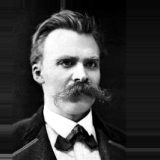
Nietzsche
Friedrich Nietzsche1844–1900
What Nietzsche argues and who answers him, as Marci Shore presents it in her Yale lectures European Intellectual History since Nietzsche: 20 claims, and 16 places where another thinker builds on him or breaks with him. Each claim is our paraphrase and links to the minute of the lecture it comes from.
God is dead. God remains dead. And we have killed him. How shall we, the murderers of all murderers, comfort ourselves?
Friedrich Nietzsche, The Gay Science. The epigraph Shore gives lecture 6.
The core ideas
The 5 claims the lectures spend most time on.
Announcing "God is dead" is not atheism. It reports an event: humanity has crossed from a world God organized into one without him, and we ourselves did the killing.
Put simply Nietzsche: saying "God is dead" is not saying there is no God. It reports that something has happened: we have moved from a world God gave order to into one without him, and we killed him.
Where to read it Nietzsche, The Gay Science §125.
What dies with God is arguably not any being, physical or metaphysical, nor one religion's creed. The word names a belief that reality has order, purpose and wholeness.
Put simply Nietzsche's "God" arguably is not a being of any kind, nor one religion's beliefs. The word stands for the belief that reality has order and purpose and makes sense as a whole.
Nihilism is simply another name for the death of God: the crisis in which our supreme values become worthless and the principles that once structured reality no longer do.
Put simply Nietzsche: "nihilism" is another name for the death of God. It is the crisis that comes when our highest values lose their worth and the principles that once ordered reality stop doing so.
Hegel's philosophy, by crowning the belated present as the goal of all history, deifies history and sets it, as "the sole sovereign power," in place of art and religion.
Put simply Nietzsche on Hegel: by treating our own late age as the goal all history was heading for, Hegel turns history into a god. It becomes "the sole sovereign power", taking the place of art and religion.
Zarathustra teaches that humanity must be surpassed: a rope stretched above an abyss between beast and Übermensch, it must serve as a bridge. No Übermensch, Zarathustra included, has yet appeared.
Put simply Nietzsche's Zarathustra: humans must be surpassed. Humanity is a rope over an abyss between beast and "Übermensch" (a future "overhuman"), and must serve as a bridge. No Übermensch has yet appeared, Zarathustra included.
Who Nietzsche answers, and who answers him
Each entry joins one of his claims to another thinker’s. The handwriting names the link; the line beside it says which kind. “Our inference” marks a link Shore does not state outright.
Nietzsche and Georg Wilhelm Friedrich Hegel 1770–1831
HegelHistory's end, for Hegel, is a mystical point where all oppositions (freedom and necessity, is and ought, subject and object) dissolve into synthesis; nobody has ever witnessed it. L4 · 41:30
NietzscheSooner or later everyone concludes that the harmonious world where contradictions resolve, Hegel's end of history, is never coming. Unity cannot be found: life is nothing but difference. L6 · 45:04
Declares Hegel's reconciling telos gone: the harmonious whole is not coming and life does not come together.
HegelHistory's end, for Hegel, is a mystical point where all oppositions (freedom and necessity, is and ought, subject and object) dissolve into synthesis; nobody has ever witnessed it. L4 · 41:30
NietzscheHegel's philosophy, by crowning the belated present as the goal of all history, deifies history and sets it, as "the sole sovereign power," in place of art and religion. L6 · 29:53
Treats the world-process philosophy as making history a god, justifying the present as its necessary result and paralyzing culture.
HegelWith Hegel, History acquires a capital H: in the Hegelian sense it is a phenomenon of its own, with a dialectical forward motion. L5 · 12:57
NietzscheHegel's philosophy, by crowning the belated present as the goal of all history, deifies history and sets it, as "the sole sovereign power," in place of art and religion. L6 · 29:53
Hegel turned History into a god that rules over art and religion
HegelDialectics is Hegel's name for what contradictions do when they meet: a position turns out unstable, its negation displaces it, and such clashes drive history forward in jolts. L4 · 32:56
NietzscheThe revered virtues may owe their worth to being "insidiously related, tied to, and involved with" their wicked opposites, perhaps even sharing one essence with them: good and wicked, true and false, come together. L6 · 31:36
Shore finds something very dialectical in Nietzsche despite his anti-Hegelianism: the same coming together of good and wicked that Hegel is always doing.
Nietzsche and Shore
NietzscheAnnouncing "God is dead" is not atheism. It reports an event: humanity has crossed from a world God organized into one without him, and we ourselves did the killing. L6 · 43:30
ShoreFor Shore, Nietzsche's announcement of God's death could never be retracted, like the Bastille's fall for Hegel; everyone since must reckon with it and its potential implication: everything is permitted. L6 · 50:08
Shore adds that the announcement, like Hegel's Bastille, is irreversible: everyone must now live after God's death.
NietzscheSooner or later everyone concludes that the harmonious world where contradictions resolve, Hegel's end of history, is never coming. Unity cannot be found: life is nothing but difference. L6 · 45:04
ShoreOne way to situate Nietzsche, Shore's through line here: he is Hegel's alter ego, an anti-Hegel perceiving every antagonism and contradiction Hegel does, yet flatly refusing reconciliation, directionality or telos. L6 · 5:44
Shore's anti-Hegel frame is what she uses to read the death of God as the loss of Hegel's telos.
NietzscheAnnouncing "God is dead" is not atheism. It reports an event: humanity has crossed from a world God organized into one without him, and we ourselves did the killing. L6 · 43:30
ShoreGirard, on Shore's reading, turns the death of God around: what matters is not God's absence but the killing, that we killed him, and the recognition that we did. L20 · 50:48
The decisive fact becomes that humans killed God, and must own the killing
Nietzsche and Jacques Derrida 1930–2004
NietzscheNo replacement God can end the nihilist crisis, and every such attempt fails, because wanting an ordering principle is where the crisis began: the disorder has no real cure. L6 · 46:11
DerridaNot only is God dead; so is every would-be successor. History, Man, the Self, any transcendental signified: none exists to ground meaning or hold a system together. L22 · 28:52
No new God or substitute order can cure the lossOur inference
NietzscheSuffering is not wholly negative and should be embraced, not merely endured, because whoever says yes to one joy says yes to every woe: "all things are entangled, ensnared, enamored." L6 · 32:55
DerridaThere are two ways to think the absent center: mourn it, in the sad, guilty, nostalgic Rousseauist manner, or affirm with Nietzsche the joyous play of a world without origin. L22 · 50:15
In the passage Shore quotes, Derrida himself names the joyous alternative to mourning the lost center "Nietzschean affirmation".
Nietzsche and Martin Heidegger 1889–1976
NietzscheAnnouncing "God is dead" is not atheism. It reports an event: humanity has crossed from a world God organized into one without him, and we ourselves did the killing. L6 · 43:30
HeideggerThe Rectoral Address asks: if Nietzsche was right that "God is dead," and we take seriously "the abandonment of man today in the midst of being," what follows for science? L24 · 22:11
Treats the death of God as the real condition of man's abandonment amid Being
NietzscheNihilism is simply another name for the death of God: the crisis in which our supreme values become worthless and the principles that once structured reality no longer do. L6 · 45:46
HeideggerIn the 1966 Spiegel interview, released only after his death, Heidegger conceded that Nazism had perhaps been wrong, yet insisted the West's real crisis was still godlessness after Nietzsche. L24 · 47:51
The West's crisis remains that of a world without God after Nietzsche
Nietzsche and Immanuel Kant 1724–1804
KantKant's test when unsure whether an act is moral: imagine everyone acting on your principle. Should disaster follow, the act fails. L3 · 32:07
NietzscheWhat eternal recurrence means is disputed. On one Kantian reading, you should live every moment as though it would return forever, acting only as you would wish to see repeated. L6 · 40:45
Shore reports one interpretation of eternal recurrence as Kantian, going back to the categorical imperative; she does not say Nietzsche took it from Kant.
Nietzsche and Richard Wagner 1813–1883
WagnerOpera should break with its French and Italian models and become distinctively German: grandiose, heavy with pathos and philosophical weight, drawn from medieval legend, and recovering ancient Greek drama. L6 · 15:19
NietzscheThe Birth of Tragedy, dedicated to Wagner, presents his music-dramas as continuing Greek tragedy, a tradition prized because it made people into artists of living. L6 · 18:41
Nietzsche's first book takes up Wagner's music-drama as heir to Greek tragedy
Nietzsche and Tristan Tzara 1896–1963
NietzscheNo replacement God can end the nihilist crisis, and every such attempt fails, because wanting an ordering principle is where the crisis began: the disorder has no real cure. L6 · 46:11
TzaraDada is rebellion without a program, freedom pursued for its own sake and pointed at nothing beyond itself; as Tzara put it, "the most acceptable system is in principle none." L10 · 44:41
After the death of God, no system at all: Dada as pure freedomOur inference
Nietzsche and Jean-Paul Sartre 1905–1980
NietzscheAnnouncing "God is dead" is not atheism. It reports an event: humanity has crossed from a world God organized into one without him, and we ourselves did the killing. L6 · 43:30
SartreWithout God, there is no "intelligible heaven" in which values might be found; human beings must create them themselves. L13 · 28:22
Takes the death of God with full seriousness: with no heaven of values, humans must make them
Nietzsche and Michel Foucault 1926–1984
NietzscheAnnouncing "God is dead" is not atheism. It reports an event: humanity has crossed from a world God organized into one without him, and we ourselves did the killing. L6 · 43:30
FoucaultAfter God's death comes the subject's, and Foucault admits how much that hurts; he sympathizes with people who find it unbearable. L21 · 49:05
After the death of God comes the death of the subject
All 20 claims, lecture by lecture
In the order they come up. The time opens that minute of the lecture on YouTube.
Lecture 6Nietzsche and the Death of God
Announcing "God is dead" is not atheism. It reports an event: humanity has crossed from a world God organized into one without him, and we ourselves did the killing.
Put simply Nietzsche: saying "God is dead" is not saying there is no God. It reports that something has happened: we have moved from a world God gave order to into one without him, and we killed him.
Where to read it Nietzsche, The Gay Science §125.
What dies with God is arguably not any being, physical or metaphysical, nor one religion's creed. The word names a belief that reality has order, purpose and wholeness.
Put simply Nietzsche's "God" arguably is not a being of any kind, nor one religion's beliefs. The word stands for the belief that reality has order and purpose and makes sense as a whole.
Sooner or later everyone concludes that the harmonious world where contradictions resolve, Hegel's end of history, is never coming. Unity cannot be found: life is nothing but difference.
Put simply Nietzsche: sooner or later we all realize that a harmonious world where every conflict is resolved, the end of history Hegel promised, is never coming. There is no unity to be found; life is all difference.
Nihilism is simply another name for the death of God: the crisis in which our supreme values become worthless and the principles that once structured reality no longer do.
Put simply Nietzsche: "nihilism" is another name for the death of God. It is the crisis that comes when our highest values lose their worth and the principles that once ordered reality stop doing so.
No replacement God can end the nihilist crisis, and every such attempt fails, because wanting an ordering principle is where the crisis began: the disorder has no real cure.
Put simply Nietzsche: the crisis cannot be solved by putting a new God in the old one's place. Every such attempt fails, because wanting something to order everything is where the crisis began. There is no real cure.
Other readings Bernard Reginster (The Affirmation of Life, 2006) reads Nietzsche's philosophy as aimed at overcoming nihilism, through a revaluation of values that affirms life, suffering included.
An excess of history sickens us: awareness of the past, and of its great figures, makes us feel small. Only the strong, with abundant "plastic power," can bear much history.
Put simply Nietzsche: too much history makes us sick. Knowing the past and its great figures makes us feel small. Only the strong can bear a lot of history; he calls the strength they need "plastic power".
Hegel's philosophy, by crowning the belated present as the goal of all history, deifies history and sets it, as "the sole sovereign power," in place of art and religion.
Put simply Nietzsche on Hegel: by treating our own late age as the goal all history was heading for, Hegel turns history into a god. It becomes "the sole sovereign power", taking the place of art and religion.
The revered virtues may owe their worth to being "insidiously related, tied to, and involved with" their wicked opposites, perhaps even sharing one essence with them: good and wicked, true and false, come together.
Put simply Nietzsche: perhaps the virtues we revere get their worth from being secretly tied to their wicked opposites, maybe even being the same thing at bottom. Good and wicked, true and false, belong together.
Suffering is not wholly negative and should be embraced, not merely endured, because whoever says yes to one joy says yes to every woe: "all things are entangled, ensnared, enamored."
Put simply Nietzsche: suffering is not all bad. We should embrace it, not just put up with it, because saying yes to one joy means saying yes to every sorrow too: "all things are entangled, ensnared, enamored."
Existence, honestly confronted, is dreadful; the question is whether it can be made bearable at all. The answer: "only as an aesthetic phenomenon," through grandiose art, is the world justifiable.
Put simply Nietzsche: looked at honestly, existence is dreadful, and the question is whether it can be made bearable at all. His answer: only as art, through great creation, can the world be justified.
The Birth of Tragedy, dedicated to Wagner, presents his music-dramas as continuing Greek tragedy, a tradition prized because it made people into artists of living.
Put simply Nietzsche's The Birth of Tragedy, dedicated to Wagner, presents Wagner's operas as heirs to ancient Greek tragedy. He prizes that tradition because it made people into artists of their own lives.
Nietzsche's charge: Christianity is a slave morality. The weak, resenting their masters, brand the strong as bad, declare their own weakness virtue, and accept oppression for a promised reward hereafter.
In the text In the Genealogy of Morals (1887), First Essay §§10–11, the man of ressentiment conceives "the evil enemy", while "bad" is the word of aristocratic origin.
Nietzsche holds that the egalitarianism of Christianity, a religion he calls nihilistic, also infects democracy, which he regards as rule by the mediocre, working against the vitality and heroism life requires.
Nobody yet knows what good and evil are, "unless it be he who creates": the categories we live by must be questioned, not trusted.
Put simply Nietzsche: no one yet knows what good and evil are, "unless it be he who creates." So we must question the moral categories we live by, not trust them.
Zarathustra teaches that humanity must be surpassed: a rope stretched above an abyss between beast and Übermensch, it must serve as a bridge. No Übermensch, Zarathustra included, has yet appeared.
Put simply Nietzsche's Zarathustra: humans must be surpassed. Humanity is a rope over an abyss between beast and "Übermensch" (a future "overhuman"), and must serve as a bridge. No Übermensch has yet appeared, Zarathustra included.
What eternal recurrence means is disputed. On one Kantian reading, you should live every moment as though it would return forever, acting only as you would wish to see repeated.
Put simply Nobody agrees what Nietzsche's "eternal recurrence" means. One reading, echoing Kant: live every moment as if it would come back forever, doing only what you would wish to see repeated.
Where to read it Nietzsche, The Gay Science §341.
In some sense Nietzsche does not care whether a God actually exists; what counts is whether we believe in one and arrange our lives around that belief.
Nietzsche blames Hegelian philosophy's huge, persisting influence for making every crisis of German culture in his century more dangerous; believing oneself a latecomer is "paralyzing and depressing."
Put simply Nietzsche: Hegel's huge, lasting influence made every crisis in German culture in his century more dangerous. Believing you have arrived late, at the tail end of history, is "paralyzing and depressing."
Anti-Hegelian as he is, Nietzsche's thinking has something dialectical about it: one Genealogy of Morals aphorism has great things "bring about their own destruction through an act of self-overcoming."
Put simply Nietzsche attacks Hegel, yet his own thinking has a Hegelian streak of things turning against themselves. In one aphorism, great things "bring about their own destruction through an act of self-overcoming."
Where to read it Nietzsche, On the Genealogy of Morals, Third Essay §27.
Nietzsche is a fierce critic of the Western tradition and accepts none of its core beliefs: truth, morality, God, democracy, or the idea that virtue makes a person happy.
The questions Nietzsche is part of
A throughline follows one question across the whole course. These are the ones his claims sit on.
Works and dates
As they come up in the lectures.
Nietzsche born in the Prussian province of Saxony; his Lutheran-minister father dies while he is very young and he is raised by five women.
Nietzsche starts at the University of Bonn, first drawn to theology, then philology and literature. Nietzsche is 20.
Nietzsche, 24 and without a completed doctorate, is offered a chair in classical philology at Basel. Nietzsche is 24.
Nietzsche forms an intense friendship with Wagner (and Wagner's wife Cosima).
Franco-Prussian War; Bismarck provokes it to unify German states; Nietzsche volunteers as a medical orderly and returns in ruined health.
The Birth of Tragedy Die Geburt der Tragödie
The Birth of Tragedy is published, dedicated to Wagner.
The Uses and Disadvantages of History for Life Vom Nutzen und Nachtheil der Historie für das Leben
Nietzsche publishes the essay on the uses and disadvantages of history, attacking Hegel.
Nietzsche retires from Basel, nominally for health reasons, and lives on in isolation, largely in sanatoria and cold rooms.
The Gay Science Die fröhliche Wissenschaft
The Gay Science is published, containing the madman's announcement of God's death.
Nietzsche proposes to Lou Salomé via his friend Paul Rée and is rejected; the famous whip photograph follows.
Thus Spoke Zarathustra Also sprach Zarathustra
Beyond Good and Evil Jenseits von Gut und Böse
On the Genealogy of Morals Zur Genealogie der Moral
The Anti-Christ Der Antichrist
Nietzsche collapses in Turin and is institutionalized; he never regains sanity.
Nietzsche dies.
Terms
The ideas his claims turn on, as the lectures gloss them.
The death of God. Nietzsche's declaration that God is dead. In Shore's framing it is the course's central hinge, prepared by the Enlightenment's sidelining of God.
The whole / totality. Nothing has meaning taken in isolation; only the interconnected whole, graspable only from its end, yields truth.
Telos. The end or goal a thing is already developing toward, e.g. the seed is "aiming" at the apple it will become.
Nihilism. The crisis in which the highest values lose their value and the principles that organized reality stop organizing it. Shore treats it as another name for God's death.
Replacing God. In Shore's framing, modernity's central task: God once performed epistemological, ontological, and ethical functions at once, and his disappearance leaves an empty space modern thought tries to fill.
Too much history. Excessive awareness of the past overwhelms and paralyzes; only those with great "plastic power" can bear a lot of history. Hegel's world-process is the target.
Aesthetic justification of existence. Nietzsche's claim that only as an aesthetic phenomenon, through great creation, can a dreadful world be justified.
Slave morality. Nietzsche's name for a morality in which the weak brand their masters evil, call themselves good, and turn weakness and suffering into virtue, promising reward in the world to come.
Revaluation of all values. Nietzsche's project of testing the worth of inherited, chiefly Christian, morality and creating new values. In the lecture, it pushes us "beyond good and evil."
Übermensch. Zarathustra's prophesied future human who overcomes present humanity and its mediocrity; humanity is only a bridge to it. Nobody in the book actually is one.
Eternal recurrence / eternal return. Nietzsche's contested idea of eternity; Shore lists a Kantian reading, an every-moment-belongs-to-the-whole reading and a Bergsonian time-as-flow reading.