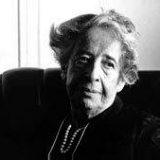
Arendt
Hannah Arendt1906–1975
What Arendt argues and who answers her, as Marci Shore presents it in her Yale lectures European Intellectual History since Nietzsche: 33 claims, and 13 places where another thinker builds on her or breaks with her. Each claim is our paraphrase and links to the minute of the lecture it comes from.
totalitarianism has discovered a means of dominating and terrorizing human beings from within.
Hannah Arendt, Origins of Totalitarianism. The epigraph Shore gives lecture 15.
The core ideas
The 6 claims the lectures spend most time on.
For Arendt the decisive break came in 1943, with the news of Auschwitz, not in 1933: having enemies is natural, but this was something politics could never make amends for.
Arendt's Origins of Totalitarianism starts from an intuition: Nazism and Stalinism, locked in a war to the death, were opposites yet in important respects deeply alike, and historically unprecedented.
For Arendt, interwar statelessness showed the rights of man to be a fiction: a right no government enforces does not exist in practice, so in effect only citizens have rights.
Arendt ties the emergence of radical evil to a system under which "all men have become equally superfluous."
Put simply Arendt links the rise of "radical evil", a new evil beyond ordinary motives, to a system in which "all men have become equally superfluous": everyone has become expendable.
Where to read it Arendt, The Origins of Totalitarianism, end of ch. 12.
Eichmann's crime, in Arendt's eyes, was failing to think. Far from excusing him, that makes him not a lesser criminal but the worst, because thinking is never optional.
In the text In the Postscript to Eichmann in Jerusalem (1965 edition), Arendt writes that "sheer thoughtlessness" predisposed Eichmann "to become one of the greatest criminals of that period."
Forgiveness, for Arendt in The Human Condition, is the sole remedy for irreversibility: a deed cannot be undone, even when its doer had no way of knowing what it was.
Put simply Arendt: what is done cannot be undone, even when the person who did it could not have known what they were doing. Forgiveness is the only remedy for that.
Where to read it Arendt, The Human Condition §33.
Who Arendt answers, and who answers her
Each entry joins one of her claims to another thinker’s. The handwriting names the link; the line beside it says which kind. “Our inference” marks a link Shore does not state outright.
Arendt and Shore
ArendtArendt ends Origins on absolute evil: once the impossible became possible, a crime appeared that no ordinary wicked motive, greed, resentment, cowardice, could explain, beyond both punishment and forgiveness. L15 · 43:49
ShoreShore judges that Arendt, between Origins and the Eichmann book, apparently reversed herself on Nazi evil: once radical, it is now banal. L15 · 44:19
Shore reads the Eichmann account as a possible revision of the earlier radical-evil framing.
ArendtForgiveness, for Arendt in The Human Condition, is the sole remedy for irreversibility: a deed cannot be undone, even when its doer had no way of knowing what it was. L24 · 46:17
ShoreArendt forgave Heidegger, in Shore's reading, although he never asked; as to how, Shore points to her 1958 writing on forgiveness, in a book silently dedicated to him. L24 · 45:49
Shore reads Arendt's account of forgiveness as the means by which she forgave Heidegger.
ShoreFor Shore, Nietzsche's announcement of God's death could never be retracted, like the Bastille's fall for Hegel; everyone since must reckon with it and its potential implication: everything is permitted. L6 · 50:08
ArendtTotalitarian cynicism takes Ivan Karamazov literally: if God is dead, "everything is permitted." That rests on a deeper conviction that "everything is possible," and the camps are laboratories verifying it. L15 · 43:03
After God's death, totalitarianism takes "everything is permitted" literally, as "everything is possible"Our inference
Arendt and Henri Bergson 1859–1941
BergsonFree will is inseparable from qualitative time: because we live time as an undivided flow, we can act spontaneously, in ways no one could have fixed beforehand. L7 · 23:13
ArendtNatality: every new being who enters the world injects radical contingency into it, able to head in many directions along courses no one can foresee. L7 · 49:55
Shore links Bergson's radical contingency of living beings to Arendt's natality.
BergsonFor Bergson life is choice, continual choice: a newborn child is already a whole, indivisible self, yet which of countless directions that self will take cannot be predicted, and should not be. L7 · 32:23
ArendtNatality: every new being who enters the world injects radical contingency into it, able to head in many directions along courses no one can foresee. L7 · 49:55
Shore sets Bergson's radical contingency entering the world with each living being beside what Arendt called natality.
Arendt and Georg Wilhelm Friedrich Hegel 1770–1831
HegelHegel's slogan "the true is the whole" means everything is interdependent and intelligible only together; since a totality shows itself only from its end, meaning arrives in retrospect. L4 · 46:56
ArendtFor Arendt, Hegel's philosophy was Western thought's last attempt to reunite being and thought, subject and object; whether it housed reality or imprisoned it, nobody could say. L4 · 47:34
Arendt questions whether achieving Hegel's totality is a home for reality or a prison, casting doubt on the value of the whole.
Arendt and Sigmund Freud 1856–1939
FreudNearly every child goes through an Oedipal phase: love shifts from breast to mother, the father becomes a rival, and a flickering wish for his death is quickly buried. L9 · 28:42
ArendtShore recalls Arendt remarking that had Freud not spent his days among German-speaking Habsburg Jews in Vienna reading Goethe and Shakespeare, the Oedipus complex might never have reached the rest of us. L9 · 35:54
Argues the supposed universality of the Oedipus complex is a product of Freud's particular cultural milieu.
Arendt and Theodor Adorno 1903–1969
AdornoOnce nature is an object, people become objects too: mastery over nature slides into mastery over other humans, then over oneself, producing the herd a fascist leader commands. L14 · 47:44
ArendtBy the masses Arendt means the hitherto unengaged majority: people too numerous, too indifferent, or both, for any party, union or other interest-based body ever to have organized them. L15 · 27:59
Splits the Frankfurt "herd" into mob and masses
Arendt and Martin Heidegger 1889–1976
HeideggerDeath singles each of us out, because everyone dies alone. It is the one moment that is truly mine (Jemeinigkeit), belonging to no one else. L12 · 44:30
ArendtBy making death anonymous, the camps emptied it of meaning as the end of a fulfilled life; the victim's death only sealed the fact that he "had never really existed." L15 · 42:18
Anonymous mass death strips away the "mineness" of death that Heidegger made the core of authenticity
Arendt and Immanuel Kant 1724–1804
KantThe Copernican turn in Kant's epistemology reverses the direction of fit: not the mind conforming to things as they are, but knowable things conforming to the mind's capacities. L2 · 38:03
ArendtIn her postwar lecture on existential philosophy, Arendt blames Kant: by severing being from thought and putting the thing-in-itself beyond reach, he opened the subject-world gap that alienates us. L19 · 7:57
Declaring the thing-in-itself unreachable cut thought off from being and alienated us from the world
Arendt and Michel Foucault 1926–1984
ArendtTotalitarianism, Arendt writes, found a way of "dominating and terrorizing human beings from within"; once everyone polices everyone else, no distance separates rulers from ruled. L15 · 41:18
FoucaultPower has no single source. It is omnipresent "not because it embraces everything, but because it comes from everywhere": radically dispersed, built into every relationship. L21 · 38:23
Shore hears echoes of Arendt in Foucault's denial of a binary between rulers and ruled, and says he is drawing on Arendt in rethinking power.
Arendt and Václav Havel 1936–2011
ArendtTotalitarian rule shapes its subjects to serve equally well as executioners or victims, so the line dividing persecutor from persecuted never holds still: under Stalin, any denouncer could be denounced. L15 · 41:03
HavelThe line dividing victims from oppressors runs through every individual: each person, in a fashion of their own, is at once the system's victim and its supporter. L23 · 42:15
Havel moves Arendt's blurred victim-executioner line inside each person, turning it into shared responsibility.Our inference
Arendt and Jacques Derrida 1930–2004
ArendtArendt ends Origins on absolute evil: once the impossible became possible, a crime appeared that no ordinary wicked motive, greed, resentment, cowardice, could explain, beyond both punishment and forgiveness. L15 · 43:49
DerridaIn a 1997 essay, Derrida holds that forgiving, to have any meaning at all, must mean forgiving exactly what is unforgivable. L24 · 47:04
Where Arendt finds evil beyond forgiveness, Derrida makes the unforgivable forgiveness's only true object.Our inference
All 33 claims, lecture by lecture
In the order they come up. The time opens that minute of the lecture on YouTube.
Lecture 4Hegel and the Historicist Chronotope
For Arendt, Hegel's philosophy was Western thought's last attempt to reunite being and thought, subject and object; whether it housed reality or imprisoned it, nobody could say.
Put simply Arendt: Hegel's philosophy was the West's last attempt to bring thought and reality, the mind and the world, back together. Nobody could say whether his system gave reality a home or locked it up.
Lecture 7Henri Bergson and the Revolt against Positivism
Natality: every new being who enters the world injects radical contingency into it, able to head in many directions along courses no one can foresee.
Put simply Arendt's "natality": every newborn brings real openness into the world. A new person can head in many directions, along paths no one can foresee.
Lecture 9Freudian Psychoanalysis
Shore recalls Arendt remarking that had Freud not spent his days among German-speaking Habsburg Jews in Vienna reading Goethe and Shakespeare, the Oedipus complex might never have reached the rest of us.
Lecture 15Hannah Arendt, Totalitarianism and the Nature of Evil
For Arendt the decisive break came in 1943, with the news of Auschwitz, not in 1933: having enemies is natural, but this was something politics could never make amends for.
Arendt's Origins of Totalitarianism starts from an intuition: Nazism and Stalinism, locked in a war to the death, were opposites yet in important respects deeply alike, and historically unprecedented.
What the Dreyfus affair means for Arendt is neither the framed officer nor the birth of Zionism, but crowds in Paris streets demanding Jewish deaths: mob and masses entering history.
Put simply Arendt: what matters about the Dreyfus affair is not the officer who was framed, nor the start of Zionism, but crowds in Paris shouting for Jewish deaths. That is when the "mob" and the "masses" enter history.
Arendt's mob is the bourgeoisie's shadow: gangsters who resent a society that shuts them out, want to force their way back into it, and share its values minus the hypocrisy.
Put simply Arendt's "mob" is the dark twin of the middle class: gangsters who resent the respectable society that shuts them out, want to force their way back in, and share its values without the hypocrisy.
Arendt describes Nazism as the bourgeoisie allied with the mob, an alliance that managed to draw in the masses, recruiting from the politically indifferent rather than from any elite.
Put simply Arendt: Nazism was an alliance of the middle class and the mob that managed to pull in the masses. It recruited from people who had never cared about politics, not from any elite.
In the text In The Origins of Totalitarianism, Part Three, ch. 10, section II, Arendt writes of "the temporary alliance between the mob and the elite."
By the masses Arendt means the hitherto unengaged majority: people too numerous, too indifferent, or both, for any party, union or other interest-based body ever to have organized them.
Under capitalism, Arendt argues, accumulation throws off surplus money and surplus people, and that surplus must go somewhere: the result is a permanent drive toward imperial expansion.
Put simply Arendt: under capitalism, piling up wealth leaves extra money and extra people with nowhere to go. That surplus has to go somewhere, so there is a constant push to expand into empires abroad.
Where Lenin saw in imperialism capitalism's final phase, Arendt sees the bourgeoisie's political rule just beginning.
Put simply Arendt, against Lenin: he saw empire-building as capitalism's last stage. She sees it as the moment the middle class only begins to rule politically.
Where to read it Arendt, The Origins of Totalitarianism, ch. 5, opening.
Human beings become superfluous, Arendt says, along two paths: losing the protection of a state, and being atomized into conformity.
Put simply Arendt: people are made "superfluous", that is, expendable, in two ways: by losing the protection of any state, and by being cut off from one another and pressed into conformity.
For Arendt, interwar statelessness showed the rights of man to be a fiction: a right no government enforces does not exist in practice, so in effect only citizens have rights.
In Arendt's analysis, victims are not the only ones made superfluous: the perpetrators, recruited from an atomized, lonely mass, trade isolation for collective organization and lose their selves.
Put simply Arendt: the victims are not the only ones made "superfluous", unneeded. The perpetrators come from lonely, isolated people who trade their isolation for belonging to a movement, and lose their selves in it.
Arendt ties the emergence of radical evil to a system under which "all men have become equally superfluous."
Put simply Arendt links the rise of "radical evil", a new evil beyond ordinary motives, to a system in which "all men have become equally superfluous": everyone has become expendable.
Where to read it Arendt, The Origins of Totalitarianism, end of ch. 12.
For Arendt, ideology persuades by smoothing reality out: it swaps the actual world, arbitrary and contingent, for a fictitious one where a single narrative, however false, explains everything consistently.
Put simply Arendt: ideology persuades by tidying up reality. It swaps the real world, full of chance and accident, for an invented one where a single story, even a false one, neatly explains everything.
Under totalitarianism the line between public and private disappears. Nowhere is left to keep out of politics or simply be let alone; under Stalinism even pillow talk concerned the regime.
Put simply Arendt: under totalitarian rule there is no private life left, nowhere to stay out of politics or be left alone. Under Stalin the regime cared even about what lovers said in bed.
Totalitarianism, Arendt writes, found a way of "dominating and terrorizing human beings from within"; once everyone polices everyone else, no distance separates rulers from ruled.
Put simply Arendt: totalitarianism found a way to "dominate and terrorize human beings from within". When everyone watches and reports on everyone else, no gap is left between rulers and ruled.
Totalitarian rule shapes its subjects to serve equally well as executioners or victims, so the line dividing persecutor from persecuted never holds still: under Stalin, any denouncer could be denounced.
Put simply Arendt: totalitarian rule makes people equally fit to be executioners or victims, so the roles never stay fixed. Under Stalin, anyone who denounced a neighbor could be denounced in turn.
By making death anonymous, the camps emptied it of meaning as the end of a fulfilled life; the victim's death only sealed the fact that he "had never really existed."
Put simply Arendt: in the camps, death was made anonymous, so it could no longer mark the end of a full life. The victim's death only confirmed that he "had never really existed."
Totalitarian cynicism takes Ivan Karamazov literally: if God is dead, "everything is permitted." That rests on a deeper conviction that "everything is possible," and the camps are laboratories verifying it.
Put simply Arendt: totalitarian cynics take Dostoevsky's Ivan Karamazov literally: if God is dead, "everything is permitted." Behind it lies a deeper belief that "everything is possible," and the camps were laboratories for proving it.
Arendt ends Origins on absolute evil: once the impossible became possible, a crime appeared that no ordinary wicked motive, greed, resentment, cowardice, could explain, beyond both punishment and forgiveness.
Put simply Arendt ends her book on totalitarianism with "absolute evil": once the impossible became possible, a crime appeared that no ordinary bad motive, like greed or cowardice, could explain. It could be neither punished nor forgiven.
Arendt, hearing Eichmann testify in German, was chilled by the gap between monstrous deed and mediocre man: an opportunistic bureaucrat who seemed less monster than clown.
Put simply Arendt: listening in German to Adolf Eichmann, who organized the murder of Europe's Jews, she was chilled by the gap between the monstrous deed and the mediocre man: an opportunistic bureaucrat, more clown than monster.
Other readings Bettina Stangneth (Eichmann Before Jerusalem, 2014) reads Eichmann as a committed antisemitic ideologue who played the part of a minor functionary in court.
Eichmann spoke entirely in clichés, and for Arendt that was telling: his failure of speech was bound up with a failure to think, for himself or from anyone else's standpoint.
Eichmann's crime, in Arendt's eyes, was failing to think. Far from excusing him, that makes him not a lesser criminal but the worst, because thinking is never optional.
In the text In the Postscript to Eichmann in Jerusalem (1965 edition), Arendt writes that "sheer thoughtlessness" predisposed Eichmann "to become one of the greatest criminals of that period."
When Scholem charged her with not loving the Jewish people, Arendt answered that no collective, no people at all, had ever had her love: "I indeed love only my friends."
Arendt refuses to explain the Holocaust by national character: nothing about Germans as such made them murderers, and nothing about Jews as such made them victims.
Arendt holds that the capacity totalitarianism exploited in alienated modern masses belongs to everyone, always; nothing essential to any race or nation decides who has it.
Put simply Arendt: the potential that totalitarianism exploited in uprooted, alienated modern masses is in all of us, always. Nothing about any race or nation decides who has it.
Lecture 19Structuralism and Anthropology
In her postwar lecture on existential philosophy, Arendt blames Kant: by severing being from thought and putting the thing-in-itself beyond reach, he opened the subject-world gap that alienates us.
Put simply Arendt blames Kant for our alienation. He split thinking from being and said we can never reach things as they really are, which opened a gap between us and the world.
Lecture 24The Heidegger Controversy
Forgiveness, for Arendt in The Human Condition, is the sole remedy for irreversibility: a deed cannot be undone, even when its doer had no way of knowing what it was.
Put simply Arendt: what is done cannot be undone, even when the person who did it could not have known what they were doing. Forgiveness is the only remedy for that.
Where to read it Arendt, The Human Condition §33.
Lecture 25From Modernity to Post-Modernity
Arendt contrasts the pre-modern lie, a rip in reality that an attentive eye could locate where it was stitched, with totalitarian ideology, which remakes reality wholesale and leaves no seam.
Put simply Arendt: an old-fashioned lie was like a tear in reality, sewn back up, and a careful observer could find the seam. Totalitarian ideology rebuilds reality completely, so there is no seam to find.
Forgiveness alone among reactions is unpredictable: though a response, it keeps something of genuine action, starting afresh instead of being dictated by the deed that provoked it.
Put simply Arendt: forgiveness is the one response no one can predict. Though it answers a wrong, it acts afresh, like a new beginning, rather than being dictated by the deed that provoked it.
Love, for Arendt, is unworldly in its very nature, and for that reason (not because it is rare) is not merely apolitical but anti-political, maybe the strongest such force.
Put simply Arendt: love by its nature turns away from the shared world. For that reason, not because it is rare, love is not just outside politics but against it, perhaps the strongest such force.
Where to read it Arendt, The Human Condition §33.
The questions Arendt is part of
A throughline follows one question across the whole course. These are the ones her claims sit on.
Works and dates
As they come up in the lectures.
Arendt goes to Marburg to study with Heidegger. Arendt is 18.
Arendt leaves Marburg for Heidelberg and grows close to Jaspers.
Heidegger visits Heidelberg and breaks off the affair with Arendt. Arendt is 22.
Arendt is arrested, released, and leaves Germany illegally for Paris via Prague and Geneva.
Arendt emigrates to New York.
We Refugees
News of Auschwitz reaches Arendt in exile in the United States.
What Is Existential Philosophy?
Arendt visits Heidegger and Elfride after the teaching ban ends; letters and a poem follow.
The Origins of Totalitarianism
Arendt's Origins of Totalitarianism published, written in emigration 1945-1950.
The Human Condition The Human Condition
Arendt publishes The Human Condition, silently dedicated to Heidegger.
Adolf Eichmann is tried in Jerusalem; Arendt covers it for The New Yorker.
Eichmann in Jerusalem: A Report on the Banality of Evil
Scholem accuses Arendt of lacking love for the Jewish people after Eichmann in Jerusalem; she replies that she loves only persons.
Arendt gives her televised interview to Günter Gaus in Germany.
Arendt praises Heidegger's lecturing on his 80th birthday.
Terms
The ideas her claims turn on, as the lectures gloss them.
Natality. Arendt's term for the arrival of a new being who injects radical contingency into the world, its course unforeseeable.
Contingency. The openness of the future: accident and choice mean that multiple outcomes are always possible; the opposite of determinism.
Oedipus complex. For Freud, a near-universal childhood stage: the child desires the mother, resents the father, and secretly wishes him gone; the wish is quickly repressed.
Totalitarianism. As Shore defines it: a regime with draconian ideology and absolute truth-claims, a messianic movement, institutions of terror, monopolies on communication and force, a panopticon state, and erased public/private line.
The mob. Arendt's technical term for bourgeois society's resentful, excluded underside: gang-like, hating the order that shut it out, sharing its values minus hypocrisy.
The masses. Arendt's term for the previously disengaged, unorganized majority, too numerous or indifferent for any interest-based body, later drawn into politics by the mob.
Imperialism. Overseas expansion driven by surplus capital and labor; for Arendt the opening stage of bourgeois rule, giving the mob an outlet and reviving nationalism.
Capital. Money invested specifically to generate more money, as distinct from ordinary money used to buy goods for consumption.
Superfluousness. The condition in which human beings are made expendable, through statelessness or atomized conformity; Arendt ties it to the emergence of radical evil.
Rightlessness. Having no legal standing because no state protects you; Arendt argues human rights are unenforceable outside citizenship.
Natural rights. Rights (life, liberty, property, equality) held to belong to individuals inherently, prior to and independent of government.
Radical evil. A term Arendt borrowed from Kant, who meant something different, for totalitarian evil: beyond ordinary motives like greed, neither punishable nor forgivable, arising when a system makes people superfluous. She later called evil banal.
The fictitious world of ideology. An ideologically constructed reality that removes contingency and is consistent within itself, so that truth and fiction can no longer be told apart.
Public vs private sphere. The division between political life and a protected space where one can be left alone; Arendt sees totalitarianism as abolishing the latter.
Mineness. Each Dasein's existence is irreducibly its own; death, which each of us undergoes alone, is the plainest case.
Belief that everything is possible. The totalitarian conviction that there are no limits to what can be done to people, underlying the claim that everything is permitted.
The banality of evil. Arendt's description, from the Eichmann trial, of monstrous deeds committed by an ordinary, clichéd, thoughtless functionary rather than a monstrous character.
Ding an sich. The mind-independent world as it is in itself, which for Kant really exists but which we can never directly access.
Alienation. In Shore's framing, the central problem of modernity: the felt homelessness of being in the world once God's unifying framework is gone and nothing stable has replaced it.
The problem of the bridge. The epistemological puzzle of how a subject enclosed in its own head can reach an independently existing object or outside world.
Forgiveness. Pardoning a wrong: for Arendt the remedy for irreversibility, for Derrida something meaningful only as forgiving the unforgivable.
The whole / totality. Nothing has meaning taken in isolation; only the interconnected whole, graspable only from its end, yields truth.