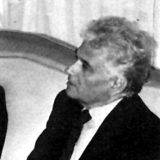
Derrida
Jacques Derrida1930–2004
What Derrida argues and who answers him, as Marci Shore presents it in her Yale lectures European Intellectual History since Nietzsche: 25 claims, and 19 places where another thinker builds on him or breaks with him. Each claim is our paraphrase and links to the minute of the lecture it comes from.
I often describe deconstruction as something which happens. It's not purely linguistic, involving text or books. You can deconstruct gestures, choreography. That's why I enlarged the concept of text.
Jacques Derrida. The epigraph Shore gives lecture 22.
The core ideas
The 7 claims the lectures spend most time on.
From the ancient Greeks through Saussure, Western metaphysics has favored speech over writing: a speaking self seems immediately there, offering a window onto inner consciousness that writing lacks.
Put simply Derrida: since the ancient Greeks, Western thinkers have ranked speech above writing. A speaker seems to be right there, giving a direct view into their mind, while writing seems one step removed.
A sign can only be a stable unity if something anchors it: an arche or transcendental signified that fixes the signifier-signified gap as absolute and irreducible.
Put simply Derrida: a word could keep one fixed meaning only if something outside language anchored it, a first origin or ultimate meaning (a "transcendental signified") that ties word and meaning together for good.
Not only is God dead; so is every would-be successor. History, Man, the Self, any transcendental signified: none exists to ground meaning or hold a system together.
Put simply Derrida: God is dead, and so is everything people tried to put in God's place, such as History, Man or the Self. Nothing exists that could ground meaning or hold a system of thought together.
Différance packs both meanings of the French différer, differing and deferring, together: meaning is other than its neighbors and still to come, so synchronic and diachronic are handled together.
Put simply Derrida's word "différance" joins "differ" and "defer." Meaning comes from differing from other words, and it is never finished, always still to come. So he studies language at one moment and over time together.
Deconstruction is politics in the good sense, an antidote to the absolutist truth claims behind Nazism and Stalinism: "the at least necessary condition for identifying and combating the totalitarian risk."
Put simply Derrida: deconstruction is political in a good way. By taking apart claims to absolute truth, like those behind Nazism and Stalinism, it is at least a precondition for spotting and fighting totalitarianism.
Derrida, in Gumbrecht's retelling, treated Heidegger's Nazism as settled; the real question was whether the ineffable something that drew him toward Nazism also made him the century's greatest philosopher.
Put simply Derrida, as Gumbrecht tells it: that Heidegger was a Nazi is settled. The real question is whether the hard-to-name quality that drew him to Nazism also made him the century's greatest philosopher.
Other readings Peter Trawny, editor of Heidegger's Black Notebooks (published from 2014), reads them as showing antisemitism at work in Heidegger's account of the history of being (Heidegger and the Myth of a Jewish World Conspiracy, 2015).
Because language is unstable, meaning flickers; but for Derrida this produces too much meaning rather than too little, an excess rather than a deficit.
Who Derrida answers, and who answers him
Each entry joins one of his claims to another thinker’s. The handwriting names the link; the line beside it says which kind. “Our inference” marks a link Shore does not state outright.
Derrida and Claude Lévi-Strauss 1908–2009
Lévi-StraussAs Derrida reads him, Lévi-Strauss holds that writing reached the societies he studied as a corruption: hierarchy, control and even violence came with it, and an innocence was lost. L22 · 20:25
DerridaSpeech cannot guarantee presence, because the one speaking is not necessarily present even to himself; so presence versus absence, like speech versus writing, is a binary to be dismantled. L22 · 22:10
Derrida takes apart Levi-Strauss's speech/writing binary, denying that speech guarantees presence.
Lévi-StraussClassical structuralism, as it comes through Lévi-Strauss's anthropology, charts many cultural relations as binary oppositions: cooked against raw, low against high, cold against hot. L19 · 43:52
DerridaTo deconstruct is to take apart, not merely to smash. The target is stability itself: any meaning that claims to be settled, decisive and self-anchoring, structuralism's binaries among them. L22 · 19:14
Structuralism's clean binaries do not hold; post-structuralism begins by unsettling them
Lévi-StraussKinship can be read as a language: its relations form a system on Saussure's model, where each term has value only by differing from the others. L19 · 42:15
DerridaDeconstruction is not confined to books: gestures, choreography, even a room of diners count as text, because Derrida has widened the notion of text to take in all of life. L22 · 23:32
All culture as language becomes all of life as text
Derrida and Terry Eagleton 1943–
DerridaStructuralism's central pairs, nature and culture, empirical and rational, sensible and intelligible, are in some measure ideological constructs: never as tidy as they look, and always open to being undone. L22 · 33:03
EagletonEagleton's hostile illustration of deconstruction: man becomes himself only by endlessly shutting woman out as his opposite, so his identity hangs on, and is endangered by, what he excludes. L22 · 33:38
Eagleton offers man/woman as a worked example of a binary that deconstruction takes apart.
DerridaDeconstruction is not confined to books: gestures, choreography, even a room of diners count as text, because Derrida has widened the notion of text to take in all of life. L22 · 23:32
EagletonEagleton's jab: deconstruction's dogma, that we are locked inside our discourse, lets you wreck everyone else's beliefs while holding none; an invulnerable position, and emptiness is its price. L23 · 4:52
If everything is text, deconstruction can demolish every belief while holding noneOur inference
Derrida and Paul de Man 1919–1983
de ManDe Man's antisemitic 1941 article held that Western literature's resisting Jewish influence proved its vitality, and that removing Jews to an isolated colony would cost it only a few mediocre writers. L22 · 45:49
DerridaDerrida grants that de Man's 1941 article is antisemitic, verging on a call for exclusion and even deportation, and that no analysis will heal the wound it gave him. L22 · 46:43
Derrida calls the 1941 article's violence unpardonable and recognizes it as antisemitism.
de ManDe Man's antisemitic 1941 article held that Western literature's resisting Jewish influence proved its vitality, and that removing Jews to an isolated colony would cost it only a few mediocre writers. L22 · 45:49
DerridaYet "on the other hand," Derrida argues, the whole of de Man's antisemitic article is "organized as an indictment of vulgar antisemitism": its meaning undoes itself. L22 · 45:09
Derrida reads de Man's article against its apparent thrust, as an indictment of vulgar antisemitism.
Derrida and Shore
DerridaAn aporia, or double bind, is the point where language turns on itself: caught between two meanings that cannot both hold, one reaches an impasse where no meaning seems possible. L22 · 38:10
ShoreShore's own illustration of aporia is the Stalinist terror: everyone had to watch ceaselessly for enemies lurking anywhere, even as history's iron laws supposedly guaranteed the communist future. L22 · 38:30
Shore offers the Stalinist terror, with its call for vigilance alongside iron laws of history, as her own example of Derrida's aporia.
ShoreThe candidates Shore names for God's vacant place, Man and History (both capitalized), set up a lasting tension between subjectivity, a turn inward, and teleology, time's forward motion. L1 · 42:16
DerridaNot only is God dead; so is every would-be successor. History, Man, the Self, any transcendental signified: none exists to ground meaning or hold a system together. L22 · 28:52
Nothing, whether History, Man or Self, can fill the place God left
Derrida and Ferdinand de Saussure 1857–1913
SaussureNothing natural or God-given ties a signifier to its signified: the word dog refers to dogs only by differing from cat and hog, and by sheer convention. L10 · 20:22
DerridaAny given sign draws its meaning from the signifiers it is not, which are absent; so language turns on absence more than on presence. L22 · 22:36
If meaning comes from differences, it depends more on what is absent than presentOur inference
SaussureStudying how a language changes over time and studying how it works as a system at one moment are separate disciplines; neither is inferior, but a linguist picks one. L19 · 21:45
DerridaDifférance packs both meanings of the French différer, differing and deferring, together: meaning is other than its neighbors and still to come, so synchronic and diachronic are handled together. L22 · 35:55
Différance fuses the synchronic and diachronic axes that Saussure kept strictly apart
Derrida and Friedrich Nietzsche 1844–1900
NietzscheNo replacement God can end the nihilist crisis, and every such attempt fails, because wanting an ordering principle is where the crisis began: the disorder has no real cure. L6 · 46:11
DerridaNot only is God dead; so is every would-be successor. History, Man, the Self, any transcendental signified: none exists to ground meaning or hold a system together. L22 · 28:52
No new God or substitute order can cure the lossOur inference
NietzscheSuffering is not wholly negative and should be embraced, not merely endured, because whoever says yes to one joy says yes to every woe: "all things are entangled, ensnared, enamored." L6 · 32:55
DerridaThere are two ways to think the absent center: mourn it, in the sad, guilty, nostalgic Rousseauist manner, or affirm with Nietzsche the joyous play of a world without origin. L22 · 50:15
In the passage Shore quotes, Derrida himself names the joyous alternative to mourning the lost center "Nietzschean affirmation".
Derrida and Georg Wilhelm Friedrich Hegel 1770–1831
HegelHistory's end, for Hegel, is a mystical point where all oppositions (freedom and necessity, is and ought, subject and object) dissolve into synthesis; nobody has ever witnessed it. L4 · 41:30
DerridaTo Derrida, anything linear, one-directional or Hegelian feels totalitarian, and goes with an illusion: that a transcendental signified, a unifying first principle, exists. L22 · 16:37
Derrida calls Hegel's linear march toward a final synthesis totalitarian.
HegelHistory's end, for Hegel, is a mystical point where all oppositions (freedom and necessity, is and ought, subject and object) dissolve into synthesis; nobody has ever witnessed it. L4 · 41:30
DerridaDerrida labels the undertaking a hauntology: the many spirits of Marx, and with them Hegel's teleological conception of time, will go on haunting us indefinitely. L25 · 36:24
Hegel's teleological time survives as a haunting rather than a destination
Derrida and Sigmund Freud 1856–1939
FreudWe can never fully know ourselves: what is most basic in us sits in the unconscious, so the self stays opaque to itself and permanently at odds with itself. L9 · 48:02
DerridaSpeech cannot guarantee presence, because the one speaking is not necessarily present even to himself; so presence versus absence, like speech versus writing, is a binary to be dismantled. L22 · 22:10
Shore points to Freud in Derrida's claim that the speaking self is not present to itself: the self is hidden from the self.
Derrida and Hans Ulrich ("Sepp") Gumbrecht 1948–
DerridaDerrida, in Gumbrecht's retelling, treated Heidegger's Nazism as settled; the real question was whether the ineffable something that drew him toward Nazism also made him the century's greatest philosopher. L24 · 50:40
GumbrechtFor Gumbrecht, Derrida's question (did what drew Heidegger to Nazism also make his thought great?) justifies the university's existence: somewhere must exist where even that can be asked. L24 · 51:26
Gumbrecht retells Derrida's question about Heidegger and draws his own conclusion from it: the university must exist so that even that question can be posed.
Derrida and Hannah Arendt 1906–1975
ArendtArendt ends Origins on absolute evil: once the impossible became possible, a crime appeared that no ordinary wicked motive, greed, resentment, cowardice, could explain, beyond both punishment and forgiveness. L15 · 43:49
DerridaIn a 1997 essay, Derrida holds that forgiving, to have any meaning at all, must mean forgiving exactly what is unforgivable. L24 · 47:04
Where Arendt finds evil beyond forgiveness, Derrida makes the unforgivable forgiveness's only true object.Our inference
Derrida and Karl Marx 1818–1883
MarxIn Hegelian fashion, the Manifesto makes no distinction between forecast and prescription: the proletariat's triumph is predicted, predestined, and right, all at once. L5 · 36:39
DerridaApproached deconstructively, Marx and Hegel are plural: there is, and has to be, more than a single one of each; Marx especially leaves many unlike spirits whose legacy needs reclaiming. L25 · 36:05
Derrida pluralizes Marx: many heterogeneous spirits to inherit, not one predestined historical outcome.Our inference
All 25 claims, lecture by lecture
In the order they come up. The time opens that minute of the lecture on YouTube.
Lecture 22French Post-Structuralism: Derrida and Deconstruction
From the ancient Greeks through Saussure, Western metaphysics has favored speech over writing: a speaking self seems immediately there, offering a window onto inner consciousness that writing lacks.
Put simply Derrida: since the ancient Greeks, Western thinkers have ranked speech above writing. A speaker seems to be right there, giving a direct view into their mind, while writing seems one step removed.
Speech cannot guarantee presence, because the one speaking is not necessarily present even to himself; so presence versus absence, like speech versus writing, is a binary to be dismantled.
Put simply Derrida: speaking does not prove that someone is truly "present", because the speaker is not fully present even to himself. So presence versus absence, like speech versus writing, is a contrast to be taken apart.
Any given sign draws its meaning from the signifiers it is not, which are absent; so language turns on absence more than on presence.
Put simply Derrida: a word gets its meaning from all the words it is not ("cat" is not "bat" or "hat"), and those are absent. So language depends more on what is missing than on what is there.
Deconstruction is not confined to books: gestures, choreography, even a room of diners count as text, because Derrida has widened the notion of text to take in all of life.
Put simply Derrida: deconstruction is not only for books. Gestures, dance, even a restaurant full of diners can be read as a "text", because he stretches the word "text" to cover all of life.
A sign can only be a stable unity if something anchors it: an arche or transcendental signified that fixes the signifier-signified gap as absolute and irreducible.
Put simply Derrida: a word could keep one fixed meaning only if something outside language anchored it, a first origin or ultimate meaning (a "transcendental signified") that ties word and meaning together for good.
Not only is God dead; so is every would-be successor. History, Man, the Self, any transcendental signified: none exists to ground meaning or hold a system together.
Put simply Derrida: God is dead, and so is everything people tried to put in God's place, such as History, Man or the Self. Nothing exists that could ground meaning or hold a system of thought together.
Play is Derrida's word for signifiers bouncing off one another; with no transcendental signified to cap it, that play has no limit and signification extends infinitely.
Put simply Derrida: words keep bouncing off one another, which he calls "play". With no ultimate meaning to stop it, this play has no limit, so meaning spreads without end.
Structuralism's central pairs, nature and culture, empirical and rational, sensible and intelligible, are in some measure ideological constructs: never as tidy as they look, and always open to being undone.
Put simply Derrida: the paired opposites structuralism relied on, such as nature versus culture, are partly ideological constructions. They are never as tidy as they look and can always be undone.
Différance packs both meanings of the French différer, differing and deferring, together: meaning is other than its neighbors and still to come, so synchronic and diachronic are handled together.
Put simply Derrida's word "différance" joins "differ" and "defer." Meaning comes from differing from other words, and it is never finished, always still to come. So he studies language at one moment and over time together.
The trace is what a signifier carries of meanings it seems not to have: a leftover, neither quite there nor quite gone, on which its own sense may nonetheless rest.
Put simply Derrida's "trace": every word carries faint leftovers of other meanings it does not seem to have. They are neither fully there nor fully gone, yet the word's own meaning may depend on them.
An aporia, or double bind, is the point where language turns on itself: caught between two meanings that cannot both hold, one reaches an impasse where no meaning seems possible.
Put simply Derrida's "aporia" or "double bind": the point where language contradicts itself. Caught between two meanings that cannot both hold, you reach a dead end where no meaning seems possible.
To deconstruct is to take apart, not merely to smash. The target is stability itself: any meaning that claims to be settled, decisive and self-anchoring, structuralism's binaries among them.
Put simply Derrida: to deconstruct means to take apart, not just to smash. What he takes apart is any meaning that claims to be settled and to hold itself in place, including structuralism's neat paired opposites.
To Derrida, anything linear, one-directional or Hegelian feels totalitarian, and goes with an illusion: that a transcendental signified, a unifying first principle, exists.
Put simply To Derrida, anything linear or one-directional, anything Hegelian, feels totalitarian. It goes with an illusion: that a single unifying first principle, a stand-in for God, exists.
There are two ways to think the absent center: mourn it, in the sad, guilty, nostalgic Rousseauist manner, or affirm with Nietzsche the joyous play of a world without origin.
Put simply Derrida: with no fixed center, we can respond in two ways. Mourn it, sadly, guiltily and nostalgically, in Rousseau's manner. Or celebrate, with Nietzsche, the joyful free play of a world with no origin.
Deconstruction is politics in the good sense, an antidote to the absolutist truth claims behind Nazism and Stalinism: "the at least necessary condition for identifying and combating the totalitarian risk."
Put simply Derrida: deconstruction is political in a good way. By taking apart claims to absolute truth, like those behind Nazism and Stalinism, it is at least a precondition for spotting and fighting totalitarianism.
Derrida grants that de Man's 1941 article is antisemitic, verging on a call for exclusion and even deportation, and that no analysis will heal the wound it gave him.
Put simply Derrida, writing about his late friend Paul de Man's wartime article of 1941, admits it is antisemitic and close to urging exclusion and even deportation. No analysis, he says, will heal the wound.
Yet "on the other hand," Derrida argues, the whole of de Man's antisemitic article is "organized as an indictment of vulgar antisemitism": its meaning undoes itself.
Put simply Derrida then argues the other side: read closely, his friend Paul de Man's antisemitic article is built as an attack on crude antisemitism. Its meaning, he claims, undoes itself.
Lecture 24The Heidegger Controversy
In a 1997 essay, Derrida holds that forgiving, to have any meaning at all, must mean forgiving exactly what is unforgivable.
Derrida's aporia of forgiveness: because forgiveness forgives only what cannot be forgiven, it must declare itself to be impossibility as such.
Put simply Derrida: forgiveness only applies to what cannot be forgiven. So it is caught in a contradiction (an "aporia"): it must present itself as impossibility itself.
Derrida, in Gumbrecht's retelling, treated Heidegger's Nazism as settled; the real question was whether the ineffable something that drew him toward Nazism also made him the century's greatest philosopher.
Put simply Derrida, as Gumbrecht tells it: that Heidegger was a Nazi is settled. The real question is whether the hard-to-name quality that drew him to Nazism also made him the century's greatest philosopher.
Other readings Peter Trawny, editor of Heidegger's Black Notebooks (published from 2014), reads them as showing antisemitism at work in Heidegger's account of the history of being (Heidegger and the Myth of a Jewish World Conspiracy, 2015).
Lecture 25From Modernity to Post-Modernity
Because language is unstable, meaning flickers; but for Derrida this produces too much meaning rather than too little, an excess rather than a deficit.
In the 1990s Derrida returned to Hegel and Marx in Specters of Marx, an essay about his own, and perhaps everyone's, inability to be finished with them.
Approached deconstructively, Marx and Hegel are plural: there is, and has to be, more than a single one of each; Marx especially leaves many unlike spirits whose legacy needs reclaiming.
Put simply Derrida: read his way, there is not one Marx or one Hegel but several, and there must be. Marx especially leaves behind many different "spirits" whose legacy needs reclaiming.
Derrida labels the undertaking a hauntology: the many spirits of Marx, and with them Hegel's teleological conception of time, will go on haunting us indefinitely.
Put simply Derrida calls this project "hauntology," from ghosts: Marx's many spirits, and Hegel's idea that time moves toward a goal, will go on haunting us indefinitely.
To critics who say a surplus of meaning amounts to none, Derrida would reply, on Shore's telling, that the infinite is not nothing.
The questions Derrida is part of
A throughline follows one question across the whole course. These are the ones his claims sit on.
Works and dates
As they come up in the lectures.
Derrida born in Algeria.
Structure, Sign and Play in the Discourse of the Human Sciences La structure, le signe et le jeu dans le discours des sciences humaines
Johns Hopkins conference on structuralism: Derrida presents his paper and meets de Man.
On Grammatology De la grammatologie
Writing and Difference L'écriture et la différence
Writing and Difference and On Grammatology published.
Graduate student finds de Man's wartime collaborationist journalism and sends it to Derrida.
Like the Sound of the Sea Deep Within a Shell: Paul de Man's War
Derrida publishes "Like the Sound of the Sea Deep Within a Shell: Paul de Man's War".
At Derrida's seminar in Germany a student asks how a Jew can read Heidegger the Nazi; Gumbrecht is present.
Specters of Marx Spectres de Marx
Derrida's essay on forgiveness appears ("Le siècle et le pardon"); in English in On Cosmopolitanism and Forgiveness, 2001.
On Cosmopolitanism and Forgiveness Cosmopolites de tous les pays, encore un effort! / Le siècle et le pardon
Terms
The ideas his claims turn on, as the lectures gloss them.
Privileging of speech over writing. Western habit of treating speech as closer to inner truth and writing as a mediated, artificial copy; Derrida targets it in Saussure and Levi-Strauss.
Presence vs. absence. Binary on which the speech-over-writing ranking rests; Derrida argues language is driven more by absence and that presence is an illusion.
Opacity of the self. Freud's view that the self is never transparent to itself, because what is most fundamental lies in the unconscious.
Deconstruction. Derrida's practice of reading that takes apart binaries and claims to stable, determinate meaning; undoing rather than smashing. He denied it was a method. The word was inspired by Heidegger.
Signifier and signified. The two faces of a linguistic sign: the sound-image that signifies and the concept signified; together they form the sign.
Différance. Derrida's coinage joining "to differ" and "to defer": meaning depends on difference from other signs and is always postponed, never finally complete.
Generalized text. Derrida's stretching of "text" and "writing" beyond books to include gestures, culture and life generally, so anything can be read and deconstructed.
Arche. An absolute origin or foundational first principle that would ground a structure and keep its meaning stable.
Transcendental signified. A meaning outside the play of signs that would anchor all the rest; in Derrida's argument a stand-in for God or any unifying first principle.
Replacing God. In Shore's framing, modernity's central task: God once performed epistemological, ontological, and ethical functions at once, and his disappearance leaves an empty space modern thought tries to fill.
The death of God. Nietzsche's declaration that God is dead. In Shore's framing it is the course's central hinge, prepared by the Enlightenment's sidelining of God.
Anti-foundationalism. The view that no foundation for knowledge or meaning is possible, as opposed to swapping in a new foundation.
Play. The unbounded interaction of signifiers with one another once no grounding center limits them; also the affirmative, creative face of meaning's instability.
Binary opposition. Paired contrasting terms (raw/cooked, hot/cold, high/low) through which classical structuralism maps cultural meaning by difference.
Synchrony vs. diachrony. Synchronic analysis studies a language as a system at one moment; diachronic analysis studies its change over time. Saussure treats them as distinct fields.
Trace. The residue of other possible meanings within a signifier: neither fully present nor fully absent, yet something the signifier's own meaning may rely on.
Aporia. A moment where meaning undermines itself and leaves an impasse between incompatible readings, so that no determinate meaning can be had.
Totalitarianism. As Shore defines it: a regime with draconian ideology and absolute truth-claims, a messianic movement, institutions of terror, monopolies on communication and force, a panopticon state, and erased public/private line.
Telos. The end or goal a thing is already developing toward, e.g. the seed is "aiming" at the apple it will become.
Nihilism. The crisis in which the highest values lose their value and the principles that organized reality stop organizing it. Shore treats it as another name for God's death.
Forgiveness. Pardoning a wrong: for Arendt the remedy for irreversibility, for Derrida something meaningful only as forgiving the unforgivable.
Surplus of meaning. Derrida's reversal of the charge of meaninglessness: without a fixed center, signification overflows instead of vanishing.
Specter. The Manifesto's opening "specter" is a different word from Hegel's Geist, and unlike a ghost of the past, it is a ghost from the future.
Hauntology. Derrida's word for how Marx's and Hegel's legacies persist as plural spectral presences we can neither dismiss nor fully take up.