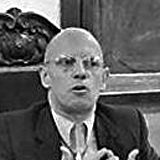
Foucault
Michel Foucault1926–1984
What Foucault argues and who answers him, as Marci Shore presents it in her Yale lectures European Intellectual History since Nietzsche: 26 claims, and 17 places where another thinker builds on him or breaks with him. Each claim is our paraphrase and links to the minute of the lecture it comes from.
Power is everywhere; not because it embraces everything, but because it comes from everywhere.
Michel Foucault, The History of Sexuality vol. I. The epigraph Shore gives lecture 21.
The core ideas
The 6 claims the lectures spend most time on.
Descartes's cogito, Husserl's transcendental ego, Heidegger's Dasein, Sartre's radical freedom: each keeps an indubitable self at the center, and Foucault's early work revolts against that sovereign subject.
Put simply Foucault's early work rebels against the "sovereign subject": the self that philosophers from Descartes to Husserl, Heidegger and Sartre kept at the center as the one thing beyond doubt.
The repressive hypothesis is a myth: the question is not why we are so repressed about sex but why we keep insisting, obsessively, that we are.
Put simply Foucault calls it a myth that modern society silenced sex. The real question is not why we are so repressed, but why we keep insisting, obsessively, that we are.
Knowledge is never innocent of power; the slash in power/knowledge marks their inseparability, which rules out disinterested inquiry and any neutral Archimedean point to stand on.
Put simply Foucault: knowing is never free of power. His term "power/knowledge" marks that the two cannot be separated, so there is no neutral inquiry and no outside spot from which to look.
Power has no single source. It is omnipresent "not because it embraces everything, but because it comes from everywhere": radically dispersed, built into every relationship.
Put simply Foucault: power has no single source. It is everywhere "not because it embraces everything, but because it comes from everywhere": spread out through every relationship.
Where to read it Foucault, The History of Sexuality, vol. 1, Part Four, ch. 2 ("Method").
The historian is an archaeologist digging in words and sources rather than earth; archaeology seeks no secret of origins, only "the systematic description of a discourse object."
Put simply Foucault: the historian is an archaeologist who digs in words and documents instead of soil. The aim is not the secret of origins, only a systematic description of how something was talked about.
Truly escaping Hegel means calculating what the escape costs and how close he stands; our anti-Hegelianism may itself be one of his tricks, with him waiting at the end.
Put simply Foucault: to really escape Hegel, we must know what breaking free will cost and how close he still is. Our very rebellion against Hegel may be one of his tricks, with him waiting for us at the end.
Who Foucault answers, and who answers him
Each entry joins one of his claims to another thinker’s. The handwriting names the link; the line beside it says which kind. “Our inference” marks a link Shore does not state outright.
Foucault and Shore
FoucaultDiscourse must be treated as discontinuous: the historian excavates layers of talk and marks the moments where the way something is spoken about shifts. L21 · 43:13
ShoreShore's example of a Foucauldian discontinuity: the moment Czech and Slovak Marxist believers begin setting Stalinist words against others, class consciousness against individual conscience, the people against persons. L21 · 44:54
Shore offers the Czech and Slovak writers' shift in vocabulary as an example of what Foucault would call a moment of discontinuity.
FoucaultPower has no single source. It is omnipresent "not because it embraces everything, but because it comes from everywhere": radically dispersed, built into every relationship. L21 · 38:23
ShoreShore reads Foucault's dispersed power as an attempt to invert and overcome the subject-object paradigm: no subject sits at the source of power, bearing down on an object. L21 · 38:04
Shore reads the denial of a single point of power as an inversion of the subject-object paradigm.
FoucaultEnlightenment reason was possible only once madness had been defined: there is no reason without an unreason to set it against, which makes the asylum the Enlightenment's dark side. L21 · 27:08
ShoreShore sees parallels between reason's dependence on madness, Beauvoir's self-definition through an other and Wolff's Eastern Europe, invented as the West's Enlightenment contrast. L21 · 27:45
Shore generalizes reason's need for madness into a pattern of identity formed against an Other.
FoucaultAfter God's death comes the subject's, and Foucault admits how much that hurts; he sympathizes with people who find it unbearable. L21 · 49:05
ShoreWhen Foucault announces the subject's death, Shore hears mourning rather than gloating, something close to Rousseau's nostalgia for the state of nature. L21 · 49:17
Shore reads Foucault's acknowledgment of the subject's loss as mournful, nostalgic rather than triumphant.
Foucault and Ferdinand de Saussure 1857–1913
SaussureA language's present state can be fully described without knowing its past, much as a chess position is legible to a passerby who never saw the earlier moves. L19 · 25:50
FoucaultFoucault's post-structuralist turn: a structure of statements is never sealed, references keep running past its edges, so even a book lacks clear-cut frontiers. L21 · 21:04
Against structuralism's closed, chessboard-like system, Foucault holds the web of statements is never sealed.
SaussureLanguage is form rather than substance: a combination of sounds means something only inside a particular linguistic system, so meaning is a matter of relations, not of things. L10 · 18:55
FoucaultNo statement is neutral or free-standing; each sits within a series, leans on other statements while setting itself apart from them, and means what it means through that network. L21 · 20:02
Shore says Foucault takes from structuralism the premise that meaning is relational, nudged up from language to discourse.
Foucault and Stephen Kotkin 1959–
FoucaultAgency belongs neither to a sovereign self nor to history's momentum; Foucault relocates it largely in language, in discourse, which becomes a key word. L21 · 11:48
KotkinMagnetic Mountain reverses the usual order: rather than a subject producing discourse, Stalinist discourse produced the Stalinist subject. L21 · 47:12
Shore lists Kotkin's Magnetic Mountain among histories written with Foucault's archaeological method, showing Stalinist discourse creating the Stalinist subject.
FoucaultPower does not only crush; it also creates. Calling it productive as well as repressive is a description, not praise or blame. L21 · 40:57
KotkinStalinist power did not merely crush, it also created: Kotkin's Magnetic Mountain brought Foucault's productive power into Stalinism studies and inaugurated a new line of work. L21 · 40:57
Takes over Foucault's view that power creates as well as represses and applies it to Stalinism.
Foucault and René Descartes 1596–1650
DescartesEven if a demon has planted every thought in my head, the thinking itself is happening, so I must exist: "cogito, ergo sum." L2 · 15:49
FoucaultDescartes's cogito, Husserl's transcendental ego, Heidegger's Dasein, Sartre's radical freedom: each keeps an indubitable self at the center, and Foucault's early work revolts against that sovereign subject. L21 · 8:47
Rejects the cogito as the sovereign ground from which knowledge starts
Foucault and Edmund Husserl 1859–1938
HusserlStrip away the contingent particulars distinguishing empirical egos and a transcendental ego remains: the deepest, most essential I, yet universal and identical in everyone, as H2O underlies all water. L11 · 34:29
FoucaultDescartes's cogito, Husserl's transcendental ego, Heidegger's Dasein, Sartre's radical freedom: each keeps an indubitable self at the center, and Foucault's early work revolts against that sovereign subject. L21 · 8:47
The transcendental ego is one more version of the sovereign subject he refuses
Foucault and Claude Lévi-Strauss 1908–2009
Lévi-StraussClassical structuralism, as it comes through Lévi-Strauss's anthropology, charts many cultural relations as binary oppositions: cooked against raw, low against high, cold against hot. L19 · 43:52
FoucaultEnlightenment reason was possible only once madness had been defined: there is no reason without an unreason to set it against, which makes the asylum the Enlightenment's dark side. L21 · 27:08
Shore calls Foucault's claim that reason required unreason a very structuralist argument in which the structuralist binaries come back.
Foucault and Herbert Marcuse 1898–1979
MarcuseWhere Freud saw repression as the unavoidable cost of living together, Marcuse sees an exit: the repression that matters is capitalism's, and its hold on the body might be undermined. L14 · 40:22
FoucaultThe repressive hypothesis is a myth: the question is not why we are so repressed about sex but why we keep insisting, obsessively, that we are. L21 · 31:11
The story of bourgeois sexual repression that liberation should undo is a myth
Foucault and Theodor Adorno 1903–1969
AdornoEnlightenment's totalitarian streak is built in, not a detour: a project designed to emancipate individuals arrives at a manipulated collective whose unity is each individual's negation. L14 · 48:14
FoucaultWhere Adorno and Horkheimer draw a dialectical spiral from Enlightenment to totalitarianism, Foucault draws a straight line: the drive to know and classify everything leads directly to control and surveillance. L21 · 35:46
Keeps the line from Enlightenment to totalitarianism but drops the dialectical reversal
Foucault and Martin Heidegger 1889–1976
HeideggerDasein is no detached observer. It is always already being-in-the-world: doing things, caring about things, alongside other beings, with no outside position to withdraw to. L12 · 24:14
FoucaultKnowledge is never innocent of power; the slash in power/knowledge marks their inseparability, which rules out disinterested inquiry and any neutral Archimedean point to stand on. L21 · 37:31
Shore hears echoes of Heidegger's observer problem in Foucault's claim that there is no neutral, innocent space outside power.
Foucault and Hannah Arendt 1906–1975
ArendtTotalitarianism, Arendt writes, found a way of "dominating and terrorizing human beings from within"; once everyone polices everyone else, no distance separates rulers from ruled. L15 · 41:18
FoucaultPower has no single source. It is omnipresent "not because it embraces everything, but because it comes from everywhere": radically dispersed, built into every relationship. L21 · 38:23
Shore hears echoes of Arendt in Foucault's denial of a binary between rulers and ruled, and says he is drawing on Arendt in rethinking power.
Foucault and Friedrich Nietzsche 1844–1900
NietzscheAnnouncing "God is dead" is not atheism. It reports an event: humanity has crossed from a world God organized into one without him, and we ourselves did the killing. L6 · 43:30
FoucaultAfter God's death comes the subject's, and Foucault admits how much that hurts; he sympathizes with people who find it unbearable. L21 · 49:05
After the death of God comes the death of the subject
Foucault and Václav Havel 1936–2011
FoucaultDescartes's cogito, Husserl's transcendental ego, Heidegger's Dasein, Sartre's radical freedom: each keeps an indubitable self at the center, and Foucault's early work revolts against that sovereign subject. L21 · 8:47
HavelShore reads Kołakowski and Patočka as holding that robust subjectivity grounds truth instead of relativizing it, linked through responsibility; subjectivity becomes a key word for Havel. L23 · 48:59
Restores a robust, responsible subject as the ground of truthOur inference
All 26 claims, lecture by lecture
In the order they come up. The time opens that minute of the lecture on YouTube.
Lecture 21Power and Archaeology - Michel Foucault
Descartes's cogito, Husserl's transcendental ego, Heidegger's Dasein, Sartre's radical freedom: each keeps an indubitable self at the center, and Foucault's early work revolts against that sovereign subject.
Put simply Foucault's early work rebels against the "sovereign subject": the self that philosophers from Descartes to Husserl, Heidegger and Sartre kept at the center as the one thing beyond doubt.
Marx's decentering of the subject through class struggle was answered, late in the nineteenth century, by seeking a total history that reduces all of society's differences to one form.
Put simply Foucault: Marx pushed the individual from the center by explaining society through class struggle. Late in the 1800s, defenders of the self answered by seeking a "total history" that reduces all of society's differences to one pattern.
Against the decentering worked by Nietzsche's genealogy, Foucault says, the sovereign-subject tradition set a search for an original foundation, making reason mankind's telos and demanding perpetual return to it.
Put simply Foucault: against the decentering of the self by Nietzsche's "genealogy," the defenders of the sovereign subject sought an original foundation: reason as humanity's goal, to which thought must always return.
Agency belongs neither to a sovereign self nor to history's momentum; Foucault relocates it largely in language, in discourse, which becomes a key word.
Put simply Foucault: what makes things happen is neither a ruling self nor the forward push of history. It lies largely in language, in "discourse": the organized ways a society talks about things.
No statement is neutral or free-standing; each sits within a series, leans on other statements while setting itself apart from them, and means what it means through that network.
Put simply Foucault: no statement stands alone or neutral. Each belongs to a series, leans on other statements while marking itself off from them, and gets its meaning from that web.
Foucault's post-structuralist turn: a structure of statements is never sealed, references keep running past its edges, so even a book lacks clear-cut frontiers.
Put simply Foucault moves past structuralism here: a web of statements is never closed. References always run past its edges, so even a book has no clear boundary.
Foucault rejects one approach above all, the phenomenological, which gives the observing subject absolute priority and ends in a transcendental consciousness; scientific discourse should be analyzed as discursive practice.
Put simply Foucault rejects above all the phenomenological approach, which gives the observing mind absolute priority and ends in a "transcendental consciousness". The history of scientific discourse should instead be analyzed as "discursive practice": how people speak and write.
The standard story calls the asylum humane progress, treating the mad as patients rather than criminals; Foucault reads it instead as a means of control, a great confinement.
In the text In Madness and Civilization (1961; Howard translation), ch. 2, Foucault dates the Great Confinement from the Paris decree of 1656 founding the Hôpital Général, which he says "is not a medical establishment".
Other readings Marcel Gauchet and Gladys Swain (Madness and Democracy, 1999) read the asylum as a democratic project.
Enlightenment reason was possible only once madness had been defined: there is no reason without an unreason to set it against, which makes the asylum the Enlightenment's dark side.
Put simply Foucault: the Enlightenment's idea of reason needed an idea of madness to define itself against. Without unreason there is no reason. That makes the asylum the Enlightenment's dark side.
The prison was sold as a rational, humane successor to torture; its real function, Foucault argues, is surveillance and isolation, like the school, hospital, factory and asylum.
Bentham's panopticon fascinates Foucault: because the prisoner can never tell whether the guard in the central booth is watching, the uncertainty itself becomes an instrument of discipline.
The repressive hypothesis is a myth: the question is not why we are so repressed about sex but why we keep insisting, obsessively, that we are.
Put simply Foucault calls it a myth that modern society silenced sex. The real question is not why we are so repressed, but why we keep insisting, obsessively, that we are.
Sexuality is not a stubborn drive or a libido; Foucault treats it as "an especially dense transfer point for relations of power."
Put simply Foucault: sexuality is not a built-in urge or sex drive. It is a place where relations of power run especially thick.
Where to read it Foucault, The History of Sexuality, vol. 1, Part Four, ch. 3 ("Domain").
Where Adorno and Horkheimer draw a dialectical spiral from Enlightenment to totalitarianism, Foucault draws a straight line: the drive to know and classify everything leads directly to control and surveillance.
Put simply Foucault draws a straight line from the Enlightenment to control and surveillance: the urge to know and sort everything leads there directly. Adorno and Horkheimer instead trace a winding, back-and-forth path toward totalitarianism.
Knowledge is never innocent of power; the slash in power/knowledge marks their inseparability, which rules out disinterested inquiry and any neutral Archimedean point to stand on.
Put simply Foucault: knowing is never free of power. His term "power/knowledge" marks that the two cannot be separated, so there is no neutral inquiry and no outside spot from which to look.
Power has no single source. It is omnipresent "not because it embraces everything, but because it comes from everywhere": radically dispersed, built into every relationship.
Put simply Foucault: power has no single source. It is everywhere "not because it embraces everything, but because it comes from everywhere": spread out through every relationship.
Where to read it Foucault, The History of Sexuality, vol. 1, Part Four, ch. 2 ("Method").
Resistance never stands outside power. Always already present, power constitutes the very thing used to resist it; the two are locked in a shifting relational dynamic.
Put simply Foucault: resistance is never outside power. Power is always already there and shapes even the means people use to resist it. The two keep shifting in relation to each other.
Where to read it Foucault, The History of Sexuality, vol. 1, Part Four, ch. 2 ("Method").
Power does not only crush; it also creates. Calling it productive as well as repressive is a description, not praise or blame.
Put simply Foucault: power does not only hold people down; it also creates things. Saying so describes power; it is neither praise nor blame.
Discourse must be treated as discontinuous: the historian excavates layers of talk and marks the moments where the way something is spoken about shifts.
Put simply Foucault: a history of how people talk must look for breaks. The historian digs through layers of talk and marks the moments when the way something is spoken about changes.
Nietzsche's genealogy is the inspiration for Foucault's archaeology: a history that looks for discontinuity.
Put simply Foucault's method, which he calls "archaeology," is a history that looks for breaks. Its inspiration is Nietzsche's "genealogy."
The historian is an archaeologist digging in words and sources rather than earth; archaeology seeks no secret of origins, only "the systematic description of a discourse object."
Put simply Foucault: the historian is an archaeologist who digs in words and documents instead of soil. The aim is not the secret of origins, only a systematic description of how something was talked about.
When the discourse shifts, the archaeologist does not ask why. Causality is not the point; the task is to describe the break.
Put simply Foucault: when the way people talk shifts, the historian does not ask why. Causes are not the point; the job is to describe the break.
After God's death comes the subject's, and Foucault admits how much that hurts; he sympathizes with people who find it unbearable.
Put simply Foucault admits how painful it is that, after God's "death," the self loses its central place too. He sympathizes with those who find that unbearable.
To those who still ask after man's essence, or who start from man to reach truth, Foucault's answer is "a philosophical laugh."
Lecture 25From Modernity to Post-Modernity
As Foucault would put it about power, everywhere is not nowhere: that power pervades everything does not mean it has vanished.
Put simply Foucault on power: the fact that power runs through everything does not mean it has disappeared. Being everywhere is not the same as being nowhere.
Truly escaping Hegel means calculating what the escape costs and how close he stands; our anti-Hegelianism may itself be one of his tricks, with him waiting at the end.
Put simply Foucault: to really escape Hegel, we must know what breaking free will cost and how close he still is. Our very rebellion against Hegel may be one of his tricks, with him waiting for us at the end.
The questions Foucault is part of
A throughline follows one question across the whole course. These are the ones his claims sit on.
Works and dates
As they come up in the lectures.
Madness and Civilization: A History of Insanity in the Age of Reason Folie et déraison: Histoire de la folie à l'âge classique
The Order of Things: An Archaeology of the Human Sciences Les Mots et les choses
The Order of Things appears, becomes a bestseller and makes Foucault a celebrity. Foucault is 40.
The Archaeology of Knowledge L'Archéologie du savoir
The Discourse on Language L'ordre du discours
Discipline and Punish: The Birth of the Prison Surveiller et punir
The History of Sexuality, vol. I: An Introduction La Volonté de savoir
Kotkin, one of Foucault's last students, studies with him at Berkeley (early 1980s).
Foucault dies of AIDS. Foucault is 58.
Terms
The ideas his claims turn on, as the lectures gloss them.
Decentering of the subject. The individual human subject is not the origin or holder-together of meaning; structures and language are primary, and subjects are produced by them.
Cogito, ergo sum. "I think, therefore I am": the one certainty radical doubt cannot dissolve, since doubting itself proves a thinking self exists.
Transcendental ego vs. empirical ego. The empirical ego is the contingent, worldly self with its own history. The transcendental ego is the pure subject left after the epoché, the source of all sense the world has for me. In the lecture, a universal "I-ness" in everyone.
Dasein. Heidegger's word for human existence, replacing "subject" and "consciousness": the entity for whom its own being is at issue.
The whole / totality. Nothing has meaning taken in isolation; only the interconnected whole, graspable only from its end, yields truth.
Nietzschean genealogy. Nietzsche's method in On the Genealogy of Morality: tracing values to contingent, often ignoble histories instead of timeless origins. Foucault's own genealogy dates from the 1970s. In the lecture, the inspiration for his archaeology.
Telos. The end or goal a thing is already developing toward, e.g. the seed is "aiming" at the apple it will become.
Reason. The Enlightenment's central "key word": the human faculty held capable of understanding, and progressively mastering, the world.
Discourse. Structured ways of speaking, organized in networks of statements, that shape knowledge, carry power and produce meaning and agency in place of a sovereign subject.
Linguistic structuralism. Meaning lives in differences within a system, not in things; the background that let avant-gardists detach words from referents.
The great confinement. Foucault's name for the mass internment, from 1656, of the poor, the idle and the mad in houses that were not medical; he treats it as the forerunner of the asylum.
Discipline and surveillance. Modern institutions govern people by isolating, observing and classifying them; Foucault takes this to be modernity's central pattern after the Enlightenment.
Binary opposition. Paired contrasting terms (raw/cooked, hot/cold, high/low) through which classical structuralism maps cultural meaning by difference.
Panopticon. Bentham's "all-seeing" prison design: inmates cannot tell when the central guard is looking, so they must always act as if watched.
The repressive hypothesis. The familiar view that bourgeois modernity silenced sex; Foucault calls it a myth that overlooks a vast proliferation of talk about sex.
Dispersed (omnipresent) power. Power with no central point: relational, generated everywhere, immanent in every relationship and always accompanied by resistance arising within it.
Totalitarianism. As Shore defines it: a regime with draconian ideology and absolute truth-claims, a messianic movement, institutions of terror, monopolies on communication and force, a panopticon state, and erased public/private line.
Dialectic. History advances through clashing contradictions: an unstable position is negated by its opposite and carried forward to a new, higher stage.
Power/knowledge. Foucault's joined term: knowing is never innocent of power, and power works through knowing, classifying and observing more than through mastery of nature.
Productive power. Power seen as generative, creating subjects, categories and practices, not only repressing; meant descriptively, without praise or blame.
Discontinuity. A point where the way something is spoken of changes; the archaeologist records the shift without explaining it.
Archaeology. Foucault's 1960s method: reconstruct, from texts, the rules governing what can be said in a given period, and mark the breaks between periods, without seeking origins or causes.
The death of God. Nietzsche's declaration that God is dead. In Shore's framing it is the course's central hinge, prepared by the Enlightenment's sidelining of God.
Postmodernism. A broad current after 1968 that breaks with much modernist thinking and is skeptical of objective truth and of any unifying grand story.