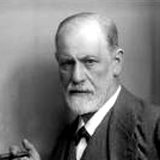
Freud
Sigmund Freud1856–1939
What Freud argues and who answers him, as Marci Shore presents it in her Yale lectures European Intellectual History since Nietzsche: 23 claims, and 23 places where another thinker builds on him or breaks with him. Each claim is our paraphrase and links to the minute of the lecture it comes from.
The first of these displeasing propositions of psycho-analysis is this: that mental processes are essentially unconscious and that those which are conscious are merely isolated acts and parts of the whole psychic entity.
Sigmund Freud, Introductory Lectures on Psychoanalysis. The epigraph Shore gives lecture 9.
The core ideas
The 5 claims the lectures spend most time on.
What matters in the mind happens below awareness: Freud holds that "mental processes are essentially unconscious," with conscious ones only scattered fragments of the whole.
Freud's self is a structure whose parts only make sense together: two vertical layers, unconscious beneath conscious, cut across by three horizontal parts, id, ego and superego.
Put simply Freud pictures the self as parts that only make sense together: an unconscious layer beneath a conscious one, crossed by three parts, the "id" (desire), the "ego" (the I) and the "superego" (conscience).
The id is desire itself, unconscious, divided into two hardwired drives Freud posits like geometric axioms rather than proves: Eros, toward love and pleasure; Thanatos, toward aggression and death.
Put simply Freud: the "id" is desire itself, and unconscious. It has two inborn drives that he assumes rather than proves: Eros, toward love and pleasure, and Thanatos, toward aggression and death.
In the text In The Ego and the Id (1923; Riviere translation), ch. IV, Freud writes of "two classes of instincts, one of which, Eros or the sexual instincts," and calls the other the death instinct.
Psychic energy behaves like matter: it can be shifted or sublimated but never discarded, so repressed desires return in another guise and blocked aggression turns on the self.
Put simply Freud: mental energy behaves like matter. It can be moved or redirected but never thrown away, so pushed-down desires come back in another form, and blocked aggression turns against oneself.
Civilization is bought with repression of both drives: to live together people must curb sex and aggression alike, which is why society and individual fulfillment pull against each other.
Put simply Freud: civilization is paid for by holding back both our basic drives. To live together, people must curb sex and aggression alike, which is why society and personal fulfillment pull against each other.
Who Freud answers, and who answers him
Each entry joins one of his claims to another thinker’s. The handwriting names the link; the line beside it says which kind. “Our inference” marks a link Shore does not state outright.
Freud and Shore
ShoreWhat stays metaphysical in Hegel, the "I that is a We," the Soviets tried to realize as literally as they could: any subjectivity diverging from the collective must be purged. L9 · 7:27
FreudFreud's self is a structure whose parts only make sense together: two vertical layers, unconscious beneath conscious, cut across by three horizontal parts, id, ego and superego. L9 · 30:55
Shore: Freud inverts the Bolshevik I/we model, starting from the first-person singular rather than the collective.
ShoreShore reads the Bolshevik project as Enlightenment perfectibility taken literally: engineer new human beings whose consciousness merges so completely with History that no separate subjectivity remains. L9 · 6:11
FreudWe can never fully know ourselves: what is most basic in us sits in the unconscious, so the self stays opaque to itself and permanently at odds with itself. L9 · 48:02
Freud's never-transparent self makes the Bolshevik goal of transparent identification with History impossible.Our inference
FreudWe can never fully know ourselves: what is most basic in us sits in the unconscious, so the self stays opaque to itself and permanently at odds with itself. L9 · 48:02
ShoreOn Shore's admittedly simplified schema, modernism answers modernity's uncertainty in two waves: a Freudian plunge into the self, then an avant-garde that vaults past it, almost a Hegelian Aufheben. L10 · 3:21
Shore characterizes first-wave modernism as a basically Freudian turn inward toward what is dark, hidden and not rational.
Freud and Karl Marx 1818–1883
MarxFor Marx, your place in the socioeconomic structure, the base, determines your thinking; consciousness, culture and art, the superstructure, derive from it. L5 · 46:02
FreudAgainst the Marxists, who expect aggressive instincts to fade once conditions change, Freud insists aggression is hardwired and older than private property, so no social rearrangement removes it. L9 · 47:30
Aggression is innate, not a product of social position; Marxists neglect Thanatos
MarxFor Marx, religion is a drug for the masses, dangled before the exploited so that a promised reward in the next world reconciles them to suffering in this one. L5 · 45:14
FreudFor Freud, belief in God is infantile: once the growing child sees his father is neither immortal nor all-powerful, he transfers his longing for an omnipotent protector onto a deity. L9 · 40:14
Religion as illusion that consoles, now traced to infantile wishes
Freud and Herbert Marcuse 1898–1979
FreudCivilization is bought with repression of both drives: to live together people must curb sex and aggression alike, which is why society and individual fulfillment pull against each other. L9 · 42:17
MarcuseWhere Freud saw repression as the unavoidable cost of living together, Marcuse sees an exit: the repression that matters is capitalism's, and its hold on the body might be undermined. L14 · 40:22
Civilization's repression is not permanent: capitalism's specific repression can be overcome
FreudThe id is desire itself, unconscious, divided into two hardwired drives Freud posits like geometric axioms rather than proves: Eros, toward love and pleasure; Thanatos, toward aggression and death. L9 · 32:50
MarcuseEros and Thanatos compete for the same space, and the death drive can only occupy ground eros has vacated; so work rearranged to re-eroticize the body shrinks aggression. L14 · 40:37
Shore calls Eros and Civilization a takeoff on Freud, using eros and Thanatos to find the way out that Freud denies.
Freud and René Girard 1923–2015
FreudCivilization is bought with repression of both drives: to live together people must curb sex and aggression alike, which is why society and individual fulfillment pull against each other. L9 · 42:17
GirardFor Girard, the founding moment of civilization is a collective murder: the group experiences "a supremely evil and then beneficent being," and that experience cannot help gripping it. L20 · 39:03
Civilization rests on violence: for Girard an actual founding murder, for Freud repressed aggression.
FreudHuman aggression is a standing threat to any society, so living together means constantly suppressing it; the hostility we cannot aim at others gets turned back on ourselves. L9 · 43:03
GirardThe mob's fundamental misattribution: it shifts its own violence onto the victim, who is then taken to have been its cause. L20 · 40:09
Violence is thrown outward onto a victim rather than turned inward and repressed
Freud and Rosa Luxemburg 1871–1919
FreudWhat matters in the mind happens below awareness: Freud holds that "mental processes are essentially unconscious," with conscious ones only scattered fragments of the whole. L9 · 22:57
LuxemburgHistory's logic runs ahead of those living it: "the unconscious comes before the conscious." Against Lenin, Luxemburg argues that history's stages must be respected and that party leaders turn conservative. L8 · 31:31
Shore says Luxemburg in 1904 was already hinting at the conscious/unconscious dualism Freud develops, though she identifies the unconscious with objective history.
Freud and Paul Robinson 1940–
FreudWhat matters in the mind happens below awareness: Freud holds that "mental processes are essentially unconscious," with conscious ones only scattered fragments of the whole. L9 · 22:57
RobinsonPicture the unconscious as a dark psychic closet: whatever the conscious mind cannot bear gets shoved in, the pile grows for a lifetime, and nothing is ever thrown out. L9 · 30:08
Robinson's closet is a picture of the unconscious as a repository that accumulates what consciousness rejects.
Freud and Yurko Prokhasko 1970–
FreudFor Freud, belief in God is infantile: once the growing child sees his father is neither immortal nor all-powerful, he transfers his longing for an omnipotent protector onto a deity. L9 · 40:14
ProkhaskoPsychoanalysis theorizes life once God is dead: having thrown him out, we hunt for windows to climb back in, torn between craving authority and wanting to undermine it. L9 · 49:00
Recasts Freud's dismissal of religion as an account of modern life after God, still hunting for windows back in.Our inference
Freud and Hannah Arendt 1906–1975
FreudNearly every child goes through an Oedipal phase: love shifts from breast to mother, the father becomes a rival, and a flickering wish for his death is quickly buried. L9 · 28:42
ArendtShore recalls Arendt remarking that had Freud not spent his days among German-speaking Habsburg Jews in Vienna reading Goethe and Shakespeare, the Oedipus complex might never have reached the rest of us. L9 · 35:54
Argues the supposed universality of the Oedipus complex is a product of Freud's particular cultural milieu.
Freud and Thomas Hobbes 1588–1679
HobbesHobbes's state of nature means permanent war: greed, self-interest and the appetite for power and wealth set everyone against everyone, in unending terror. L2 · 19:29
FreudJoining the Enlightenment debate, Freud grants that the state of nature is genuinely free and liberating, but that freedom comes with a great deal of violence and aggression. L9 · 42:58
A violent state of nature; happiness traded for security, as in Hobbes
Freud and Jean-Jacques Rousseau 1712–1778
RousseauRousseau's natural human was virtuous and compassionate; property and society made people vain, selfish and competitive, and there is no road back to that lost condition. L2 · 32:02
FreudJoining the Enlightenment debate, Freud grants that the state of nature is genuinely free and liberating, but that freedom comes with a great deal of violence and aggression. L9 · 42:58
Society still costs us our nature, but nature was violent, not virtuous
Freud and André Breton 1896–1966
FreudThe cure is nothing but talk: the analysand speaks uncensored, the analyst coaxes fragments of the unconscious out through the cracks, and symptoms become manageable rather than magically fixed. L9 · 22:51
BretonSurrealism swings somewhat back toward Freud: psychic automatism, a free association of the mind released from every aesthetic or moral consideration. L10 · 45:00
Shore says surrealism becomes "a little more Freudian" with free association and psychic automatism.
Freud and Franz Kafka 1883–1924
FreudWe can never fully know ourselves: what is most basic in us sits in the unconscious, so the self stays opaque to itself and permanently at odds with itself. L9 · 48:02
KafkaGregor Samsa's waking as a "monstrous vermin" in The Metamorphosis forces the question of whether any stable self exists, or identity is only a mask with nothing underneath to grip. L10 · 13:37
Shore calls Gregor's waking from unsettling dreams very Freudian and ties the story's unstable self to what Freud tells us about subjectivity.
Freud and Edmund Husserl 1859–1938
FreudWe can never fully know ourselves: what is most basic in us sits in the unconscious, so the self stays opaque to itself and permanently at odds with itself. L9 · 48:02
HusserlWhere Freud locates the essential self in what is most hidden, the transcendental ego is pure light: nothing in it stays concealed, and knowing is a matter of clear seeing. L11 · 45:42
Keeps a radical theory of subjectivity but flips the depth from hidden to transparent, all light.
Freud and Jean-Paul Sartre 1905–1980
FreudWhat matters in the mind happens below awareness: Freud holds that "mental processes are essentially unconscious," with conscious ones only scattered fragments of the whole. L9 · 22:57
SartreAgainst Freud, consciousness cannot be cleanly cut into an opaque unconscious and a transparent conscious half; the whole of it is translucent, neither one nor the other. L13 · 43:50
Rejects the split into an opaque unconscious and a conscious part: consciousness is translucent
Freud and Wilhelm Reich 1897–1957
FreudFor Freud, neurosis and psychosis lie on one continuum of repression, differing in degree; Shore draws the consequence that everyone is mentally ill, since nobody lacks repressed trauma. L9 · 19:15
ReichEvery neurosis has its root in sexual repression: Freud's claim pushed to the extreme, with libido treated as a literal physical energy, orgone, that can be stored in a box. L14 · 32:14
Neurosis from sexual repression, pushed to a literal, physical libido
Freud and Simone de Beauvoir 1908–1986
FreudThe id is desire itself, unconscious, divided into two hardwired drives Freud posits like geometric axioms rather than proves: Eros, toward love and pleasure; Thanatos, toward aggression and death. L9 · 32:50
BeauvoirBeauvoir finds Freud as reductive as Marx: psychoanalysis swaps existential choice for hardwired drives and involuntary repression, a determinism she cannot accept, however seriously she takes sexuality. L16 · 42:11
Hardwired drives and repression are too deterministic; they crowd out existential choice
Freud and Claude Lévi-Strauss 1908–2009
FreudWhat matters in the mind happens below awareness: Freud holds that "mental processes are essentially unconscious," with conscious ones only scattered fragments of the whole. L9 · 22:57
Lévi-StraussCulture, taken broadly to include language, art, customs, tools and belief, operates largely unconsciously, a Freudian premise; anthropology's task is to expose the deep laws beneath it. L19 · 40:15
Takes Freud's premise that most mental life, and so culture, is unconscious
Freud and Jacques Derrida 1930–2004
FreudWe can never fully know ourselves: what is most basic in us sits in the unconscious, so the self stays opaque to itself and permanently at odds with itself. L9 · 48:02
DerridaSpeech cannot guarantee presence, because the one speaking is not necessarily present even to himself; so presence versus absence, like speech versus writing, is a binary to be dismantled. L22 · 22:10
Shore points to Freud in Derrida's claim that the speaking self is not present to itself: the self is hidden from the self.
All 23 claims, lecture by lecture
In the order they come up. The time opens that minute of the lecture on YouTube.
Lecture 6Nietzsche and the Death of God
Freud's verdict: no one who has ever lived, or is likely to, understood himself as deeply as Nietzsche.
Lecture 9Freudian Psychoanalysis
Mental life is treated more as a thing in itself: once an imagined event can make someone ill, the psyche is no mere by-product of biology or chemistry.
Put simply Freud: if something merely imagined can make a person ill, the mind must be treated more as real in its own right, not as a mere by-product of biology or chemistry.
In his first theory of hysteria, the illness traces back to repressed trauma from childhood, usually sexual; the buried memory resurfaces disguised as a neurotic symptom.
Put simply Freud's first theory of "hysteria": the illness comes from a childhood trauma, usually sexual, pushed out of awareness. The buried memory comes back in disguise, as a nervous symptom.
What matters in the mind happens below awareness: Freud holds that "mental processes are essentially unconscious," with conscious ones only scattered fragments of the whole.
For Freud, sexual life begins in infancy, though sexual here means far more than genital intercourse: desire in an expansive sense.
For Freud, neurosis and psychosis lie on one continuum of repression, differing in degree; Shore draws the consequence that everyone is mentally ill, since nobody lacks repressed trauma.
Put simply Freud: milder disorders ("neurosis") and severe ones ("psychosis") differ only in degree, both coming from repression. Shore draws the conclusion that everyone is mentally ill, since nobody lacks repressed trauma.
In the text In "Neurosis and Psychosis" (1924; Riviere translation), Freud writes that "Neurosis is the result of a conflict between the ego and its id", and psychosis of a like disturbance between the ego and the outer world.
Nearly every child goes through an Oedipal phase: love shifts from breast to mother, the father becomes a rival, and a flickering wish for his death is quickly buried.
Put simply Freud: nearly every child goes through an "Oedipal" phase. The child's love moves from the breast to the mother, the father becomes a rival, and a fleeting wish for his death is quickly pushed out of mind.
Freud's self is a structure whose parts only make sense together: two vertical layers, unconscious beneath conscious, cut across by three horizontal parts, id, ego and superego.
Put simply Freud pictures the self as parts that only make sense together: an unconscious layer beneath a conscious one, crossed by three parts, the "id" (desire), the "ego" (the I) and the "superego" (conscience).
The id is desire itself, unconscious, divided into two hardwired drives Freud posits like geometric axioms rather than proves: Eros, toward love and pleasure; Thanatos, toward aggression and death.
Put simply Freud: the "id" is desire itself, and unconscious. It has two inborn drives that he assumes rather than proves: Eros, toward love and pleasure, and Thanatos, toward aggression and death.
In the text In The Ego and the Id (1923; Riviere translation), ch. IV, Freud writes of "two classes of instincts, one of which, Eros or the sexual instincts," and calls the other the death instinct.
The superego is conscience rather than consciousness: an inner voice that constantly tells you you are bad, a source of guilt and also society internalized.
Put simply Freud: the "superego" is conscience, not awareness. It is the inner voice always telling you that you are bad, a source of guilt, and society's rules taken inside you.
The ego's job is to negotiate, every moment, between an id that wants and a superego that forbids; since they barely admit compromise, misery is built into the self.
Put simply Freud: the "ego" must negotiate every moment between the id, which wants, and the superego, which forbids. Since the two barely allow compromise, misery is built into the self.
Psychic energy behaves like matter: it can be shifted or sublimated but never discarded, so repressed desires return in another guise and blocked aggression turns on the self.
Put simply Freud: mental energy behaves like matter. It can be moved or redirected but never thrown away, so pushed-down desires come back in another form, and blocked aggression turns against oneself.
The cure is nothing but talk: the analysand speaks uncensored, the analyst coaxes fragments of the unconscious out through the cracks, and symptoms become manageable rather than magically fixed.
Put simply Freud's cure is only talk: the patient speaks freely, without self-censoring, and the analyst draws bits of the unconscious out through the cracks. Symptoms become manageable, not magically cured.
For Freud, belief in God is infantile: once the growing child sees his father is neither immortal nor all-powerful, he transfers his longing for an omnipotent protector onto a deity.
Civilization is bought with repression of both drives: to live together people must curb sex and aggression alike, which is why society and individual fulfillment pull against each other.
Put simply Freud: civilization is paid for by holding back both our basic drives. To live together, people must curb sex and aggression alike, which is why society and personal fulfillment pull against each other.
Human aggression is a standing threat to any society, so living together means constantly suppressing it; the hostility we cannot aim at others gets turned back on ourselves.
Put simply Freud: human aggression is a constant threat to any society, so living together means always holding it down. The hostility we cannot aim at others gets turned back on ourselves.
Society trades happiness, not just Hobbes's liberty, for security: the pleasure principle, what the id craves, cannot be squared with the reality principle people need in order to coexist.
Put simply Freud: Hobbes said society trades freedom for security; Freud says it trades happiness. What our desires crave (the "pleasure principle") cannot be squared with what living together requires (the "reality principle").
Against the Marxists, who expect aggressive instincts to fade once conditions change, Freud insists aggression is hardwired and older than private property, so no social rearrangement removes it.
Where to read it Freud, Civilization and Its Discontents, ch. V.
We can never fully know ourselves: what is most basic in us sits in the unconscious, so the self stays opaque to itself and permanently at odds with itself.
Put simply Freud: we can never fully know ourselves. What is most basic in us lies in the unconscious, so the self stays hidden from itself and always at odds with itself.
For Freud we are formed very young: childhood, reaching back to birth itself, is the formative time, and it is necessarily traumatic.
Civilization, Freud writes, is largely "constantly created anew": every individual entering society must in turn give up instinctual satisfaction for the community's sake.
Put simply Freud: civilization is rebuilt in every generation, because each new person joining society must give up some satisfaction of their drives for the good of the community.
Joining the Enlightenment debate, Freud grants that the state of nature is genuinely free and liberating, but that freedom comes with a great deal of violence and aggression.
Put simply Freud: life before organized society (the "state of nature") really is free and liberating, but that freedom comes with a great deal of violence and aggression.
Lecture 19Structuralism and Anthropology
The prohibition on incest belongs to the earliest, most primordial taboos, laid down as culture first separated itself from nature.
Put simply Freud: the ban on incest is one of the very first taboos, laid down as human culture first broke away from nature.
The questions Freud is part of
A throughline follows one question across the whole course. These are the ones his claims sit on.
Works and dates
As they come up in the lectures.
Freud born in a small Moravian town in the Habsburg Empire. Freud is 0.
Freud's family moves to Vienna when he is almost four, as restrictions on Jews are lifted. Freud is 3.
Freud marries Martha, aged 30 (six children, including Anna). Freud is 30.
Freud first uses the term "psychoanalysis".
The Interpretation of Dreams Die Traumdeutung
Freud appointed associate professor at the University of Vienna.
Vienna Psychoanalytic Society convened.
Freud's University of Vienna lectures, published 1917 as Introductory Lectures, popularize psychoanalysis during World War I.
Introductory Lectures on Psychoanalysis Vorlesungen zur Einführung in die Psychoanalyse
Civilization and Its Discontents Das Unbehagen in der Kultur
Anschluss in March 1938; Freud leaves Vienna for Paris, then London.
Freud dies weeks after the outbreak of World War II, after asking his physician for morphine.
An Outline of Psycho-Analysis Abriss der Psychoanalyse
Terms
The ideas his claims turn on, as the lectures gloss them.
Positivism. Understanding the world strictly through empirical observation, with no supernatural forces or metaphysical explanation admitted.
Repression. Pushing disturbing desires and memories out of awareness into the unconscious, where they persist; for Freud it underlies neurosis and, on a larger scale, civilization.
Return of the repressed. Banished desires and memories never vanish but resurface in disguised forms: symptoms, guilt, slips, or aggression turned against oneself.
The unconscious. For Freud, most of mental life: repressed wishes and memories that drive thought, feeling and symptoms while staying outside awareness; consciousness is only a fleeting surface.
Childhood sexuality. Freud's claim that sexual desire begins in infancy and is defined far beyond genital intercourse; its repression in childhood is formative and traumatic.
Transformation of quantity into quality. Gradual quantitative changes accumulate until, at a threshold, they trigger a sudden change in kind rather than degree.
Oedipus complex. For Freud, a near-universal childhood stage: the child desires the mother, resents the father, and secretly wishes him gone; the wish is quickly repressed.
The id. Freud's das Es, "the it": the unconscious store of inborn drives, Eros and the death drive alike, pressing for immediate satisfaction. In the lecture, "pure libido," simply desire.
The ego. "The I": the self that has to negotiate, moment by moment, between the id's wants and the superego's prohibitions with little room for compromise.
The superego. Conscience, not consciousness: society internalized as a voice that condemns the self's desires and generates guilt.
Eros and Thanatos. Freud's two basic classes of drive: Eros, the life drive of sex and love, and the death drive, a pull toward the inorganic that shows as aggression when turned outward. In the lecture, Thanatos is aggression and killing.
Dialectic. History advances through clashing contradictions: an unstable position is negated by its opposite and carried forward to a new, higher stage.
Psychic economy. Drive energy is conserved, only displaced or sublimated; energy spent on repression drains what is left for pleasure. A zero-sum model of the self.
Psychoanalysis. Both theory and treatment: an analyst coaxes the unconscious to surface through free association, so that symptoms can be alleviated by talk alone.
Religion as infantile illusion. Freud's view that God is a projection of the wish for an all-powerful protector, transferred to heaven once one learns the real father's limits.
Civilization. The Enlightenment's word for humanity's shared achievements, claimed as universal; Shore stresses that in practice it meant a European, even Parisian, standard. Freud's Kultur is translated the same way.
State of nature v. state of culture. The imagined pre-political condition of humanity (violent, free, or virtuous depending on the thinker) contrasted with organized civil society.
Pleasure principle. The id's program: seek immediate satisfaction of desire. Freud holds it can never be carried through and clashes with the world.
Reality principle. The requirement to defer or renounce satisfaction to fit material and social conditions, which makes shared life possible at the cost of happiness.
Opacity of the self. Freud's view that the self is never transparent to itself, because what is most fundamental lies in the unconscious.
Incest taboo. Prohibition on sexual unions within the close family, held by Freud to be among the earliest taboos and taken by Lévi-Strauss as founding kinship.