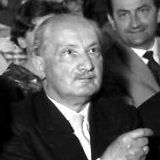
Heidegger
Martin Heidegger1889–1976
What Heidegger argues and who answers him, as Marci Shore presents it in her Yale lectures European Intellectual History since Nietzsche: 31 claims, and 35 places where another thinker builds on him or breaks with him. Each claim is our paraphrase and links to the minute of the lecture it comes from.
Dasein is an entity which does not just occur amongst other entities. Rather it is ontically distinguished by the fact that, in its very being, that being is an issue for it.
Martin Heidegger, Being and Time. The epigraph Shore gives lecture 12.
The core ideas
The 8 claims the lectures spend most time on.
Modern philosophy since Descartes asks how we know before asking what being is. That order is backward: the Greeks understood that the question of being comes first.
Put simply Heidegger: since Descartes, philosophy has asked "how do we know?" before "what does it mean to be?" That order is backward. The ancient Greeks understood that the question of being comes first.
Dasein is no detached observer. It is always already being-in-the-world: doing things, caring about things, alongside other beings, with no outside position to withdraw to.
Put simply Heidegger: we are never detached observers. We are always already "in the world": doing things, caring about things, living among others, with nowhere outside to step back to.
The subject-object split assumes an Archimedean vantage outside the world. There is none: Dasein is inside, so the bridge problem is not solved but dissolved, since no gap exists.
Put simply Heidegger: the old puzzle of how a mind reaches the world assumes we could stand outside the world and look at it. We cannot. We are already inside, so there is no gap to bridge and the puzzle disappears.
Our first and usual relation to things is using them, not looking at them: the hammer is ready-to-hand. Only when it breaks does it turn into present-at-hand, something to contemplate.
Put simply Heidegger: we mostly deal with things by using them, not by looking at them. A working hammer is simply "ready-to-hand". Only when it breaks do we stare at it as an object, "present-at-hand".
Inauthenticity is conformity: handing the burden of deciding to convention and doing what one does. The agent there is das Man, the impersonal one, which is everyone and no one.
Put simply Heidegger: living inauthentically means conforming, letting convention make your decisions and doing "what one does". The one in charge is "das Man", the faceless "they" that is everyone and no one.
Other readings Hubert Dreyfus (Being-in-the-World, 1991) reads das Man as the shared background of norms and practices that makes things intelligible at all, a positive structure of Dasein that also pulls toward conformity.
Where to read it Heidegger, Being and Time §27 (H. 126–130).
Authenticity means facing, eyes open, that one is finite and always moving toward one's own death (Sein-zum-Tode). Inauthenticity is at bottom a way of fleeing that awareness.
Put simply Heidegger: living authentically means facing, eyes open, that you are finite and always moving toward your own death, his "being-toward-death". Living inauthentically is at bottom a way of running from that knowledge.
The Rectoral Address identifies the university's will to science with the Volk's will to its historic, spiritual mission: "science and German fate must come to power at the same time."
Put simply Heidegger's inaugural speech as university rector ties the university's pursuit of knowledge to the German people's historic, spiritual mission: "science and German fate must come to power at the same time."
In the 1966 Spiegel interview, released only after his death, Heidegger conceded that Nazism had perhaps been wrong, yet insisted the West's real crisis was still godlessness after Nietzsche.
Put simply In a 1966 Der Spiegel interview, published only after his death in 1976, Heidegger allowed that Nazism was perhaps wrong. Still, he insisted, the West's real crisis was a world without God, after Nietzsche.
In the text In the Spiegel interview (1966, published 1976), asked about his 1933 statement that the Führer alone was Germany's reality and law, Heidegger replies: "The sentences you quote I would no longer write today."
Who Heidegger answers, and who answers him
Each entry joins one of his claims to another thinker’s. The handwriting names the link; the line beside it says which kind. “Our inference” marks a link Shore does not state outright.
Heidegger and Edmund Husserl 1859–1938
HusserlIntentionality is the structure of consciousness: always reaching for its object, like a magnet on a string. Neither subject nor object comes first; their relation does, bridged by intentionality. L11 · 40:21
HeideggerDescartes starts from thinking and Husserl from thinking about an object; Heidegger starts from existing. That I am comes before anything I think: being precedes knowing. L12 · 20:46
Reverses the order: being precedes thinking, so the "I think an object" already presupposes an I existing in the world.
HusserlIntentionality is the structure of consciousness: always reaching for its object, like a magnet on a string. Neither subject nor object comes first; their relation does, bridged by intentionality. L11 · 40:21
HeideggerThe subject-object split assumes an Archimedean vantage outside the world. There is none: Dasein is inside, so the bridge problem is not solved but dissolved, since no gap exists. L12 · 25:27
Husserl bridges subject and object by intentionality; Heidegger denies there is any gap to bridge.
HusserlStrip away the contingent particulars distinguishing empirical egos and a transcendental ego remains: the deepest, most essential I, yet universal and identical in everyone, as H2O underlies all water. L11 · 34:29
HeideggerHeidegger drops the words subject, consciousness and human being in favor of Dasein, literally being-there. Whatever remains of the subject is an entity that is somewhere. L12 · 18:35
Dasein is the next move in overcoming the notion of subjectivity that the transcendental ego began to unsettle.
HusserlThe phenomenological reduction jolts us from the natural attitude, where the world's existence is taken for granted, into reflection on consciousness; the reality question is bracketed, suspended rather than doubted. L11 · 30:57
HeideggerOur first and usual relation to things is using them, not looking at them: the hammer is ready-to-hand. Only when it breaks does it turn into present-at-hand, something to contemplate. L12 · 27:26
Shore calls ready-to-hand breakdown another variation on Husserl's question: when do we really see?
HusserlWhere Freud locates the essential self in what is most hidden, the transcendental ego is pure light: nothing in it stays concealed, and knowing is a matter of clear seeing. L11 · 45:42
HeideggerHusserl's transcendental ego is wholly transparent to itself; Dasein never is. Forever up to something, evading something, tempted toward inauthenticity, it stays partly hidden from itself, closer to Freud. L12 · 46:01
Dasein occupies the transcendental ego's privileged place but is never transparent to itself.
HusserlPhenomenology, both in Husserl's conception and largely in its later development, is more method than theory: an account of how we ought to go about understanding the world. L11 · 30:57
HeideggerWriting to his wife during the war, Heidegger rejected Husserl's phenomenology as "too narrow and bloodless": no such method could be made absolute, because life outruns it. L24 · 7:00
Phenomenology as method is too confined and lifeless for life's richness
Heidegger and Shore
HeideggerInauthenticity is conformity: handing the burden of deciding to convention and doing what one does. The agent there is das Man, the impersonal one, which is everyone and no one. L12 · 32:39
ShoreHeidegger insists Being and Time passes no moral judgment; Shore thinks that disavowal disingenuous, since any reader can see he finds living authentically far more impressive than living inauthentically. L12 · 33:28
Shore argues the claimed moral neutrality about conformity is disingenuous.
HeideggerThe subject-object split assumes an Archimedean vantage outside the world. There is none: Dasein is inside, so the bridge problem is not solved but dissolved, since no gap exists. L12 · 25:27
ShoreShore leaves open whether Dasein radically thickens the subject, darker than Descartes', Kant's or Husserl's, or ends it: if subject and object are no longer apart, is there a subject? L12 · 48:08
Draws out a consequence Heidegger's dissolution of the bridge invites: with no distance, is there still a subject?
HeideggerAsking what Being is presupposes some rough prior sense of it; without that, the question could not even be framed. The questioner is already inside: the hermeneutic circle. L12 · 19:52
ShoreDerrida's opening question on writing echoes Heidegger twice: needing a preliminary idea of writing before asking where it begins is the hermeneutic circle, and "always already" is Heidegger's phrase. L22 · 23:11
Shore hears echoes of Heidegger's hermeneutic circle in Derrida's point that one must already know what writing is to ask where it begins.
HeideggerInauthenticity is conformity: handing the burden of deciding to convention and doing what one does. The agent there is das Man, the impersonal one, which is everyone and no one. L12 · 32:39
ShoreLiving in truth carries a strong Heideggerian motif: Havel takes over the authentic/inauthentic distinction but turns it into an explicitly moral one. L23 · 43:07
Shore says Havel takes Heidegger's authenticity and inauthenticity and makes the distinction explicitly moral: living in truth against living a lie.
HeideggerConfronting one's own death alone, shaken by Angst, can produce resoluteness: taking hold of oneself and owning one's choices. That is authenticity's slightly empowering side, which Heidegger wants felt. L12 · 44:18
ShoreIn Heidegger's call for decision in everything and responsibility in every action, Shore hears existentialist motifs, decisionism and answerability, surfacing in his 1933 address as rector. L24 · 25:14
Shore hears existentialist motifs of decisionism and responsibility in Heidegger's words as rector; she does not explicitly tie them to Being and Time's resoluteness.
Heidegger and Jean-Paul Sartre 1905–1980
HeideggerDasein is no detached observer. It is always already being-in-the-world: doing things, caring about things, alongside other beings, with no outside position to withdraw to. L12 · 24:14
SartreIn his early Transcendence of the Ego (1937), Sartre rejects Husserl's phenomenological reduction on broadly Heideggerian grounds: always already in a world, we cannot bracket our belief in it. L13 · 19:10
Takes Heidegger's always-already-in-the-world to its anti-Husserlian conclusion: no reduction is possible.
HeideggerDasein's condition is thrownness (Geworfenheit): it lands, with a kind of violence, in a time and place it never chose, with no before and no outside from which to consent. L12 · 31:33
SartreSartre shifts Heidegger's thrownness toward abandonment: we find ourselves dumped in a world without God, forlorn, with nothing either inside us or outside us to rely on. L13 · 29:13
Keeps thrownness but stresses abandonment: cast into the world with nothing to lean on
HeideggerFear always takes an object: snakes, spiders, planes. Angst takes none; what it faces is precisely nothing, the nothingness every existence is inevitably headed toward. L12 · 41:22
SartreNothingness, for Sartre, is freedom rather than something to dread: what is not yet determined is precisely the open room in which we make ourselves. L13 · 33:22
Nothingness stops meaning death and comes to mean the open space of freedom
HeideggerInauthenticity is conformity: handing the burden of deciding to convention and doing what one does. The agent there is das Man, the impersonal one, which is everyone and no one. L12 · 32:39
SartreIn its commonest form, bad faith shelters behind determinism: pleading fate, natural law or an unchangeable character denies one's freedom and recasts oneself as a mere object. L13 · 40:55
Bad faith parallels flight into das Man, recast as a lie one tells oneself about one's freedom.Our inference
Heidegger and Simone de Beauvoir 1908–1986
HeideggerThe they-self (das-Man-Selbst) has fallen into the world: lost in gossip, trivial curiosity and vague indecision, its being taken over by others, it "must first find itself." L12 · 35:03
BeauvoirBeauvoir holds women partly responsible for their own subordination: too often they shrink in bad faith from freedom's burden, remaining the inessential and accepting the object role. L16 · 32:42
Shore glosses Beauvoir's temptation to remain the object as a kind of Heideggerian falling into the they-self.
HeideggerAuthenticity means facing, eyes open, that one is finite and always moving toward one's own death (Sein-zum-Tode). Inauthenticity is at bottom a way of fleeing that awareness. L12 · 38:17
BeauvoirFrom Heidegger, Beauvoir takes the strong notion that human finitude must be accepted: we are mortal, moving toward death, and that is the context in which we make decisions. L16 · 20:23
Choosing as finite beings toward death: being-toward-death as the frame of ethics
Heidegger and Emmanuel Levinas 1906–1995
HeideggerNobody is thrown into an empty world. For Heidegger, other people belong to Dasein's situation from the outset, so existing in the world already means existing alongside others. L17 · 11:56
LevinasWhere Husserl started from subject and object and Heidegger from Dasein in its world, Levinas grounds ontology, epistemology and ethics alike in the face-to-face relation between self and other. L17 · 39:42
Shore presents Levinas as re-grounding everything one step further, in the self-other relation, after Husserl's subject-object bridge and Heidegger's always-already-in-the-world.
HeideggerConfronting one's own death alone, shaken by Angst, can produce resoluteness: taking hold of oneself and owning one's choices. That is authenticity's slightly empowering side, which Heidegger wants felt. L12 · 44:18
LevinasIn Levinas's Philosophy and Awakening, the other tears me loose from the central place where I posit myself; I must then see myself from their side and answer for myself. L17 · 43:37
Shore likens Levinas's face-to-face to Heidegger's being-toward-death as the moment of shakenness, which for Levinas comes from the other, not from death.
Heidegger and Jan Patočka 1907–1977
HeideggerIn the 1966 Spiegel interview, released only after his death, Heidegger conceded that Nazism had perhaps been wrong, yet insisted the West's real crisis was still godlessness after Nietzsche. L24 · 47:51
PatočkaPatočka asks whether Germans in 1933 could have known what is now obvious about Nazism, and whether, in some circumstances, there might have been no choice but trying it. L24 · 48:41
Asked to answer the Spiegel interview, Patočka further mitigates 1933: could a German then have known?
HeideggerDasein is no detached observer. It is always already being-in-the-world: doing things, caring about things, alongside other beings, with no outside position to withdraw to. L12 · 24:14
PatočkaTo be in the world from the outset is to be responsible for it from the outset; that responsibility goes everywhere with Dasein, an ontological trait, not a contingent tie. L25 · 43:29
Because Dasein is always already in the world, it is answerable for the world
Heidegger and Friedrich Nietzsche 1844–1900
NietzscheAnnouncing "God is dead" is not atheism. It reports an event: humanity has crossed from a world God organized into one without him, and we ourselves did the killing. L6 · 43:30
HeideggerThe Rectoral Address asks: if Nietzsche was right that "God is dead," and we take seriously "the abandonment of man today in the midst of being," what follows for science? L24 · 22:11
Treats the death of God as the real condition of man's abandonment amid Being
NietzscheNihilism is simply another name for the death of God: the crisis in which our supreme values become worthless and the principles that once structured reality no longer do. L6 · 45:46
HeideggerIn the 1966 Spiegel interview, released only after his death, Heidegger conceded that Nazism had perhaps been wrong, yet insisted the West's real crisis was still godlessness after Nietzsche. L24 · 47:51
The West's crisis remains that of a world without God after Nietzsche
Heidegger and René Descartes 1596–1650
DescartesEven if a demon has planted every thought in my head, the thinking itself is happening, so I must exist: "cogito, ergo sum." L2 · 15:49
HeideggerDescartes starts from thinking and Husserl from thinking about an object; Heidegger starts from existing. That I am comes before anything I think: being precedes knowing. L12 · 20:46
"I am, therefore I think": existing precedes knowing
Heidegger and Jean-Jacques Rousseau 1712–1778
RousseauVirtue needs authenticity, and society, which forces us into pretending we are someone else, rules authenticity out. Being virtuous therefore means withdrawing from society. L3 · 20:51
HeideggerInauthenticity is conformity: handing the burden of deciding to convention and doing what one does. The agent there is das Man, the impersonal one, which is everyone and no one. L12 · 32:39
Inauthenticity as conformity to the social gaze, now das ManOur inference
Heidegger and Max Horkheimer 1895–1973
HeideggerDasein is no detached observer. It is always already being-in-the-world: doing things, caring about things, alongside other beings, with no outside position to withdraw to. L12 · 24:14
HorkheimerHeidegger's notion of care applies to social inquiry: we are already inside the world and it matters to us, so no neutral, detached, scientific stance toward it exists. L14 · 24:27
Takes "care": we are always already in the world, with no neutral standpoint
Heidegger and Hannah Arendt 1906–1975
HeideggerDeath singles each of us out, because everyone dies alone. It is the one moment that is truly mine (Jemeinigkeit), belonging to no one else. L12 · 44:30
ArendtBy making death anonymous, the camps emptied it of meaning as the end of a fulfilled life; the victim's death only sealed the fact that he "had never really existed." L15 · 42:18
Anonymous mass death strips away the "mineness" of death that Heidegger made the core of authenticity
Heidegger and Alexandre Kojève 1902–1968
HeideggerDasein is no detached observer. It is always already being-in-the-world: doing things, caring about things, alongside other beings, with no outside position to withdraw to. L12 · 24:14
KojèveFollowing Heidegger, Kojève replaces talk of nature or the world with le donné, the given: we are always already caught up in it, so no uninvolved standpoint exists. L16 · 13:49
Shore says Kojève, following Heidegger, holds that the world is never independent of Dasein; his "given" draws on Dasein always already being in the world.
Heidegger and Karel Kosík 1926–2003
HeideggerDasein's condition is thrownness (Geworfenheit): it lands, with a kind of violence, in a time and place it never chose, with no before and no outside from which to consent. L12 · 31:33
KosíkPeople are thrown into a history already moving on its own, yet they also act within it: individual and history shape each other in an interactive model. L18 · 41:09
Shore says Kosík rereads Marx and Hegel through Heidegger, yielding the idea that we are always already thrown into history yet act within it.
Heidegger and René Girard 1923–2015
HeideggerInauthenticity is conformity: handing the burden of deciding to convention and doing what one does. The agent there is das Man, the impersonal one, which is everyone and no one. L12 · 32:39
GirardNobody wants anything purely from within. Desire is mimetic: we come to want a thing by imitating someone else who already wants it. L20 · 20:55
Mimetic desire echoes das Man: wanting what others want is conformity at the level of desire.Our inference
Heidegger and Michel Foucault 1926–1984
HeideggerDasein is no detached observer. It is always already being-in-the-world: doing things, caring about things, alongside other beings, with no outside position to withdraw to. L12 · 24:14
FoucaultKnowledge is never innocent of power; the slash in power/knowledge marks their inseparability, which rules out disinterested inquiry and any neutral Archimedean point to stand on. L21 · 37:31
Shore hears echoes of Heidegger's observer problem in Foucault's claim that there is no neutral, innocent space outside power.
Heidegger and Herbert Marcuse 1898–1979
HeideggerThe Rectoral Address identifies the university's will to science with the Volk's will to its historic, spiritual mission: "science and German fate must come to power at the same time." L24 · 21:48
MarcuseIn 1947 Marcuse told Heidegger he passed, for many, as a leading Nazi intellectual: he had bound himself to the regime in 1933 and never publicly recanted, even after 1945. L24 · 42:53
Marcuse cites Heidegger's own 1933 speeches as proof of identification with the regime; the Rectoral Address is the speech Shore has just read (Marcuse does not name it in Shore's excerpt).Our inference
Heidegger and Karl Jaspers 1883–1969
Jaspers"We are guilty of being alive": we Germans who survived preferred living to protesting as our Jewish friends were taken, reasoning, logically but feebly, that dying would have helped nobody. L24 · 36:37
HeideggerHeidegger granted Marcuse's point that he never issued a public, plainly intelligible repudiation; doing so, he claimed, would have destroyed him and his family. L24 · 45:30
In the 1948 letter Shore reads out, Heidegger himself cites Jaspers's line that remaining alive is our guilt when explaining his lack of a public repudiation.
Heidegger and Edith Stein 1891–1942
HeideggerBy 1919 Heidegger privately believed his thinking had passed Husserl's, yet he told his wife he must keep playing the loyal phenomenologist, for a Freiburg chair and for money. L24 · 8:27
SteinWriting to Ingarden, Stein said Heidegger was using Husserl's complete trust to steer students away from phenomenology, and that everyone but "the good master" himself could see it. L24 · 9:01
Stein privately accuses Heidegger of exploiting Husserl's trust, the conduct that Heidegger's letter to his wife describes from the inside.
Heidegger and Johann Gottfried Herder 1744–1803
HerderHumans are social beings with a deep longing for home. Belonging to a unique, rooted community answers it and overcomes alienation. Herder hated cosmopolitanism. L3 · 42:35
HeideggerFor the Rectoral Address, a Volk's spiritual world is a power, one drawn from guarding at the deepest level the forces rooted in its "soil and blood." L24 · 23:04
Heidegger redeploys Romantic rooted belonging as a Nazi Volk spirit of soil and blood.Our inference
All 31 claims, lecture by lecture
In the order they come up. The time opens that minute of the lecture on YouTube.
Lecture 12Heideggerean Existentialism
Modern philosophy since Descartes asks how we know before asking what being is. That order is backward: the Greeks understood that the question of being comes first.
Put simply Heidegger: since Descartes, philosophy has asked "how do we know?" before "what does it mean to be?" That order is backward. The ancient Greeks understood that the question of being comes first.
Descartes starts from thinking and Husserl from thinking about an object; Heidegger starts from existing. That I am comes before anything I think: being precedes knowing.
German separates Sein, the uncountable verbal noun for existing, from ein Seiendes, a countable entity. English uses being for both, so the book's opening distinction is often lost.
Put simply Heidegger's German has two words where English has one: "Sein," the bare fact of existing, and "ein Seiendes," a being, a thing you can count. English says "being" for both, so his opening distinction often gets lost.
Among entities, only Dasein can ask what Being means, because its own existence matters to it. In Heidegger's words, it is "ontically distinctive in that it is ontological."
Put simply Heidegger: of all the things that exist, only we, his "Dasein", can ask what it means to be, because our own existence matters to us. Being able to ask about being is what sets us apart.
Where to read it Heidegger, Being and Time §4 (H. 12).
Heidegger drops the words subject, consciousness and human being in favor of Dasein, literally being-there. Whatever remains of the subject is an entity that is somewhere.
Put simply Heidegger stops saying "subject", "consciousness" or "human being". He says "Dasein", literally "being there". What is left of the self is something that is always somewhere.
Asking what Being is presupposes some rough prior sense of it; without that, the question could not even be framed. The questioner is already inside: the hermeneutic circle.
Put simply Heidegger: to ask what being is, we must already have a rough sense of what "to be" means, or we could not even ask. The asker is already inside the question. This is the "hermeneutic circle".
Dasein is no detached observer. It is always already being-in-the-world: doing things, caring about things, alongside other beings, with no outside position to withdraw to.
Put simply Heidegger: we are never detached observers. We are always already "in the world": doing things, caring about things, living among others, with nowhere outside to step back to.
The subject-object split assumes an Archimedean vantage outside the world. There is none: Dasein is inside, so the bridge problem is not solved but dissolved, since no gap exists.
Put simply Heidegger: the old puzzle of how a mind reaches the world assumes we could stand outside the world and look at it. We cannot. We are already inside, so there is no gap to bridge and the puzzle disappears.
Our first and usual relation to things is using them, not looking at them: the hammer is ready-to-hand. Only when it breaks does it turn into present-at-hand, something to contemplate.
Put simply Heidegger: we mostly deal with things by using them, not by looking at them. A working hammer is simply "ready-to-hand". Only when it breaks do we stare at it as an object, "present-at-hand".
Dasein's condition is thrownness (Geworfenheit): it lands, with a kind of violence, in a time and place it never chose, with no before and no outside from which to consent.
Put simply Heidegger: we are "thrown" into existence. Each of us lands, with a kind of violence, in a time and place we never chose, with no earlier moment or outside spot from which we could have agreed to it.
Inauthenticity is conformity: handing the burden of deciding to convention and doing what one does. The agent there is das Man, the impersonal one, which is everyone and no one.
Put simply Heidegger: living inauthentically means conforming, letting convention make your decisions and doing "what one does". The one in charge is "das Man", the faceless "they" that is everyone and no one.
Other readings Hubert Dreyfus (Being-in-the-World, 1991) reads das Man as the shared background of norms and practices that makes things intelligible at all, a positive structure of Dasein that also pulls toward conformity.
Where to read it Heidegger, Being and Time §27 (H. 126–130).
The they-self (das-Man-Selbst) has fallen into the world: lost in gossip, trivial curiosity and vague indecision, its being taken over by others, it "must first find itself."
Put simply Heidegger: the self that just follows "the they" has "fallen" into the world. Lost in gossip, trivial curiosity and vague indecision, it lets others take over its life. It "must first find itself."
Surrendering to the they estranges Dasein from its authentic self, yet Heidegger argues the estrangement is comforting: going along with the crowd is easier than being oneself.
Put simply Heidegger: giving in to the crowd cuts us off from our real selves. But that loss is comforting, because going along with everyone is easier than being yourself.
Authenticity means facing, eyes open, that one is finite and always moving toward one's own death (Sein-zum-Tode). Inauthenticity is at bottom a way of fleeing that awareness.
Put simply Heidegger: living authentically means facing, eyes open, that you are finite and always moving toward your own death, his "being-toward-death". Living inauthentically is at bottom a way of running from that knowledge.
Fear always takes an object: snakes, spiders, planes. Angst takes none; what it faces is precisely nothing, the nothingness every existence is inevitably headed toward.
Put simply Heidegger: fear is always of something, like snakes or planes. "Angst", a deep dread, has no object. What it faces is nothing at all: the nothingness every life is heading toward.
Where to read it Heidegger, Being and Time §40 (H. 186–189).
Angst brings Unheimlichkeit, uncanniness, literally not being at home. The world cannot be a secure home for an existence that, squarely faced, is ungrounded by its own finitude.
Put simply Heidegger: dread brings "Unheimlichkeit", usually translated "uncanniness" but literally "not being at home". Our lives will end and so have no firm footing; faced honestly, that means the world can never be a secure home.
Death singles each of us out, because everyone dies alone. It is the one moment that is truly mine (Jemeinigkeit), belonging to no one else.
In the text In Being and Time (1927; Macquarrie and Robinson translation), mineness belongs to all of Dasein's being: §9 says "The Being of any such entity is in each case mine"; §47 says death "is in every case mine".
Confronting one's own death alone, shaken by Angst, can produce resoluteness: taking hold of oneself and owning one's choices. That is authenticity's slightly empowering side, which Heidegger wants felt.
Put simply Heidegger: facing your own death alone, shaken by dread, can make you "resolute": you take hold of your life and own your choices. That is authenticity's slightly empowering side, and he wants readers to feel it.
Husserl's transcendental ego is wholly transparent to itself; Dasein never is. Forever up to something, evading something, tempted toward inauthenticity, it stays partly hidden from itself, closer to Freud.
Put simply Husserl's pure self can see all of itself clearly. Heidegger's human being never can. Always busy with something, dodging something, tempted to follow the crowd, it stays partly hidden from itself. In this Heidegger is closer to Freud.
Lecture 17Husserl's Children, Searching for the Other
Nobody is thrown into an empty world. For Heidegger, other people belong to Dasein's situation from the outset, so existing in the world already means existing alongside others.
Put simply Heidegger: you never start out alone. From the moment you exist, other people are already part of your world.
Lecture 24The Heidegger Controversy
Writing to his wife during the war, Heidegger rejected Husserl's phenomenology as "too narrow and bloodless": no such method could be made absolute, because life outruns it.
Put simply Heidegger, in a wartime letter to his wife: Husserl's philosophy of how things appear to consciousness ("phenomenology") is "too narrow and bloodless." No such method can be made absolute, because life is richer than any method.
By 1919 Heidegger privately believed his thinking had passed Husserl's, yet he told his wife he must keep playing the loyal phenomenologist, for a Freiburg chair and for money.
Put simply In 1919 Heidegger told his wife he had already outgrown Husserl's philosophy but had to pretend to follow it, to win a professorship at Freiburg and to support them financially.
The Rectoral Address identifies the university's will to science with the Volk's will to its historic, spiritual mission: "science and German fate must come to power at the same time."
Put simply Heidegger's inaugural speech as university rector ties the university's pursuit of knowledge to the German people's historic, spiritual mission: "science and German fate must come to power at the same time."
The Rectoral Address asks: if Nietzsche was right that "God is dead," and we take seriously "the abandonment of man today in the midst of being," what follows for science?
Put simply Heidegger's rector's speech asks: if Nietzsche was right that "God is dead," and people today really are left abandoned in the world, what follows for science?
For the Rectoral Address, a Volk's spiritual world is a power, one drawn from guarding at the deepest level the forces rooted in its "soil and blood."
Put simply Heidegger's rector's speech: a people's spiritual world is a power. It comes from guarding, at the deepest level, the forces rooted in that people's "soil and blood."
Addressing students as rector, Heidegger declared that the Führer alone was Germany's reality, present and to come, and its law.
In 1935 lectures, Heidegger distinguished what passed for Nazi philosophy from the movement's "inner truth and grandeur," which he located in the encounter between planetary technology and modern humanity.
Put simply Heidegger, in 1935 lectures: what was being peddled as Nazi philosophy had nothing to do with the movement's "inner truth and grandeur." That, he said, lay in modern humanity's encounter with worldwide technology.
In the text In Introduction to Metaphysics (lectures 1935, published 1953), Heidegger writes of "the inner truth and greatness of this movement". In the Spiegel interview he says the parenthesis that follows was in his manuscript; the Fried and Polt translation marks it as a later insertion.
Replying to Marcuse in 1948, Heidegger said he had expected in 1933 that National Socialism would spiritually renew all of life, reconcile social conflict and save Western existence from communism.
Heidegger granted Marcuse's point that he never issued a public, plainly intelligible repudiation; doing so, he claimed, would have destroyed him and his family.
Put simply Heidegger admitted to Marcuse that he never made a public, clear statement disowning his Nazi past, claiming that doing so would have been the end of him and his family.
In the 1966 Spiegel interview, released only after his death, Heidegger conceded that Nazism had perhaps been wrong, yet insisted the West's real crisis was still godlessness after Nietzsche.
Put simply In a 1966 Der Spiegel interview, published only after his death in 1976, Heidegger allowed that Nazism was perhaps wrong. Still, he insisted, the West's real crisis was a world without God, after Nietzsche.
In the text In the Spiegel interview (1966, published 1976), asked about his 1933 statement that the Führer alone was Germany's reality and law, Heidegger replies: "The sentences you quote I would no longer write today."
"Only a god can save us," Heidegger told Der Spiegel; what remains for us is to ready ourselves, staying open to whether a god comes or stays away.
The questions Heidegger is part of
A throughline follows one question across the whole course. These are the ones his claims sit on.
Works and dates
As they come up in the lectures.
Heidegger born in Messkirch, on the edge of the Black Forest.
Stein, having stepped down as Husserl's assistant while contemplating conversion, meets "Little Heidegger" at Husserl's door; Heidegger takes over her post.
Heidegger tells his wife he has outgrown Husserl but must feign loyalty for his career; Stein notices him drawing students away.
Arendt goes to Marburg to study with Heidegger.
Heidegger, needing a major publication to secure the Marburg chair, withdraws to his hut at Todtnauberg to write Being and Time.
Heidegger delivers the draft of Being and Time to Husserl for his birthday, dedicated to him.
Being and Time Sein und Zeit
Being and Time (Sein und Zeit) published.
Husserl retires at Freiburg and Heidegger succeeds to his chair; Levinas studies with both.
Levinas studies with Husserl in Freiburg and attends Heidegger's seminar as Heidegger succeeds Husserl in the chair.
Heidegger visits Heidelberg and breaks off the affair with Arendt.
Davos debate between Heidegger and Ernst Cassirer.
The Self-Assertion of the German University (Rectoral Address) Die Selbstbehauptung der deutschen Universität
Patočka studies with Husserl and Heidegger at the same time.
Heidegger joins the Nazi party.
Heidegger delivers the Rectoral Address, The Self-Assertion of the German University.
Heidegger resigns the rectorship but stays in the party.
Introduction to Metaphysics (1935 lecture course)
Heidegger's 1935 lectures dismiss the "philosophy of National Socialism".
Husserl dies; Heidegger and his wife do not attend the funeral.
Jaspers reports to Freiburg's denazification committee on Heidegger.
Marcuse writes to Heidegger asking for a public repudiation of his Nazi identification.
Heidegger replies to Marcuse, explaining his 1933 hopes and his silence.
Arendt visits Heidegger and Elfride after the teaching ban ends; letters and a poem follow.
My Way to Phenomenology Mein Weg in die Phänomenologie
"Only a God Can Save Us": Der Spiegel interview with Heidegger Nur noch ein Gott kann uns retten
Heidegger gives Der Spiegel an interview on condition it appear only after his death.
Paul Celan visits Heidegger's hut at Todtnauberg in the Black Forest, three years before Celan's suicide.
Arendt praises Heidegger's lecturing on his 80th birthday.
Heidegger dies; Der Spiegel publishes the 1966 interview; Patocka's students smuggle a copy to Prague and record his reaction.
Terms
The ideas his claims turn on, as the lectures gloss them.
Ontology vs. epistemology. Ontology asks what it is to be; epistemology asks what we can know. Heidegger insists the former comes first.
The question of Being. The question of what "to be" means, which Heidegger holds is philosophy's proper first task and the subject of Being and Time.
Forgetting of Being. Heidegger's charge that philosophy since the Greeks has neglected the question of Being, fixating on knowledge and entities instead.
Cogito, ergo sum. "I think, therefore I am": the one certainty radical doubt cannot dissolve, since doubting itself proves a thinking self exists.
Being vs. a being. Being is the uncountable verbal noun "to be"; a being is a countable entity. English often collapses the two.
Ontic vs. ontological. Ontic concerns particular entities in the world; ontological concerns Being as such. Dasein is ontically distinctive by being ontological.
Dasein. Heidegger's word for human existence, replacing "subject" and "consciousness": the entity for whom its own being is at issue.
Hermeneutic circle. To pose a question we must already stand inside some preliminary understanding of what it asks about.
Being-in-the-world / always already. Dasein is never outside the world looking in; it is always already involved in it, using things and living among others.
Care. Dasein is never a neutral onlooker; it is always concerned about, and busy with, things and others in its world.
Being-with. Dasein's world is always shared: to be in the world is to be with other beings, not a solitary subject.
The problem of the bridge. The epistemological puzzle of how a subject enclosed in its own head can reach an independently existing object or outside world.
Ready-to-hand vs. present-at-hand. Things first show up as usable equipment (ready-to-hand); only when use breaks down do they appear as detached objects (present-at-hand).
Thrownness. Dasein finds itself already cast into a time, place and situation it did not choose, with no vantage point before or outside it.
Authenticity. Owning one's existence instead of living by convention. For Rousseau, resisting society's false politeness; for Heidegger (Eigentlichkeit), facing one's finitude and deciding for oneself rather than going along with "the they."
Das Man (the "they") and the they-self. The anonymous "one" whose norms govern everyday life; the they-self is the Dasein that simply does what one does.
Falling / fallenness. Everyday Dasein's absorption in the world and the crowd: gossip, trivial curiosity and ambiguity in place of clear self-owned decisions.
Alienation. In Shore's framing, the central problem of modernity: the felt homelessness of being in the world once God's unifying framework is gone and nothing stable has replaced it.
Being-toward-death. Human existence is finite and always heading toward death; authentic existence keeps this in view instead of fleeing it.
Anxiety / dread (Angst) vs. fear. Fear targets a definite thing; Angst has no object and discloses the nothingness of our finite existence.
Uncanniness / not-at-homeness. The feeling of not being at home in the world that anxiety brings, since finite existence has no secure ground.
Mineness. Each Dasein's existence is irreducibly its own; death, which each of us undergoes alone, is the plainest case.
Resoluteness. Taking hold of one's existence and owning one's choices, prompted by being shaken into awareness of one's own death.
Masters of suspicion. Paul Ricoeur's name for Marx, Nietzsche and Freud, who treat conscious self-understanding as a mask for hidden forces. In the lecture, Shore also counts Heidegger among them.
Transcendental ego vs. empirical ego. The empirical ego is the contingent, worldly self with its own history. The transcendental ego is the pure subject left after the epoché, the source of all sense the world has for me. In the lecture, a universal "I-ness" in everyone.
Volk. A people imagined as one collective and bearer of a historical destiny; the sense in which Heidegger's 1933 address uses it.
The death of God. Nietzsche's declaration that God is dead. In Shore's framing it is the course's central hinge, prepared by the Enlightenment's sidelining of God.