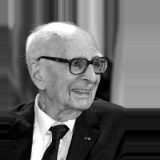
Lévi-Strauss
Claude Lévi-Strauss1908–2009
What Lévi-Strauss argues and who answers him, as Marci Shore presents it in her Yale lectures European Intellectual History since Nietzsche: 13 claims, and 10 places where another thinker builds on him or breaks with him. Each claim is our paraphrase and links to the minute of the lecture it comes from.
...we must never lose sight of the fact that, in both anthropological and linguistic research, we are dealing strictly with symbolism.
Claude Lévi-Strauss, "Structural Analysis in Linguistics and Anthropology". The epigraph Shore gives lecture 19.
The core ideas
The 2 claims the lectures spend most time on.
Kinship can be read as a language: its relations form a system on Saussure's model, where each term has value only by differing from the others.
Put simply Lévi-Strauss: family relationships work like a language. As with Saussure's words, each relation means something only through how it differs from the other relations in the system.
What makes kinship a system is not blood or descent but a representation held in people's minds: arbitrary, not grown spontaneously from any real situation.
Put simply Lévi-Strauss: a kinship system is not made of blood ties or descent. It exists in people's minds, as a set of ideas fixed by convention, not something that grows naturally out of real life.
Who Lévi-Strauss answers, and who answers him
Each entry joins one of his claims to another thinker’s. The handwriting names the link; the line beside it says which kind. “Our inference” marks a link Shore does not state outright.
Lévi-Strauss and René Girard 1923–2015
Lévi-StraussThe crisis that opens many myths is one of too little difference, not too much: boundaries blur, distinctions collapse. L19 · 46:15
GirardThe sacrificial crisis is "a crisis of distinctions": cultural order is nothing but a system of differences that fixes who each person is relative to everyone else. L20 · 34:18
Shore presents Girard as coming out of a dialogue with Lévi-Strauss and calls his view that differentiation holds culture in place a structuralist premise.
Lévi-StraussCultural phenomena, on Girard's summary of Lévi-Strauss, work like languages: signs mean nothing in isolation, only through other signs, so symbolic forms are read from within, never referred beyond themselves. L20 · 18:29
GirardBeneath every myth lies a real victim and a real sacrifice; the story is never self-contained, and one can always dig back through it to the killing. L20 · 46:55
Charges that staying at the level of signifiers misses the real victim beneath every myth.
Lévi-StraussCultural phenomena, on Girard's summary of Lévi-Strauss, work like languages: signs mean nothing in isolation, only through other signs, so symbolic forms are read from within, never referred beyond themselves. L20 · 18:29
GirardLévi-Strauss, Girard objects, stops at signs that point only to other signs; analysis has to push through the structure to the anterior human reality underneath. L20 · 16:59
Rejects confining interpretation to relations among signs, demanding a return to substance beneath the structure.
Lévi-Strauss and Jacques Derrida 1930–2004
Lévi-StraussAs Derrida reads him, Lévi-Strauss holds that writing reached the societies he studied as a corruption: hierarchy, control and even violence came with it, and an innocence was lost. L22 · 20:25
DerridaSpeech cannot guarantee presence, because the one speaking is not necessarily present even to himself; so presence versus absence, like speech versus writing, is a binary to be dismantled. L22 · 22:10
Derrida takes apart Levi-Strauss's speech/writing binary, denying that speech guarantees presence.
Lévi-StraussClassical structuralism, as it comes through Lévi-Strauss's anthropology, charts many cultural relations as binary oppositions: cooked against raw, low against high, cold against hot. L19 · 43:52
DerridaTo deconstruct is to take apart, not merely to smash. The target is stability itself: any meaning that claims to be settled, decisive and self-anchoring, structuralism's binaries among them. L22 · 19:14
Structuralism's clean binaries do not hold; post-structuralism begins by unsettling them
Lévi-StraussKinship can be read as a language: its relations form a system on Saussure's model, where each term has value only by differing from the others. L19 · 42:15
DerridaDeconstruction is not confined to books: gestures, choreography, even a room of diners count as text, because Derrida has widened the notion of text to take in all of life. L22 · 23:32
All culture as language becomes all of life as text
Lévi-Strauss and Clifford Geertz 1926–2006
Lévi-StraussMyth has a grammar: its smallest units combine by rules analogous to those of language, and that grammar is built into the human mind itself. L19 · 45:18
GeertzLévi-Strauss is captivated by man in the abstract while caring little for actual, particular men. L19 · 50:45
Geertz charges that Lévi-Strauss's universal structures of mind seek abstract Man, not actual people.
Lévi-Strauss and Ferdinand de Saussure 1857–1913
SaussureLanguage is form rather than substance: a combination of sounds means something only inside a particular linguistic system, so meaning is a matter of relations, not of things. L10 · 18:55
Lévi-StraussKinship can be read as a language: its relations form a system on Saussure's model, where each term has value only by differing from the others. L19 · 42:15
Kinship read as a language: units valued only by their differences within the system
Lévi-Strauss and Sigmund Freud 1856–1939
FreudWhat matters in the mind happens below awareness: Freud holds that "mental processes are essentially unconscious," with conscious ones only scattered fragments of the whole. L9 · 22:57
Lévi-StraussCulture, taken broadly to include language, art, customs, tools and belief, operates largely unconsciously, a Freudian premise; anthropology's task is to expose the deep laws beneath it. L19 · 40:15
Takes Freud's premise that most mental life, and so culture, is unconscious
Lévi-Strauss and Michel Foucault 1926–1984
Lévi-StraussClassical structuralism, as it comes through Lévi-Strauss's anthropology, charts many cultural relations as binary oppositions: cooked against raw, low against high, cold against hot. L19 · 43:52
FoucaultEnlightenment reason was possible only once madness had been defined: there is no reason without an unreason to set it against, which makes the asylum the Enlightenment's dark side. L21 · 27:08
Shore calls Foucault's claim that reason required unreason a very structuralist argument in which the structuralist binaries come back.
All 13 claims, lecture by lecture
In the order they come up. The time opens that minute of the lecture on YouTube.
Lecture 19Structuralism and Anthropology
Culture, taken broadly to include language, art, customs, tools and belief, operates largely unconsciously, a Freudian premise; anthropology's task is to expose the deep laws beneath it.
Put simply Lévi-Strauss: culture, meaning language, art, customs, tools and beliefs, works mostly without our being aware of it, an idea taken from Freud. The anthropologist's job is to uncover the hidden rules beneath it.
Anthropological research, like linguistic research, is "dealing strictly with symbolism": its material is signifiers.
Put simply Lévi-Strauss: anthropology, like the study of language, deals strictly with symbolism. Its material is signifiers, the words and symbols themselves rather than the things they name.
Kinship can be read as a language: its relations form a system on Saussure's model, where each term has value only by differing from the others.
Put simply Lévi-Strauss: family relationships work like a language. As with Saussure's words, each relation means something only through how it differs from the other relations in the system.
What makes kinship a system is not blood or descent but a representation held in people's minds: arbitrary, not grown spontaneously from any real situation.
Put simply Lévi-Strauss: a kinship system is not made of blood ties or descent. It exists in people's minds, as a set of ideas fixed by convention, not something that grows naturally out of real life.
To grasp the avunculate, the bond between maternal uncle and nephew, one must treat it as a single relation inside a kinship system taken as a whole.
Put simply Lévi-Strauss: to understand the special bond between a boy and his mother's brother, you must see it as one relation within the society's whole family system.
Classical structuralism, as it comes through Lévi-Strauss's anthropology, charts many cultural relations as binary oppositions: cooked against raw, low against high, cold against hot.
Put simply Classical structuralism, in Lévi-Strauss's hands, maps much of culture as pairs of opposites: raw and cooked, high and low, hot and cold.
Across human cultures, including oral and indigenous ones without large written literatures, myths rework a limited stock of themes and share constant structures that operate like a language.
Put simply Lévi-Strauss: across human cultures, including those that pass stories on by word of mouth, myths rework a limited set of themes. They share constant patterns that work like a language.
Myth has a grammar: its smallest units combine by rules analogous to those of language, and that grammar is built into the human mind itself.
Put simply Lévi-Strauss: myths have a grammar. Their smallest parts combine by rules, as sounds combine into words, and that grammar is built into the human mind.
Myths are instruments by which a culture sorts and orders its reality.
Put simply Lévi-Strauss: myths are tools a culture uses to sort and organize its world.
A myth works as an imaginary resolution of a contradiction that is real in social life.
Put simply Lévi-Strauss: a myth settles, in imagination, a conflict that is real in a society's life.
In the text The phrase "imaginary resolution of a real contradiction" is Fredric Jameson's (The Political Unconscious, 1981, ch. 1), developed from Lévi-Strauss's reading of Caduveo face painting in Tristes Tropiques.
The crisis that opens many myths is one of too little difference, not too much: boundaries blur, distinctions collapse.
Put simply Lévi-Strauss: many myths open with a crisis of too little difference, not too much. The lines that keep things distinct blur and break down.
In the text In "The Structural Study of Myth" (1955), Lévi-Strauss writes that "mythical thought always progresses from the awareness of oppositions toward their resolution"; "a crisis of distinctions" is Girard's phrase in Violence and the Sacred.
Lecture 20Violence and the Sacred - René Girard
Cultural phenomena, on Girard's summary of Lévi-Strauss, work like languages: signs mean nothing in isolation, only through other signs, so symbolic forms are read from within, never referred beyond themselves.
Put simply Girard's summary of Lévi-Strauss: culture works like a language. Signs mean nothing alone, only through other signs, so cultural symbols must be read from inside the system, never traced to something beyond it.
Lecture 22French Post-Structuralism: Derrida and Deconstruction
As Derrida reads him, Lévi-Strauss holds that writing reached the societies he studied as a corruption: hierarchy, control and even violence came with it, and an innocence was lost.
Works and dates
As they come up in the lectures.
In New York, Koyré introduces fellow émigrés Jakobson and Lévi-Strauss; structuralism grows from their collaboration.
Structural Analysis in Linguistics and in Anthropology
Tristes Tropiques Tristes Tropiques
Terms
The ideas his claims turn on, as the lectures gloss them.
The unconscious. For Freud, most of mental life: repressed wishes and memories that drive thought, feeling and symptoms while staying outside awareness; consciousness is only a fleeting surface.
Semiology. The study of signs and the laws governing how they function, to which structural linguistics leads.
Kinship system as language. Lévi-Strauss reads a society's family relationships as a sign system: each relation has value only through its differences from the other relations.
Linguistic structuralism. Meaning lives in differences within a system, not in things; the background that let avant-gardists detach words from referents.
Arbitrariness of the linguistic sign. The tie between signifier (sound or letters) and signified (the concept) is conventional, not natural.
Incest taboo. Prohibition on sexual unions within the close family, held by Freud to be among the earliest taboos and taken by Lévi-Strauss as founding kinship.
Binary opposition. Paired contrasting terms (raw/cooked, hot/cold, high/low) through which classical structuralism maps cultural meaning by difference.
Structural analysis of myth. Reading myths as variations on limited themes governed by an underlying grammar, comparable to language, that classifies experience and eases social contradictions.
Myth. For Girard, an account of the scapegoat's killing from the killers' standpoint, telling it so as to justify the violence.
Privileging of speech over writing. Western habit of treating speech as closer to inner truth and writing as a mediated, artificial copy; Derrida targets it in Saussure and Levi-Strauss.